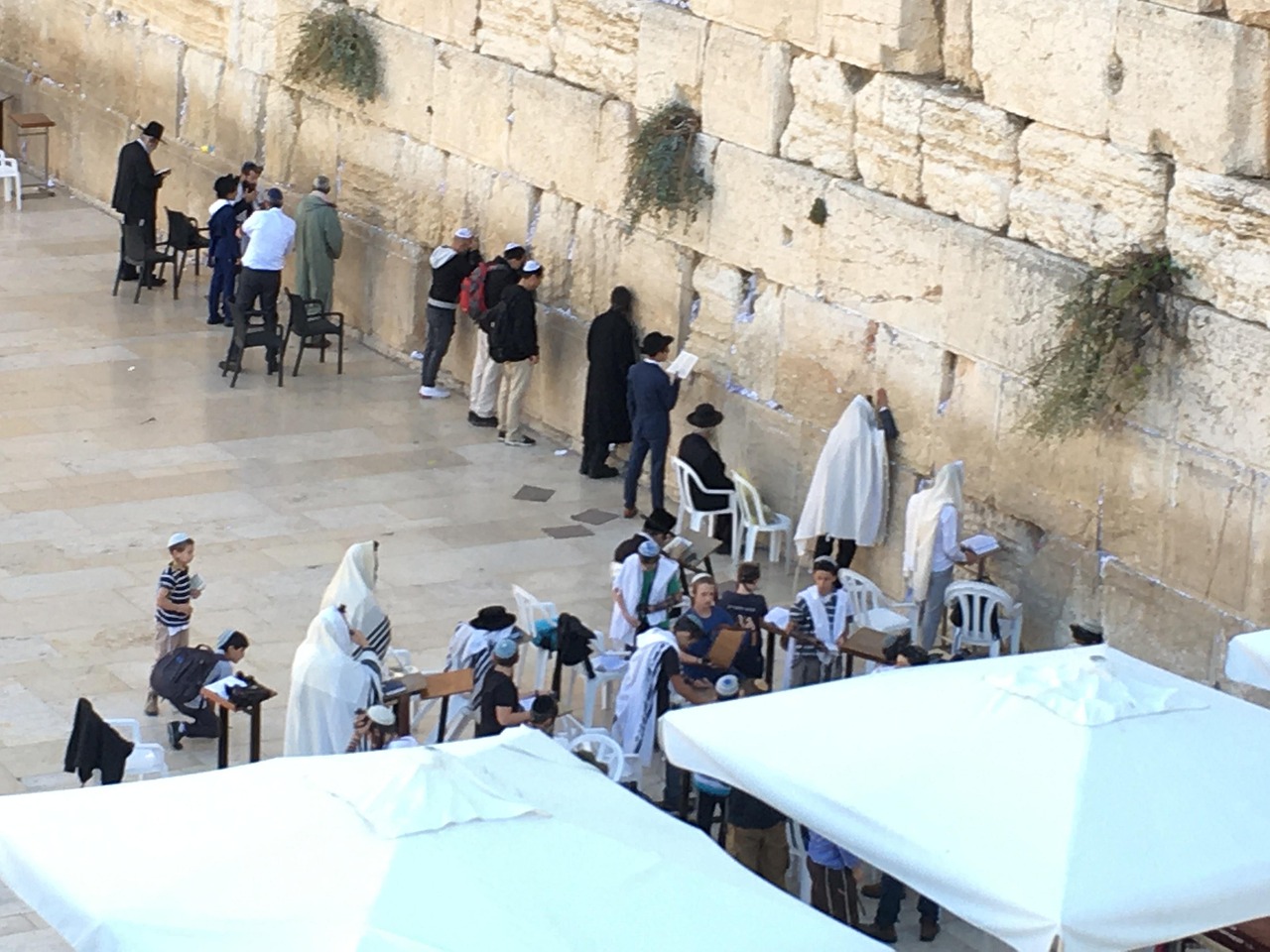
It is a massive limestone wall. That’s it. On the surface, if you didn’t know the history, you might just see a series of huge, weathered blocks of stone tucked into a corner of the Old City. But when you stand there, you feel it. The Wailing Wall of Jerusalem—better known locally and religiously as the Kotel or Western Wall—isn't just a relic. It is a living, breathing epicenter of human emotion. You see people weeping. You see soldiers praying. You see tourists standing awkwardly, not sure if they should touch the stone or just stare.
History is heavy here.
Most people think this was a wall of the Temple itself. It wasn't. Honestly, it was just a retaining wall. King Herod the Great, a man known for his massive ego and even bigger building projects, wanted to expand the platform of the Second Temple. He needed a way to hold up all that extra earth. So, his engineers built this. It was a construction project. But because it's the closest accessible spot to where the Holy of Holies once stood on the Temple Mount, it became the most sacred site in the world for Jewish prayer.
The Name Game: Why do we call it the Wailing Wall?
You’ll hear "Western Wall" and "Wailing Wall of Jerusalem" used interchangeably, but they carry different weights. The term "Wailing Wall" is actually a translation of the Arabic el-Mabka, or the Place of Weeping. For centuries, European travelers watched Jews come to this spot to mourn the destruction of the Temple, which happened back in 70 CE at the hands of the Romans.
The Jews themselves usually just call it the Kotel.
There’s a bit of a misconception that the "wailing" refers to some sort of loud, performative grief. It doesn’t. It refers to the deep, centuries-old yearning for a lost home. Interestingly, during the period of Jordanian rule between 1948 and 1967, Jews were completely barred from even visiting the wall. Imagine that. The holiest site in your faith, and you can’t even touch it. When Israeli paratroopers reached the wall during the Six-Day War, the photos of them crying against the stones became some of the most iconic images of the 20th century.
What You See When You Actually Get There
The wall is divided. There’s a men’s section and a women’s section, separated by a mechitza, which is basically a partition. If you're visiting, you’ve got to respect the dress code. Modesty is the name of the game here. Men need to cover their heads—they provide cardboard kippahs if you don’t have one—and women should have shoulders and knees covered.
The stones themselves are a geological timeline.
- The bottom layers? Those are Herodian. Huge, dry-laid ashlar blocks with distinct recessed margins. Some of these stones weigh over 500 tons. How did they move them? They likely used massive wooden cranes and rollers, but standing next to one makes you feel tiny.
- The middle layers? Those are Umayyad and Mamluk.
- The top layers? They’re much smaller stones, added later during the Ottoman period.
One thing that surprises people is the sheer volume of paper. Every crack and crevice in the Wailing Wall of Jerusalem is stuffed with notes. These are kvitelach. People write their deepest secrets, their desperate pleas, and their thanks on scraps of paper and wedge them into the limestone. It’s a physical manifestation of prayer. Twice a year, the Rabbi of the Western Wall and his staff use long sticks to clean out the notes. They don't burn them. They bury them on the Mount of Olives because they contain the name of God.
The Western Wall Tunnels: The Part You Don't See
If you only stand in the plaza, you're seeing maybe 20% of the actual wall. To see the rest, you have to go underground. The Western Wall Tunnels are a labyrinth of archaeological discovery. You walk along the original Herodian street. You see the "Master Course," a single stone that is nearly 45 feet long.
Archaeologist Dan Bahat, who spent years researching this area, points out that the craftsmanship underground is even better than what's on the surface because it hasn't been weathered by 2,000 years of wind and rain. You can still see the chisel marks. It feels like the workers just stepped away for a lunch break and never came back.
Myths vs. Reality
People get a lot of things wrong about this place. Let's clear some up.
Myth 1: It’s a Mosque wall. Well, sort of. The Western Wall is the western boundary of the Haram al-Sharif (the Noble Sanctuary), which houses the Al-Aqsa Mosque and the Dome of the Rock. In Islam, it’s known as the Buraq Wall, the place where the Prophet Muhammad tied his winged steed, Al-Buraq, during the Night Journey. This is why the site is so contested. It is physically the same structure, but it holds two entirely different, deeply sacred meanings for two different groups of people.
Myth 2: You have to be Jewish to pray there. Not even close. Anyone can go. You’ll see Christians, Buddhists, and atheists standing there in silence. The wall doesn't ask for your ID card. It’s a space for reflection, regardless of what you believe.
Myth 3: The wall is the "Holiest Site." Technically, the Temple Mount (the platform above the wall) is the holiest site in Judaism. However, due to religious restrictions and political sensitivities, most Jews do not go up there to pray. Thus, the wall remains the primary focal point of devotion.
The Social Dynamic of the Plaza
The plaza in front of the Wailing Wall of Jerusalem is the city's living room. It's not always a place of quiet contemplation. On Monday and Thursday mornings, it’s chaos—the good kind. This is when Bar Mitzvahs happen. You’ll hear drums, see families dancing under umbrellas, and hear candy being pelted at 13-year-old boys.
Then there’s Friday night. Shabbat.
As the sun sets over the Jerusalem hills, the energy shifts. Hundreds of people stream into the plaza. Groups of students burst into song. It’s a sensory overload of chanting, swaying, and singing. If you want to experience the soul of Jerusalem, this is the hour to be there.
But it’s also a place of friction. There have been long-standing debates about egalitarian prayer. Groups like Women of the Wall have fought for decades for the right to pray with Torah scrolls and wear prayer shawls at the main plaza, leading to intense legal and physical standoffs with the ultra-Orthodox authorities who manage the site. It’s a reminder that even in a place of peace, human politics is never far away.
Practical Advice for the Modern Traveler
If you’re planning to visit the Wailing Wall of Jerusalem, don’t just rush in and out. Take your time.
- Go at night. The wall is open 24/7. At 3:00 AM, the crowds are gone. It’s just you, the yellow floodlights, and the sound of a few birds nesting in the plants growing between the rocks. It’s hauntingly beautiful.
- Book the tunnel tour weeks in advance. They sell out. Seriously. You can’t just show up and expect to get in.
- Watch your step. The stones in the Old City are polished smooth by millions of feet over thousands of years. They are slippery, even when dry. Wear shoes with grip.
- Security is tight. You’ll go through a metal detector. It’s standard. Don’t bring big bags if you can help it; it just makes the line slower.
- Don’t walk away with your back to the wall. It’s a tradition to back away slowly, keeping your face toward the stones as a sign of respect, until you’re out of the immediate prayer area. You don't have to do this, but you'll see many others doing it.
The Significance of the Stones
Why does a wall matter so much? Archaeologists like Eilat Mazar have spent lifetimes digging around the City of David and the Temple Mount, trying to piece together the narrative of Jerusalem. What they find is that the Wailing Wall of Jerusalem acts as an anchor. It’s a physical link to a past that often feels like a myth.
When you touch the stone, you aren't just touching rock. You’re touching the year 19 BCE. You’re touching the Crusades, the Mamluks, the Ottomans, the British Mandate, and the modern state of Israel.
The wall has survived earthquakes that leveled the rest of the city. It has survived wars. It has survived being used as a literal trash dump during certain periods of history when the city’s rulers wanted to humiliate the Jewish population. Yet, here it stands.
It is a symbol of endurance. Whether you see it as a religious site, a historical monument, or a political flashpoint, there is no denying that the Western Wall is one of the few places on Earth where the past isn't actually past—it’s the present.
Actionable Steps for Planning Your Visit
- Check the Jewish Calendar: Before you go, see if it’s a holiday. Places like the Western Wall become extremely crowded during Sukkot, Passover, and Shavuot. This can be an amazing experience, but it also means heavy security and limited space.
- Virtual Experience: If you can't get to Jerusalem, the Western Wall Heritage Foundation operates a 24-hour "Wall Cam." It sounds cheesy, but watching the sunrise over the stones from your laptop in another country is surprisingly moving.
- Documentation: Photography is generally allowed on weekdays, but it is strictly forbidden on Shabbat (from Friday sunset to Saturday sunset) and on Jewish holidays. Respect this. Security or local worshippers will ask you to put your phone away.
- Writing Your Note: You don't need fancy paper. Any scrap will do. If you can't go in person, there are various organizations that allow you to email a prayer, which they will then print and place in the cracks for you.
The Wailing Wall of Jerusalem is a place of contrast. It’s old and new, silent and loud, joyous and grieving. It’s a wall that was never meant to be a temple, but somehow, over two millennia, it became one. Standing there, you realize that while the stones are impressive, the true power of the place comes from the millions of people who have stood in that same dust, hoping for something better.