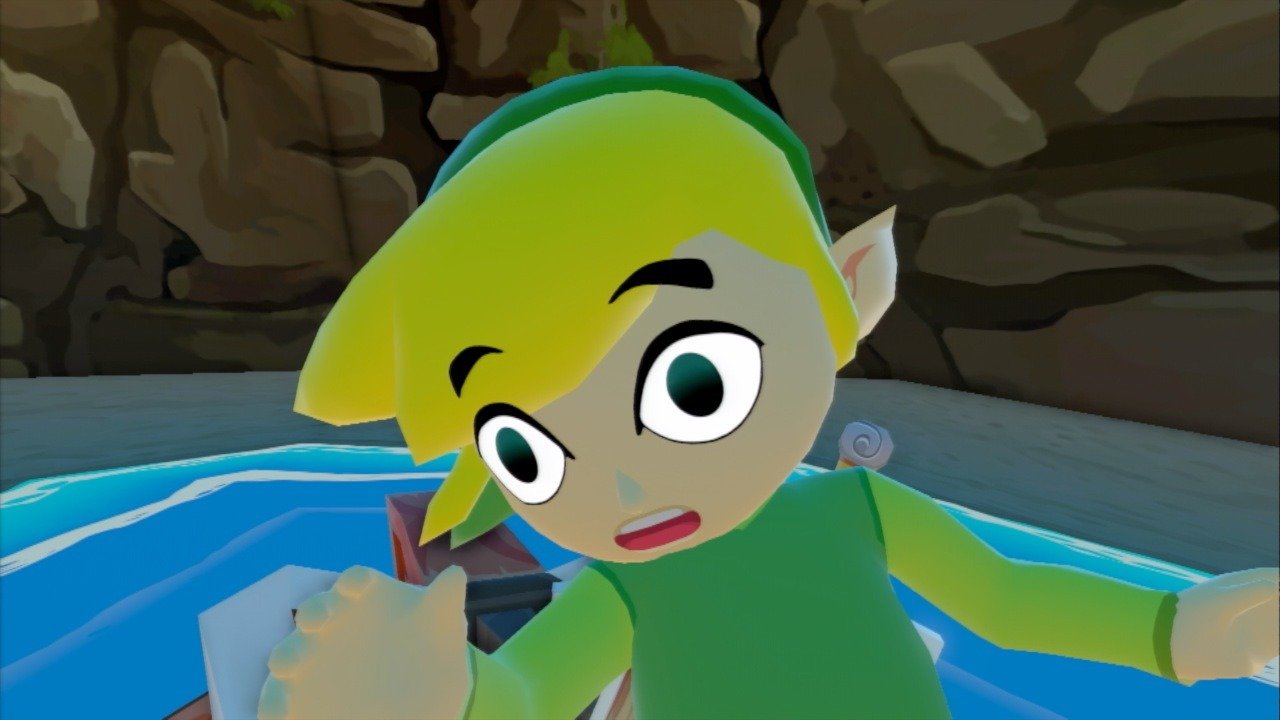
When The Legend of Zelda: The Wind Waker first debuted at Space World 2001, people actually booed. It sounds fake, but it's true. Fans wanted a gritty, realistic Link after seeing the GameCube technical demo, and instead, Shigeru Miyamoto handed them a cartoon with eyes the size of dinner plates. They called it "Celda." They said it looked like a toddler’s show.
They were wrong.
The secret sauce that makes this game a masterpiece—even decades later—is the Wind Waker Link faces. Those massive, expressive eyes weren't just a stylistic choice; they were a revolutionary gameplay mechanic and a masterclass in character animation that most modern "photorealistic" games still can't touch. Honestly, if you go back and play it now, you’ll notice that Link is more alive in this 2002 title than characters in many AAA games released last year.
The Eye Tracking Logic You Probably Didn't Notice
Most players think Link’s expressions are just random or triggered by cutscenes. That’s not how it works at all. Eiji Aonuma and his team at Nintendo EAD developed a sophisticated "eye-tracking" system. This means Link’s eyes are constantly scanning the environment.
If there is a secret switch nearby? Link looks at it. Is a ChuChu sneaking up behind him? Link’s eyes dart toward the threat before the music even changes. This wasn't just for show. It was a subtle way of guiding the player without using a clunky UI or an intrusive "detective vision" mode. The game talks to you through Link's face.
It's basically a silent hint system. If you're stuck in a room in the Forbidden Woods, stop moving. Just watch Link. His pupils will literally lead you to the hookshot target or the vine you missed. It’s genius because it keeps the immersion intact while providing mechanical value.
Why "Toon Link" Had to Be This Way
There is a technical reason for those exaggerated features. On the GameCube hardware, rendering realistic skin textures and micro-expressions was a nightmare. By leaning into a cel-shaded, minimalist aesthetic, Nintendo freed up processing power to focus on "squash and stretch" animation principles.
Link’s face is divided into specific texture layers. His eyes are separate from his eyebrows, which are separate from his mouth. This allowed the animators to swap out individual assets on the fly to create hundreds of combinations. When Link crawls through a tight space, his cheeks puff out and his eyes squint with effort. When he gets launched out of a barrel into Forsaken Fortress, his face flattens against the screen. It’s pure slapstick, reminiscent of Looney Tunes or the works of Hayao Miyazaki.
Satoru Iwata once discussed in an "Iwata Asks" interview how the team struggled to convey emotion in earlier 3D titles like Ocarina of Time. The hardware just wasn't there. But with the stylized Wind Waker Link faces, they could communicate fear, joy, exhaustion, and sass with just a few pixels.
The "Sass" Factor: Link’s Personality Peak
Let’s be real: this is the most "person" Link has ever been. In Twilight Princess, he’s a bit of a blank slate. In Skyward Sword, he’s a bit of a sap. But Wind Waker Link? He’s a brat. He’s a kid who was forced out of bed on his birthday and told he has to save the world.
The expressions convey a level of skepticism we rarely see in heroes. Look at his face when he’s talking to the King of Red Lions. He often looks annoyed or completely baffled. That personality is 100% carried by the facial animations. Without those giant, expressive brows, he’s just another silent protagonist. With them, he’s a kid who is clearly thinking, "I cannot believe I have to do this right now."
Breaking Down the Animation Tech
It wasn't just about big eyes. The developers used a technique called "texture swapping" combined with some clever skeletal animation.
- The Pupil Shift: Link’s pupils aren't centered. They move independently of the eye "white," allowing for side-eye glances that feel incredibly human.
- The Eyebrow Overlap: His eyebrows are actually rendered on top of his hair in many frames. This is a classic 2D animation trick used to ensure that even if his fringe covers his forehead, you never lose the emotional "read" of the character.
- Mouth Shapes: There are dozens of specific mouth shapes (phonemes) that the game cycles through during dialogue, making the "HYAH!" and "WAHHH!" grunts feel like they're actually coming from his throat.
Think about the moment Link gets the Master Sword. The look of pure, unadulterated shock followed by a heavy sense of responsibility? That’s not a pre-rendered movie. That’s the in-game engine working overtime.
How Modern Games (Even Zelda) Have Changed
It’s interesting to compare these Wind Waker Link faces to the Link we see in Breath of the Wild or Tears of the Kingdom. While the modern Link is still somewhat stylized, he’s much more subdued. He has "idle" animations, sure, but he doesn't have that same "environmental awareness" in his gaze that the GameCube version perfected.
Many fans argue that the HD Wii U remake of Wind Waker actually lost a bit of the soul. By adding heavy bloom and dynamic lighting, some of the crispness of the facial expressions got washed out. The original 480p version on a CRT monitor actually highlights the "pop" of his features better because the contrast is so high.
Why It Matters for Game Design Today
If you're a developer or just a fan of character design, Wind Waker is the gold standard for "readability." Readability is the ability for a player to look at a character and instantly understand their state.
- Is Link hurt? His eyes droop.
- Is he near fire? He looks panicked and his sweat is visible.
- Did he just find a rupee? Pure, wide-eyed greed.
This level of feedback makes the game feel responsive. It creates a feedback loop where the player feels connected to the avatar. You aren't just controlling a puppet; you're navigating the world with a partner.
Actionable Takeaways for Zelda Fans
If you're revisiting the Great Sea anytime soon, try these three things to truly appreciate the work that went into these animations:
- The Lookout Challenge: When you enter a new room in a dungeon, don't move the camera. Look at Link's eyes. See if you can find the "key" object in the room just by following his gaze.
- The Camera Box: Use the Picto Box (deluxe version) to zoom in on Link's face during different actions—like standing near a fire or after swinging the sword until he’s tired. The detail in the "exhaustion" face is incredible.
- NPC Reactions: It’s not just Link. Watch the faces of the NPCs on Windfall Island. The same tech is applied to them, creating a cohesive world where everyone feels like they’re part of the same cartoon universe.
The Wind Waker Link faces proved that realism isn't the only way to achieve "immersion." Sometimes, a giant, goofy, cartoon eyeball can tell a more compelling story than ten million polygons. This game didn't just age well; it set a bar for expressive character design that the industry is still trying to clear.
To get the most out of this experience, play the original GameCube version on a CRT if you can find one. The color depth and lack of modern post-processing effects allow the cel-shaded "squash and stretch" animations to truly shine without the "plastic" look sometimes found in modern remasters. Pay close attention to the eyebrow-to-hair layering during the final Ganondorf encounter—it's a masterclass in maintaining character expression during high-intensity action.