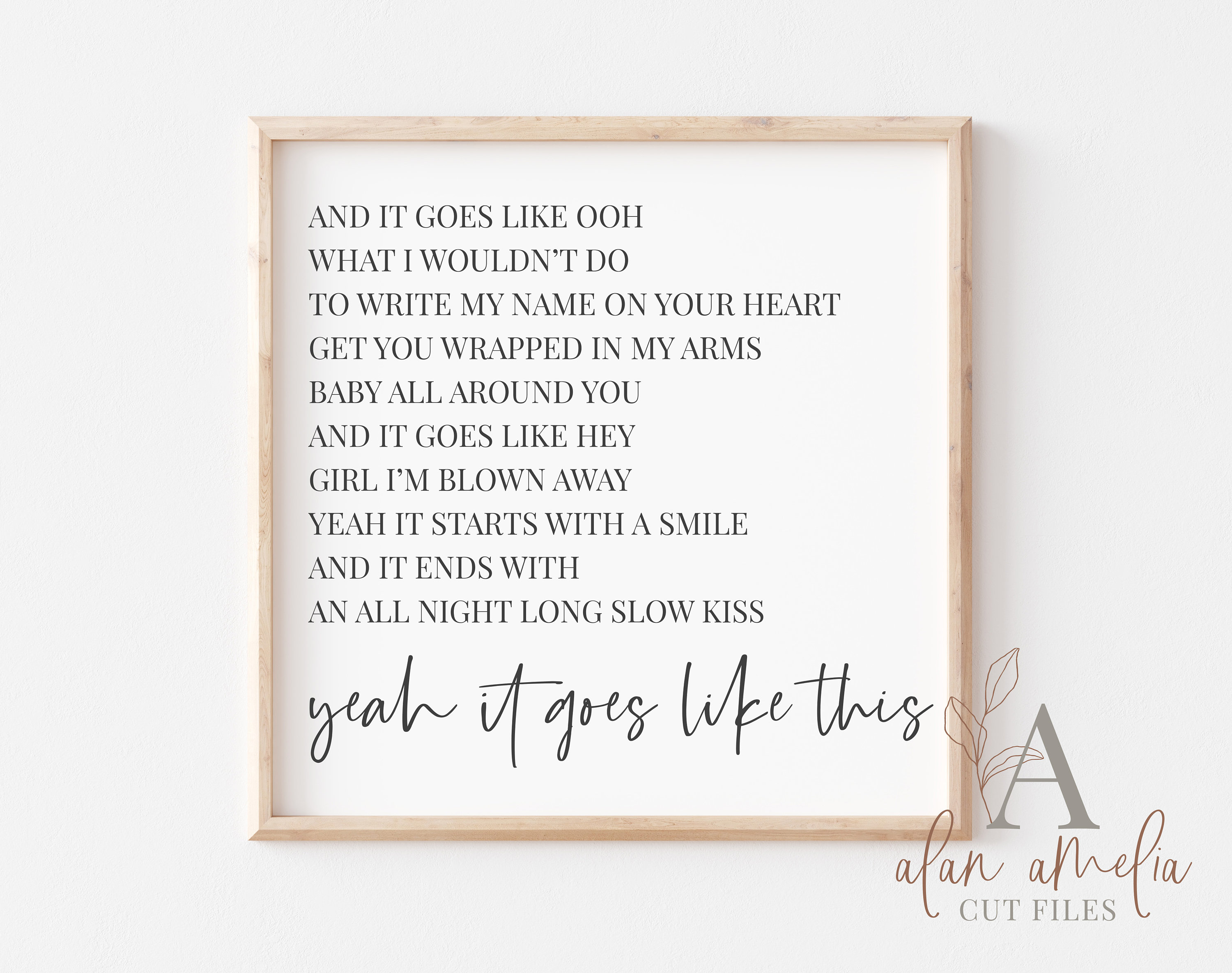
It was 2013. You couldn't turn on a radio without hearing that specific, mid-tempo guitar riff. Thomas Rhett wasn't the superstar he is now; he was a songwriter trying to find his footing in a Nashville scene that was rapidly shifting toward "Bro-Country." Then came "Goes Like This." It didn't just top the charts. It basically rewrote the blueprint for how a country love song could feel casual, rhythmic, and incredibly sticky all at once.
People still search for the goes like this lyrics because they capture a very specific kind of effortless romance. It’s not about grand operatic gestures. It’s about a guy in a truck, a girl who looks good in the moonlight, and a melody that feels like it’s been stuck in your head since the day you were born.
Honestly, the song’s success was a bit of a family affair, which most casual listeners don’t realize. It was co-written by Rhett Akins (Thomas’s dad), Ben Hayslip, and Jimmy Robbins. That pedigree matters. You’ve got the old-school Nashville sensibility of Akins mixed with Robbins’ modern pop sensibilities.
The Anatomy of a Perfect Hook
The "Goes Like This" lyrics are built on a conversational foundation. Think about the opening line: "Hey girl, you make me wanna write a song." It is incredibly meta. It tells you exactly what it’s doing while it’s doing it. This isn't Shakespeare, and it doesn't try to be. That is exactly why it worked.
Most country songs at the time were trying way too hard to be "tough" or "rural." Rhett went the other way. He went sweet. He went relatable.
The structure of the chorus is where the magic happens:
"It goes like this, it goes like that / It takes me over just like that /
With a boom boom boy, my heart is beating /
Free-falling, feeling like I’m dreaming."
It's rhythmic. It's almost percussive. If you look at the syllable count, it’s designed to mimic a heartbeat. That "boom boom" isn't just a filler; it’s a cue for the listener to feel the pulse of the track. Critics sometimes scoffed at the simplicity, but you can’t argue with a multi-platinum certification.
Why the Song Stayed Relevant for a Decade
Music moves fast. Trends die. But this song stayed. Why? Because the goes like this lyrics tap into a universal experience of early-stage infatuation where you’re literally lost for words.
Sometimes, the best way to describe a feeling is to admit you can’t describe it. The song says, "I don't know how to say this, so I'll just hum it." That’s a brilliant songwriting trick. It invites the listener to fill in the blanks with their own emotions.
When Thomas Rhett performs this live—and I’ve seen the footage from his Home Team tours—the crowd takes over the "hey, hey, hey" parts naturally. It’s communal.
Breaking Down the Second Verse
A lot of people gloss over the second verse, but it’s where the storytelling gets specific.
"I'm a little bit of 'I don't know what I'm doing' / But I'm a whole lot of 'I'm falling for you.'"
That’s a vulnerable admission for a male country singer in the early 2010s. Usually, the narrator is the cool guy, the one in control. Here, Rhett is admitting he’s a bit of a mess. He’s out of his depth. That vulnerability is what transitioned him from just another guy with a hat to a "husband goal" icon in the eyes of his fan base.
It’s also interesting to note the production choices by Dann Huff. Huff is a legend in Nashville. He knew that the lyrics needed space to breathe. He didn't clutter the track with heavy drums or over-the-top steel guitar. He kept the focus on Rhett’s phrasing.
The Cultural Shift: From Bro-Country to Boyfriend Country
If you look at the timeline of Nashville music, "Goes Like This" was a pivot point. It helped usher in what some call "Boyfriend Country."
Before this, the lyrics in country hits were often about "shaking it" for the guy or sitting in the passenger seat of a truck. While those tropes are present here, the focus shifted to the connection and the feeling of the narrator.
The goes like this lyrics treat the subject with a level of genuine affection that felt refreshing. It paved the way for artists like Dan + Shay or Brett Young. It proved that you could have a massive hit without being a "tough guy."
Technical nuances you might have missed
The rhyme scheme in the bridge is surprisingly tight.
"Every little thing you do / Got me feeling something new /
It’s a little bit of me and a whole lot of you."
It uses internal rhyme and monosyllabic words to keep the momentum going. This is a technical choice to ensure the song never feels "heavy." It stays light, airy, and repeatable. In the world of streaming—even though this was the tail end of the iTunes era—repeatability is king.
Misconceptions and Fact-Checking
There’s a common rumor that Thomas Rhett didn't like the song at first. That’s not quite true. In several interviews, including a notable one with The Boot, Rhett mentioned that while he knew it was a hit, he was nervous about whether it fit his "identity." He was young. He wanted to be taken seriously as a songwriter.
Ironically, the song written by his father was the one that gave him the career longevity to eventually write his own hits like "Die A Happy Man."
Another thing: people often mishear the "boom boom" line. Some think it’s "blue moon" or "zoom zoom." It is definitely "boom boom," an onomatopoeia for the heart. Simple? Yes. Effective? Absolutely.
Actionable Insights for Music Lovers
If you're looking to really appreciate the goes like this lyrics or even try your hand at writing something similar, here is what you should take away:
- Study the "Rule of Three": Notice how the song uses three-part structures in the verses (Idea A, Idea A-variation, Idea B-punchline).
- Embrace Onomatopoeia: Don't be afraid of "non-word" lyrics. "Hey, hey, hey" and "boom boom" provide hooks that transcend language barriers.
- Watch the Phrasing: Listen to how Rhett "clips" his words in the chorus. He’s singing slightly ahead of the beat, which creates a sense of excitement and urgency.
- Analyze the Transition: Compare this song to his later work like "Country Again." You can see the DNA of his rhythmic phrasing starting right here in 2013.
To get the full experience, go back and watch the music video. It’s a time capsule of 2013 fashion—plaid shirts, backwards hats, and that specific digital film grain. But the lyrics? They don't feel dated. They feel like a Friday night.
If you're building a playlist of quintessential 2010s country, this is the anchor track. It’s the bridge between the traditional 90s influence of his father and the pop-forward future of the genre.
Pay close attention to the way the bridge modulates slightly before dropping back into the final chorus. It’s a masterclass in tension and release. Most people just sing along, but if you strip away the music, you’ll see a poem about the beautiful frustration of being so into someone that your brain basically short-circuits.
Check the liner notes of the It Goes Like This album. You’ll see that this track was actually one of the last ones added. It was the "missing piece" that the record label knew they needed for a radio breakthrough. They were right.