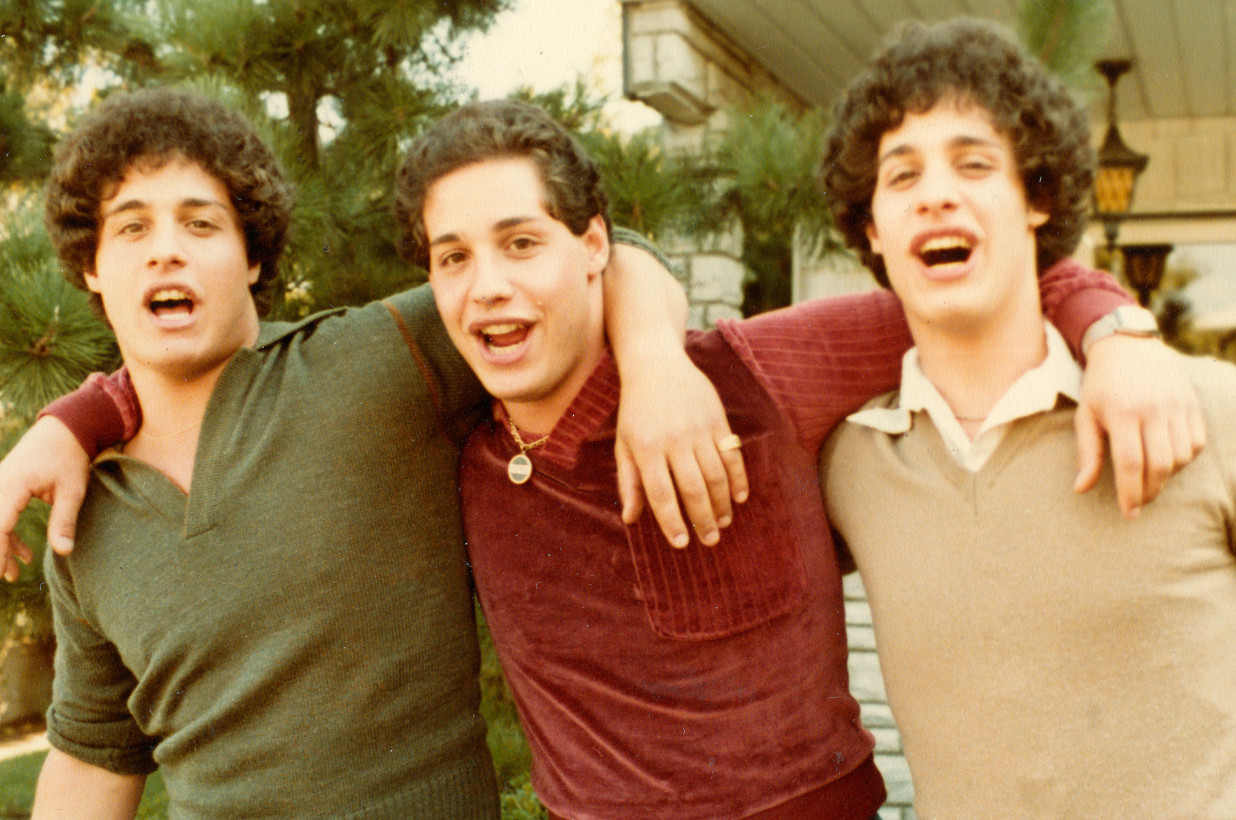
It starts like a cheesy 80s comedy. A kid named Bobby Shafran walks onto a college campus in upstate New York for his first day, and everyone is treating him like an old friend. People are hugging him. Girls are kissing him. They’re calling him "Eddy." It’s weird. It’s deeply unsettling. But it’s also the beginning of one of the most disturbing psychological stories in American history. When Bobby finally meets Eddy Galland, they realize they aren't just lookalikes. They’re twins. Then, a newspaper runs the story, and a third guy named David Kellman sees the photo. Now they're triplets.
The three identical strangers cast—the real people who lived this nightmare—weren't just characters in a 2018 documentary. They were living, breathing victims of a social experiment that sounds like something out of a sci-fi horror novel.
The Men Behind the Three Identical Strangers Cast
Bobby Shafran, Eddy Galland, and David Kellman were born on July 12, 1961. They were separated at birth by the Louise Wise Services adoption agency. They grew up within a 100-mile radius of each other. None of the families knew the other brothers existed. Think about that for a second. You grow up thinking you're an only child or an ordinary adoptee, only to find out your entire childhood was a curated environment.
Bobby was the "gregarious" one, or so it seemed. David was the talker. Eddy was more sensitive. When they first reunited in 1980, the media fell in love with them. They wore the same clothes. They smoked the same Marlboro cigarettes. They even sat the same way. It was a "nature vs. nurture" dream come true for the tabloids. They became instant celebrities, even making a cameo in the Madonna movie Desperately Seeking Susan.
But the glitz faded fast.
Beneath the matching smiles, things were dark. All three brothers had struggled with mental health issues as teenagers. Before they even knew they were triplets, they had all spent time in psychiatric hospitals. This wasn't just a coincidence. It was a clue to a much larger, much more sinister puzzle involving the people who separated them.
The Secret Experiment That Broke Them
The real "cast" of this story includes people you never see on camera until the documentary starts digging: Dr. Peter Neubauer and his team.
In the 1960s, Neubauer, a prominent psychoanalyst, collaborated with the adoption agency to intentionally split up twins and triplets. The goal? To study how different parenting styles affected genetically identical children. They were lab rats. The families were told the children were part of a "standard developmental study." They had no idea their sons were part of a secret experiment.
Researchers would visit the homes, take notes, film the boys, and administer tests. They watched the boys struggle. They watched them bang their heads against their cribs—a sign of separation anxiety that all three exhibited as infants. The researchers documented the pain and did nothing.
The Father Figures
The experiment even looked at the fathers.
- Bobby’s father was a doctor: busy, somewhat distant, but professional.
- David’s father, "Bubala," was a warm, larger-than-life grocery store owner who became a favorite of all three boys after they reunited.
- Eddy’s father was a strict disciplinarian.
Many believe the clash between Eddy’s sensitive nature and his father’s rigid personality contributed to the tragic turn his life took later on.
Why the Story Still Haunts Us
If you watch the film, you see the transition from joy to rage. The three identical strangers cast—specifically Bobby and David, as Eddy is no longer with us—speak with a palpable sense of betrayal. They realized that their lives were stolen. Their bond was severed for the sake of data that was never even fully published.
Dr. Neubauer died in 2008. He never apologized. He never released the full results of the study. The records are currently sealed at Yale University until 2066. Why? Probably because the ethical violations are so massive that the university and the estate of the researchers are terrified of the legal fallout.
The documentary's director, Tim Wardle, spent years trying to get people to talk. He faced massive resistance. It turns out, when you start poking around the elite circles of New York psychoanalysis from the 60s, people get very quiet.
The Tragedy of Eddy Galland
We have to talk about Eddy.
Reunion isn't always a fairy tale. While the brothers opened a restaurant together called "Triplets" and lived the high life for a while, the underlying mental health issues and the pressure of their shared trauma became too much. Eddy Galland struggled with depression and eventually took his own life at the age of 33. He left behind a wife and a daughter. His death shattered the remaining two brothers. It broke the "triplet" magic. It turned a miracle into a mourning process.
The Science: Nature vs. Nurture
The study was supposed to settle the debate. Does your DNA dictate who you are, or does your environment?
The triplets showed that DNA is powerful. They had the same taste in women, the same IQ levels, and the same physical mannerisms. But their outcomes were different. Bobby and David eventually found a way to cope, though their relationship became strained over the years. They aren't the carbon copies the media portrayed them as in the 80s. They are individual men who share a profound, unique trauma.
What we've learned from the three identical strangers cast isn't about genetics. It's about ethics. It's about the fact that "science" without humanity is just cruelty.
What the Documentary Got Right (and Wrong)
Tim Wardle’s film is a masterpiece of storytelling, but it’s a documentary, not a courtroom transcript.
- The Mystery Element: The film plays like a thriller. In reality, the brothers had been suspicious of the "study" for decades before the cameras started rolling.
- The Scope: The triplets weren't the only ones. There were other sets of twins, like Beth Lathan and Amy McCollough, who were also part of the Neubauer study. The "cast" of victims is much larger than just the three men.
- The Agency: Louise Wise Services is defunct now, but for years, they were the "it" agency for Jewish adoptions in New York. Their involvement in this experiment remains a stain on the history of social work.
Honestly, it’s hard to watch the brothers today and not feel a sense of loss. When Bobby and David appear in interviews, they look like men who are still looking for answers that are locked in a vault at Yale. They are the survivors of a war they didn't know they were fighting.
Actionable Insights for Viewers and Researchers
If you're fascinated by the story of the three identical strangers cast, there are ways to dig deeper and understand the broader implications of their lives.
- Watch the Documentary Critically: Pay attention to the background characters. The researchers who are still alive and refuse to apologize offer a chilling look at "scientific detachment."
- Research the Yale Records: While the full study is sealed until 2066, some redacted documents have been released to the survivors. Keep an eye on the work of journalists like Lawrence Wright, who was one of the first to break this story in The New Yorker.
- Support Ethical Adoption Practices: The story is a reminder of why transparency in adoption is vital. Modern laws have changed significantly to prevent the separation of siblings, but the fight for "open records" continues in many states.
- Explore the Nature vs. Nurture Debate: Look into the "Minnesota Study of Twins Reared Apart." It’s a more ethical (though still debated) version of what Neubauer was trying to do. It provides a more balanced scientific view of how our genes shape us.
The story of Bobby, Eddy, and David isn't just a "crazy thing that happened." It’s a cautionary tale about what happens when humans treat other humans as variables in an equation. It’s about the power of brotherhood and the devastating impact of its loss.
Bobby and David are still out there. They are fathers. They are neighbors. They are no longer the "three identical strangers" of the 1980s talk show circuit. They are men who lived through a secret and came out the other side with a story that the world needs to remember so it never happens again.