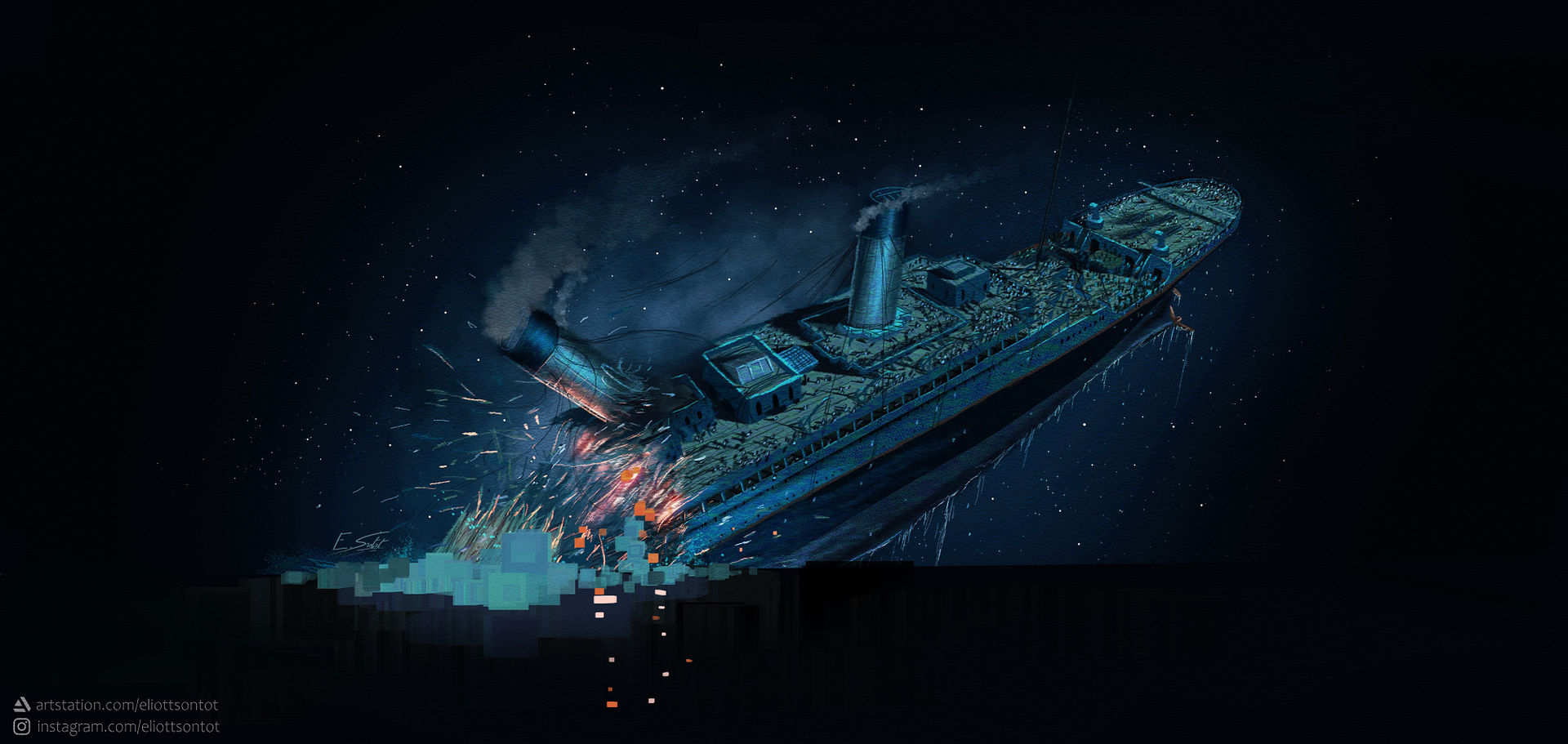
It was the big lie that lasted seventy-three years. If you ask anyone who survived that freezing April night in 1912 what they saw, the answers usually split down the middle. Literally. For decades, the official story—bolstered by the British and American inquiries—was that the ship sank in one piece. They called the people who saw the Titanic breaking in half "distraught" or "unreliable." They were wrong.
When Robert Ballard finally found the wreck in 1985, the truth was sitting two miles down on the ocean floor. The bow and stern were nearly 2,000 feet apart. It wasn't a clean dive. It was a violent, structural failure that changed everything we thought we knew about naval engineering and that specific tragedy.
The Myth of the Unsinkable Monolith
For a long time, the White Star Line had a reputation to protect. Admitting their flagship snapped like a dry twig under pressure wasn't great for business. Even though survivors like Jack Thayer drew incredibly accurate sketches of the ship breaking, the "official" version of history ignored them.
Think about the physics for a second. You have a 46,000-ton vessel. The stern is rising out of the water, lifting those massive bronze propellers into the air. That’s millions of pounds of steel hanging in the sky with no support from the water beneath it. Something had to give. Honestly, it’s a miracle it held together as long as it did.
Why the steel snapped
A lot of people point to the rivets. There’s this famous study about "bad iron" rivets used in the bow and stern because they couldn't fit the hydraulic cranes into the tight spaces of the hull. But the actual Titanic breaking in half happened near the center, right around the second funnel.
The steel itself was high-quality for 1912, but it was "brittle." In the freezing waters of the North Atlantic, that steel became less flexible. When the stress reached a certain point—around a 15 to 20-degree angle—the top decks started to pull apart. The expansion joints, meant to let the ship flex in heavy waves, weren't designed to handle the entire weight of the ship being suspended in mid-air.
The Moment of Structural Failure
It wasn't a cinematic, slow-motion event. It was loud. Imagine the sound of a skyscraper being torn apart by a giant. Survivors described it as a series of explosions or heavy gunfire.
- The "Big Hogging" Stress: As the bow filled with water, it pulled the ship down. The stern stayed buoyant.
- The Upper Deck Failure: The Titanic was essentially a giant box girder. The top decks (the Boat Deck and A-Deck) were the first to tear.
- The Keel Snap: Once the top gave way, the "V" shape formed. The heavy engines and boilers in the bottom of the ship acted like a hinge until the double bottom finally failed.
The ship didn't just snap and fall flat. The bow sank first, dragging the stern up to a near-vertical position before the two sections finally severed. This is where the 1997 movie actually got it mostly right, though the real break probably happened at a much lower angle than James Cameron depicted.
The Mystery of the Center Section
What's really wild is what's missing. When you look at the debris field, there are huge chunks of the "waist" of the ship that are just... gone. Or rather, they're shredded.
There are two large pieces of the double bottom—the very floor of the ship—sitting by themselves on the seafloor. This proves the ship didn't just break once. It was a catastrophic disintegration of the midsection. Roger Long, a naval architect who has spent years analyzing this, suggests the ship began to fail much earlier than people think. He argues that the internal structure was failing while the ship was still at a relatively shallow angle.
Evidence from the Deep
If you look at the bow today, it’s remarkably intact. It plowed into the mud at a decent clip and looks like a ghost ship. The stern, though? It’s a wreck. It looks like it went through a blender.
When the Titanic breaking in half occurred, the stern was still full of air. As it sank, the water pressure increased rapidly. The air trapped inside had nowhere to go, so the stern basically imploded as it went down. Decks pancaked on top of each other. Heavy machinery was flung out like toys. This is why the stern section is so much harder for divers to navigate or even identify—it’s a twisted graveyard of rusted steel.
What the 2005 Expedition Revealed
In 2005, a team found those two large sections of the double bottom. This was the "smoking gun." It showed that the ship broke from the top down. The top decks pulled apart, the sides buckled, and the very last thing to go was the reinforced bottom of the hull.
- The break happened between the second and third funnels.
- The double bottom sections stayed attached to the stern for a few moments before falling away.
- The "V" break theory: For a brief moment, the ship may have formed a temporary bridge before the final separation.
Lessons for Modern Engineering
We don't build ships like this anymore. The Titanic disaster led to the creation of SOLAS (Safety of Life at Sea), but the structural failure taught us about "brittle fracture" and the importance of redundant hull strength.
Modern cruise ships are built with entirely different stress tolerances. We use "ductile" steel that can bend without snapping, even in freezing temperatures. We also don't rely on expansion joints in the same way, and the distribution of weight is managed by sophisticated computer models that didn't exist when Thomas Andrews was sketching out the Olympic-class liners.
Was it avoidable?
Maybe. If the ship had stayed level, it might have floated for hours longer. But once that water moved past the bulkheads, the weight distribution became a death sentence. The Titanic breaking in half was an inevitability the moment the bow submerged deep enough to lift the stern's center of gravity.
How to Explore the History Yourself
If you’re fascinated by the mechanics of the sinking, you don't have to take a submersible to the bottom of the Atlantic. There are better ways to get a handle on the scale of this failure.
First, check out the Belfast Titanic Experience. They have the original plans and a massive scale of the hull. You can see exactly where the stress points were. Second, read the transcripts of the 1912 inquiries. Pay attention to the testimony of the firemen and greasers—the guys who were deep in the belly of the ship. Their accounts of the "groaning" of the steel are haunting and scientifically accurate.
Lastly, look into the work of Parks Stephenson. He’s one of the leading experts on the wreck’s current state. His 3D scans of the debris field show the "severed" nature of the hull in a way photos never could.
The ship is disappearing. Iron-eating bacteria (Halomonas titanicae) are consuming the hull every day. In a few decades, the site of the Titanic breaking in half will be nothing but a rust stain on the ocean floor. The physical evidence is melting away, making the data we have now more precious than ever.
Go look at the debris field maps. Notice how the heavy boilers fell in a straight line, while the lighter pieces drifted. It tells a story of a ship that didn't just sink—it fought itself the whole way down.
Practical Next Steps
To truly understand the scale of the structural failure, start by comparing the wreck photos of the bow versus the stern. The visual difference explains the physics of the break better than any textbook. Follow the updates from RMS Titanic Inc., the company that has salvage rights; they frequently release new sonar imagery that reveals how the midsection continues to collapse. If you're near a maritime museum with a Titanic exhibit, look for "bent" artifacts—shoes, light fixtures, or pieces of plating—that show the sheer force of the water pressure and the mechanical stress of the final moments. This isn't just a story about a ship hitting an iceberg; it's a case study in what happens when man-made steel meets the limit of its endurance.