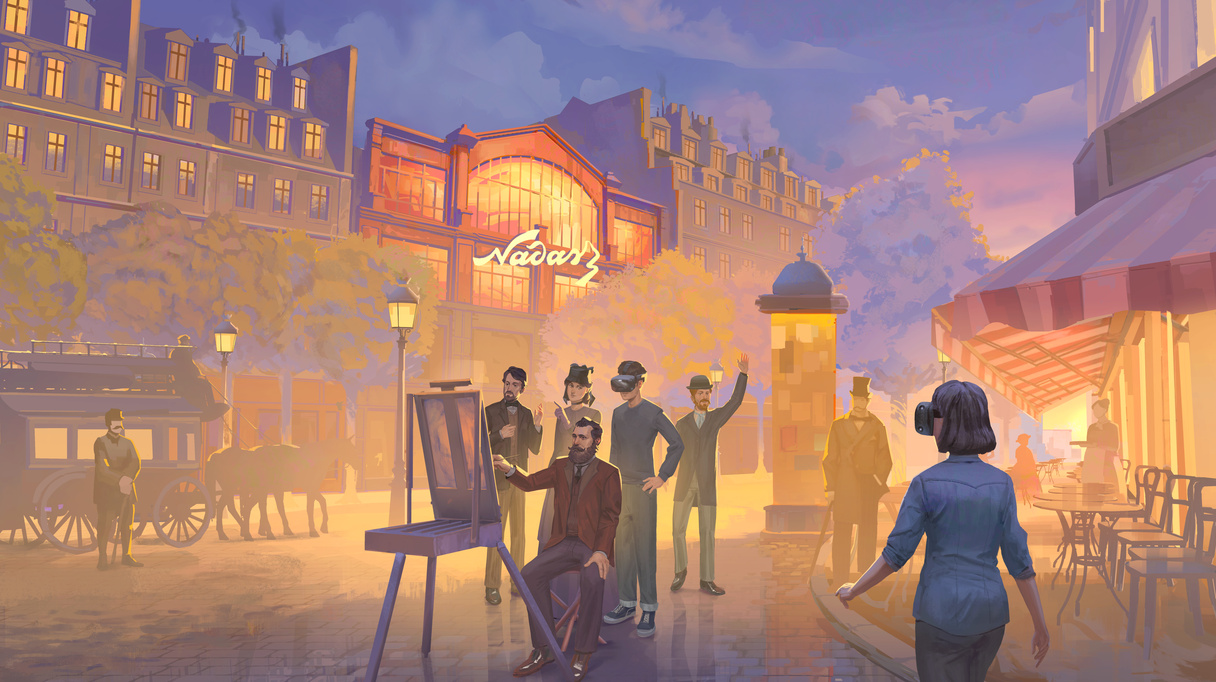
Walk into the Musée d'Orsay in Paris right now and you’ll see people wearing heavy headsets, waving their arms at thin air, and stumbling slightly as they "walk" through a world that hasn't existed for 150 years. It looks ridiculous. But inside those goggles, they aren't in a museum in 2026. They are standing on the Boulevard des Capucines. They’re smelling—or at least, the brain thinks it’s smelling—the coal smoke and damp pavement of April 15, 1874. Tonight with the Impressionists Paris 1874 isn't just another dry art history lesson; it is a time-traveling immersive expedition that actually manages to fix the biggest problem with art museums: context.
We’ve all done the "museum shuffle." You stand in front of a Monet, read a tiny white card that says "Oil on canvas, 1874," and nod like you understand something profound. You don't. Not really. You can’t feel the scandal. To us, these paintings look like beautiful, expensive postcards or wallpaper patterns. But in 1874? These canvases were an act of war. This VR experience, co-produced by Excurio and Gedeon Programmes in partnership with the Musée d'Orsay, tries to make you feel that specific, sharp friction.
What actually happens during Tonight with the Impressionists Paris 1874?
Basically, you’re invited to the opening night of the first Impressionist exhibition. You aren't just a ghost; you’re guided by Rose, a fictional but historically grounded character who pulls you through the studio of the photographer Nadar.
The technical execution is wild. Most VR is lonely. This is "free-roaming" VR. You can see the avatars of your friends or the strangers in the room with you, which prevents you from head-butting a wall or another tourist. You spend 45 minutes walking through the 3,000 square feet of the studio, but in your mind, you’ve covered miles of Parisian streets and the rolling hills of Argenteuil.
The shock of the unfinished
People forget that the word "Impressionist" was a slur. It was a nasty insult thrown by a critic named Louis Leroy. When you stand in the virtual recreation of that first show, you see why. Compared to the dark, polished, "perfect" paintings of the official Salon, the works of Claude Monet, Berthe Morisot, and Edgar Degas looked like garbage to the 19th-century eye.
They looked unfinished.
In the VR world, you get to see Impression, Sunrise—the painting that gave the movement its name—not behind bulletproof glass, but hanging on a wall in a room that feels lived-in. You see the brushstrokes. You see the way the light hits the canvas. The experience uses high-resolution 3D scans of the actual paintings, so the textures are unnervingly real. It’s a far cry from those "Immersive Van Gogh" shows where they just project low-res sunflowers on the floor. This is about the space.
The legends are all there (and they're kind of jerks)
One of the best parts of Tonight with the Impressionists Paris 1874 is the way it handles the artists. They aren't statues. You encounter Renoir, Pissarro, and the formidable Berthe Morisot.
Morisot is a standout. In an era where women were barely allowed to have professional careers, let alone lead art revolutions, she was a core member of the "Anonymous Society of Painters, Sculptors, and Printmakers." The VR doesn't gloss over the sexism of the time. You feel the claustrophobia of the social expectations she was fighting against.
Then there’s Degas. He’s often portrayed as the grumpy one, and the VR leans into that. You aren't just looking at his dancers; you're in the opera house. You see the grittiness. You see that his interest in movement wasn't just about "pretty" ballet; it was about the mechanics of the human body and the somewhat tawdry reality of the backstage world.
Why the setting of Nadar's studio matters
You can't talk about this exhibition without talking about the venue. Gaspard-Félix Tournachon—better known as Nadar—was a celebrity photographer. His studio at 35 Boulevard des Capucines was the height of modern cool.
- It had massive glass windows.
- It was painted red.
- It was right in the heart of the "new" Paris created by Baron Haussmann.
The VR experience recreates this red-walled sanctuary perfectly. It matters because the Impressionists were rejecting the stuffy, dim galleries of the Louvre. They wanted light. They wanted the street. By putting the viewer in Nadar’s studio, the creators show you that this wasn't just a change in painting style; it was a change in how humans interacted with the city. You look out the virtual window and see the bustling crowds. You realize these artists were painting the "now."
Forget the "Immersive" hype—this is different
We are currently drowning in "immersive" art. Usually, that means a warehouse in a gentrified neighborhood where they project a 100-foot-tall version of a painting while playing Enya. It’s fine for Instagram, but it’s intellectually empty.
Tonight with the Impressionists Paris 1874 is different because it’s based on rigorous scholarship. The curators at the Musée d'Orsay spent years verifying the layout of the 1874 show. They know which painting hung next to which. They know what the lighting looked like at 8:00 PM in April.
This accuracy creates a weird psychological effect. When you "return" to the real world and walk through the actual galleries of the Orsay, the paintings look different. You have a spatial memory of them. You remember "meeting" the artist. It turns a flat image into a three-dimensional memory. Honestly, it’s the only way art history should be taught.
The technical hurdles and what to expect
Look, VR isn't perfect yet. The headsets can be heavy. If you wear glasses, it can be a bit of a squeeze, though most modern sets accommodate them. Some people get a little bit of "sim sickness," though because you are physically walking (not using a joystick to move), your inner ear usually stays happy.
The experience is currently a touring juggernaut. It started in Paris, moved to places like the Middle East and the United States (appearing at the National Gallery of Art), and continues to pop up in major cultural hubs.
A few things to keep in mind if you go:
- Book early. These slots sell out because they can only let a certain number of people into the "playing field" at once.
- Wear comfortable shoes. You are walking for nearly an hour.
- Don't rush Rose. The guide moves at a specific pace. If you try to run ahead, you'll just hit a digital "out of bounds" wall.
- Look up. The ceilings and the architectural details are just as researched as the paintings.
Is it worth the price?
Tickets usually run between $25 and $45 depending on the city. That’s more than a movie but less than a Broadway show. If you’re a casual fan of art, it’s a 10/10. If you’re a hardcore art historian, you might find some of the dialogue a bit "History Channel," but the visual reconstructions of lost sites like the Grenouillère or Monet’s garden at Argenteuil are worth the price of admission alone.
The most profound moment isn't a painting. It’s when the VR takes you outside of the studio and into the landscape. You see the steam from a train. You see the water reflecting the sun exactly the way Monet tried to catch it with his messy, "unfinished" brushstrokes.
You suddenly realize that they weren't trying to be "artistic." They were just trying to be honest.
How to actually appreciate Impressionism after the VR
Once you’ve finished the experience, the best thing to do is go find a real painting. Don't look at the whole thing. Stand close—as close as the museum guards will let you—and look at the side of a brushstroke. Look at how a dab of bright orange sits next to a smear of cobalt blue.
In the VR, you saw the why. In the real world, you see the how.
To get the most out of this new wave of art tech, follow these steps:
- Research the 1874 Salon before you go. Knowing what the "boring" art looked like makes the Impressionist stuff look even crazier.
- Check the Musée d'Orsay's official site for the latest tour dates. This experience moves around, and it's often tied to specific anniversaries.
- Don't take photos of the screen. It looks terrible on a phone. Just stay in the moment. The "memory" of the VR is much better than a blurry photo of a lens.
The 1874 exhibition was a failure financially. They sold very few paintings. The critics laughed. But standing there, 150 years later, you realize they won. They changed how everyone on Earth sees the world. Tonight with the Impressionists Paris 1874 lets you be there at the exact second the world changed. It’s a trip worth taking.