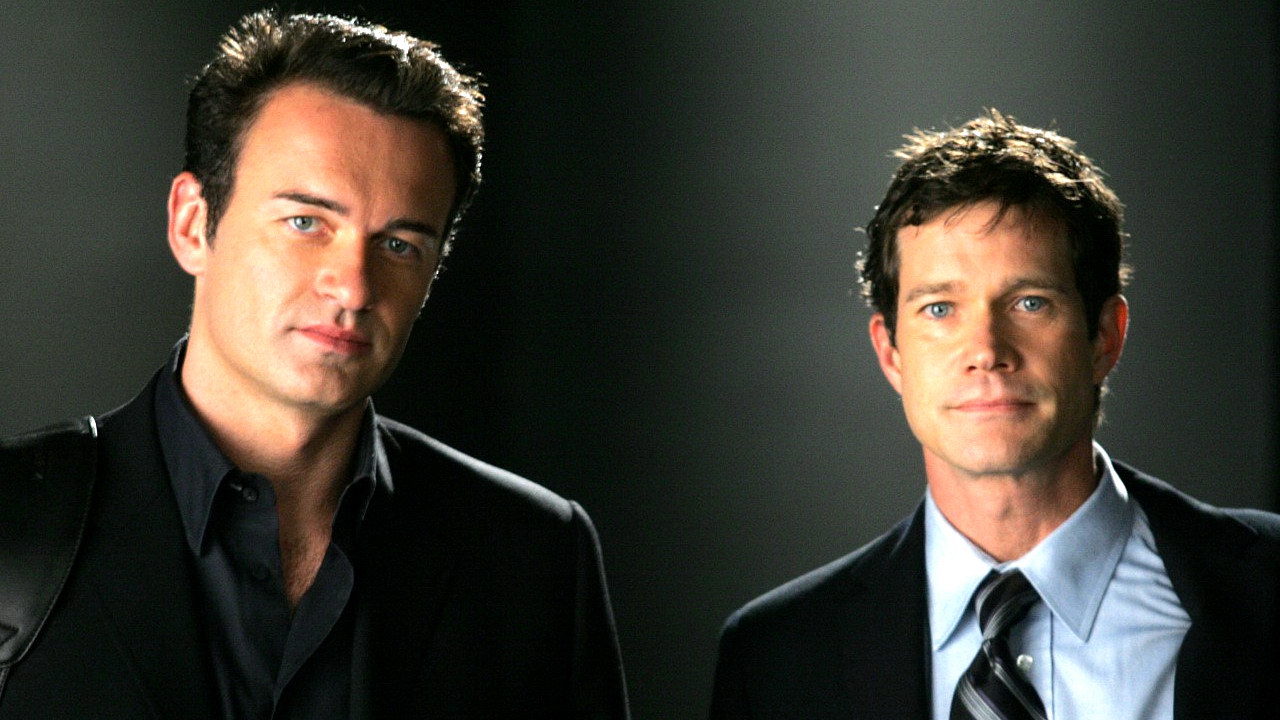
Television has a weird way of making the impossible look easy. We see a surgeon walk into a room, pick up a scalpel, and forty minutes later—minus commercials—a life is fundamentally changed. But when the FX hit series Nip/Tuck aired its third season back in 2005, it tackled something way more complex than a standard nose job or a tummy tuck. It introduced audiences to Treacher Collins syndrome through a character named Conor McNamara. People still search for Treacher Collins Nip Tuck before and after because the prosthetic work was so jarringly realistic that many viewers thought they were watching a real medical miracle unfold in real-time.
It wasn't real. Well, the surgery on the show wasn't, but the condition is very much a reality for about 1 in 50,000 people.
Treacher Collins syndrome (TCS) is a genetic disorder that messes with how the bones and tissues in the face develop. Specifically, it’s often caused by mutations in the TCOF1, POLR1C, or POLR1D genes. When we talk about the Treacher Collins Nip Tuck before and after results seen on screen, we’re actually looking at the work of makeup legends like Christien Tinsley. They had to transform a healthy infant into a child with severe craniofacial deformities, and then "surgically" correct it over the course of the season.
The Conor McNamara Storyline: Fact vs. Hollywood Friction
In the show, Julia McNamara gives birth to a son, Conor, who is diagnosed with TCS. The show runners didn't hold back. They showed the underdeveloped cheekbones, the downward-slanting eyes, and the tiny jaw—classic hallmarks of the condition. The "before" was a triumph of practical effects. The "after" was a narrative arc that explored the ego of surgeons Sean McNamara and Christian Troy as they tried to "fix" their own kin.
Honestly, the show got a lot of things right about the emotional toll, but it took massive liberties with the timeline. In the Nip/Tuck universe, major reconstructive surgery happens fast. In reality? It's a marathon, not a sprint.
Actual patients with Treacher Collins don't just have one "before and after" photo. They have a binder full of them. We are talking about a decades-long journey involving dozens of procedures. You don't just "fix" a malformed jaw in one afternoon. You use bone grafts. You use distraction osteogenesis—a brutal-sounding but effective process where the bone is literally pulled apart slowly to encourage new bone to grow in the gap.
What the "Before" Actually Looks Like
If you’re looking at Treacher Collins Nip Tuck before and after comparisons, you have to understand the anatomy. Most people notice the eyes first. They droop because the cheekbones (the zygomatic arches) aren't there to support them. Sometimes there’s a notch in the lower eyelid called a coloboma.
Then there are the ears. In many cases, they are barely there or completely missing (microtia). This isn't just an aesthetic issue. It means the ear canal is often closed, leading to significant hearing loss. The jaw is usually the biggest hurdle. A recessed chin (micrognathia) can make breathing and eating incredibly dangerous for a newborn.
The show used these physical traits to drive drama. It worked. It made people uncomfortable, which is exactly what life with a rare craniofacial condition can feel like in a world obsessed with symmetry.
The Surgery: Breaking Down the "After"
In the real world, the "after" in a Treacher Collins Nip Tuck before and after scenario is the result of a multi-disciplinary team. We’re talking neurosurgeons, plastic surgeons, ENT specialists, and orthodontists.
- Phase One: Infancy. The priority is breathing. If the jaw is too small, a tracheostomy might be needed. Some kids get jaw distraction surgery before they’re even out of diapers.
- Phase Two: Childhood. This is usually when the "Nip/Tuck" style reconstruction happens. Surgeons build cheekbones using bone harvested from the ribs. It’s intense. It’s painful. And the body doesn't always accept the graft.
- Phase Three: Adolescence. This is about the jaw and the teeth. Orthognathic surgery aligns the bite. Rhinoplasty might happen here too, to help with nasal airflow.
The show made it seem like the surgery was a gift of "normalcy." But if you talk to real advocates in the TCS community, like Jono Lancaster—perhaps the most famous face of Treacher Collins today—the "after" isn't just about a straighter jaw. It’s about self-acceptance. Lancaster has famously turned down reconstructive surgeries, choosing instead to embrace his face as it is. That’s a stark contrast to the Nip/Tuck ethos where the knife is the only solution to suffering.
Why the Nip/Tuck Depiction Still Matters
Look, Nip/Tuck was a soap opera with a medical license. It was flashy, often dark, and sometimes totally ridiculous. But by putting a TCS character at the center of a major season arc, it forced a mainstream audience to look at a condition they usually turned away from.
The Treacher Collins Nip Tuck before and after visuals served as a bridge. For some, it was their first exposure to the idea that "deformity" isn't a lack of humanity. However, medical experts often criticized the show for oversimplifying the risks. Surgery on a TCS patient is a nightmare for an anesthesiologist. Because the airway is so constricted, intubating a patient is incredibly difficult. The show skipped over these terrifying technicalities in favor of bedside drama.
The Real-Life Inspiration: Beyond the Screen
While Conor McNamara was fictional, the struggles were rooted in the experiences of real families. Organizations like myFace and the Children's Craniofacial Association (CCA) work with kids who actually live the Treacher Collins Nip Tuck before and after life every day.
They don't have a film crew. They have school bullies. They have mounting medical bills. They have the "The Wonder" effect—referencing the book and movie Wonder, which also features a protagonist with Treacher Collins. Wonder did a lot to soften the image of the condition, making it about kindness. Nip/Tuck made it about the visceral, bloody reality of medical intervention. Both have their place.
Addressing the "Miracle Cure" Myth
The biggest misconception fueled by the Treacher Collins Nip Tuck before and after search is that surgery "cures" the condition. It doesn't. You can't surgery-away a genetic mutation.
Even after the best surgeries in the world, a person with TCS will likely still have unique features. The hearing aids (often Bone Anchored Hearing Aids or BAHAs) will still be necessary. The speech therapy will still be a weekly staple. The "after" is better function and a more conventional appearance, but it’s never a total erasure of the "before."
Practical Insights for Understanding TCS Transitions
If you are researching this because of a personal connection or just a deep dive into medical history, here are a few hard truths to keep in mind:
- Bone resorption is real. Even if a surgeon builds beautiful cheekbones out of rib bone, the body can sometimes reabsorb that bone over time, making the face "sink" back toward its original shape.
- Psychological "Afters" matter more. Most patients report that the mental health support they receive is just as vital as the physical reconstruction.
- Technology has changed. Since Nip/Tuck aired, 3D printing has revolutionized these surgeries. Surgeons can now 3D print "jigs" and models of a specific child's skull to practice the surgery before they ever make an incision.
The Treacher Collins Nip Tuck before and after narrative is a fascinating time capsule of mid-2000s television. It pushed boundaries and used high-end prosthetics to tell a story about perfection and its cost. While the show ended years ago, the conversation it started about craniofacial diversity continues. Real medical progress has moved far beyond what Sean and Christian could have achieved in their fictional Miami clinic, proving that reality is often more hopeful—and significantly more complicated—than scripted drama.
To get a true sense of the journey, look into the stories of real-life survivors and advocates. Search for the work of the Craniofacial Team at NYU Langone or the Children’s Hospital of Philadelphia (CHOP). These are the places where the real "before and after" transformations happen, driven by science rather than ratings. Check out the "Choose Kind" movement or follow the hashtags used by the craniofacial community to see what life looks like when the cameras stop rolling. Knowing the difference between Hollywood prosthetics and actual surgical milestones is the first step in truly understanding Treacher Collins syndrome.