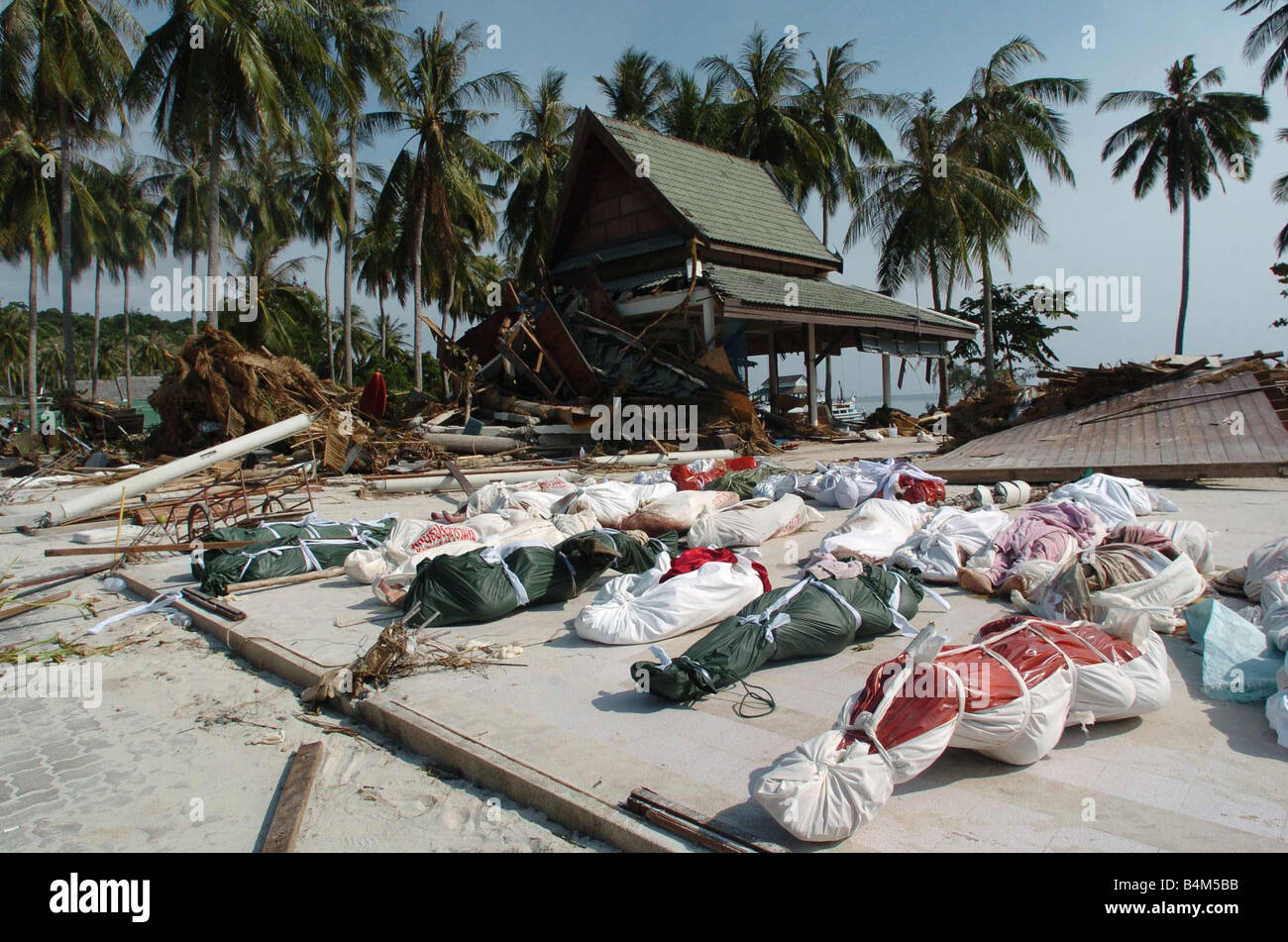
It was just another Sunday morning.
December 26, 2004. Boxing Day. In the coastal resorts of Phuket, Khao Lak, and the Phi Phi Islands, tourists were sleeping off Christmas dinners or grabbing early breakfast by the pool. The Andaman Sea looked like a mirror.
Then, the water did something weird. It didn't just crash; it vanished.
Many people actually walked out onto the exposed seabed to look at the stranded fish and shimmering shells. They had no idea that a massive tsunami disaster in thailand was seconds away from rewriting history.
Honestly, we talk about "natural disasters" all the time, but the 2004 Indian Ocean tsunami was in a category of its own. It wasn't just a big wave. It was a geological reset button that killed over 227,000 people across 14 countries. In Thailand alone, the official death toll settled at 5,395, though if you talk to locals in Phang Nga, they'll tell you the real number—including the undocumented migrant workers—is likely much higher.
The Science of the Surge
Basically, the whole thing started with a massive 9.1 to 9.3 magnitude earthquake off the coast of Sumatra, Indonesia. This wasn't a normal quake. The fault line rupture was about 1,300 kilometers long. That is roughly the distance from London to Rome.
When that much of the Earth's crust moves, it displaces a literal mountain of water.
In the deep ocean, a tsunami doesn't look like a "Hawaii Five-O" curling wave. It's a fast-moving bulge, sometimes only a meter high, traveling at the speed of a jet plane—around 500 to 800 km/h. But as it hits the shallow coastal shelf of Thailand, that energy has nowhere to go but up.
By the time it reached Khao Lak, the water had morphed into a churning wall of debris-filled sludge reaching heights of up to 10 meters. It didn't just hit the beach; it erased it.
Why Thailand was caught so off guard
You've got to remember that back in 2004, there was no Indian Ocean Tsunami Warning System. Nothing.
The Pacific had one, sure. But the Indian Ocean? People thought tsunamis were "Japan problems" or "Chile problems." Thailand isn't even on the Ring of Fire.
Because of that, the first sign of trouble for most was the "drawback." This is a classic tsunami precursor where the tide recedes hundreds of meters in seconds. If you ever see this, do not—I repeat, do not—go look at the fish. Run for high ground.
One famous story involves a 10-year-old British girl named Tilly Smith. She had just learned about tsunamis in school two weeks prior. She recognized the "frothy" water and the receding tide at Maikhao Beach and screamed at her parents to get everyone off the sand. She saved over a hundred people that day.
The Human Toll: Beyond the Numbers
The statistics for the tsunami disaster in thailand are staggering, but they're also kinda sterile. They don't capture the chaos of the aftermath.
- Fatalities: 5,395 confirmed dead (nearly half were foreign tourists).
- Missing: Over 2,800 people simply vanished, swept out to sea or buried under tons of mud.
- Economic hit: $2.2 billion in damages, mostly to the tourism sector that sustains the southern provinces.
The province of Phang Nga took the hardest hit. Specifically, the Ban Nam Khem fishing village and the luxury resorts of Khao Lak. In Khao Lak, the waves traveled more than 2 kilometers inland.
I've talked to survivors who described the sound as being like a "thousand freight trains" or a "low-altitude jet engine." It wasn't just water. It was a cocktail of cars, concrete blocks, palm trees, and glass. If the water didn't get you, the debris did.
The Identification Nightmare
One of the most harrowing parts of the Thailand story is the forensic challenge that followed. Because Thailand is a global tourism hub, the victims came from over 35 different countries.
Sweden lost 543 people. Germany lost 539.
The Thai government, led by the Disaster Prevention and Mitigation department, had to set up massive temporary morgues in Buddhist temples. For months, international forensic teams worked in the sweltering heat to identify bodies using DNA and dental records. It was the largest forensic identification project in human history.
The Ghost of Khao Lak
Even today, if you visit the Andaman coast, the trauma is woven into the landscape.
Take "Police Boat 813" in Khao Lak. During the tsunami, this massive steel vessel was on offshore patrol guarding a member of the Royal Family. The wave picked it up and dumped it nearly 2 kilometers inland. It’s still there. They left it as a permanent memorial because moving it was almost impossible, and it serves as a terrifyingly clear marker of how far the sea can reach.
There's also a lingering psychological impact. For years after the tsunami disaster in thailand, many locals refused to go near the beach at night. There were endless stories of "ghost tourists" seen wandering the ruins of luxury hotels. It sounds like folklore, but when a community loses thousands of people in twenty minutes, the grief manifests in powerful ways.
Is Thailand Safe Now?
This is the big question. If you’re planning a trip to Phuket or Krabi, you probably want to know if this could happen again.
The short answer: Yes, a tsunami could happen again. The long answer: You are much more likely to survive it now.
Since 2004, the Thai government has dumped massive resources into the National Disaster Warning Center (NDWC). Here is what has changed:
- Deep-Ocean Buoys: There are now DART (Deep-ocean Assessment and Reporting of Tsunamis) buoys positioned in the Indian Ocean. These sensors detect pressure changes on the sea floor and beam the data to satellites in real-time.
- Warning Towers: If you walk along Patong Beach or Khao Lak today, you’ll see tall, silver towers. These are sirens. They are tested regularly and are connected to a central command in Bangkok.
- Evacuation Routes: There are clear, blue signs everywhere pointing toward "Tsunami Evacuation Routes." These lead to reinforced concrete buildings or natural hills.
- Education: Schools in coastal provinces now have mandatory drills. Even the hotel staff are trained to move guests to the 3rd or 4th floor immediately upon hearing a warning.
The "two-hour window" is the key. In 2004, it took about 90 minutes to two hours for the waves to hit Thailand after the Sumatra quake. That is plenty of time to evacuate an entire city—if you have a warning system. Today, Thailand has that system.
Actionable Insights: What to Do if You're There
Don't let the history of the tsunami disaster in thailand scare you off. The Andaman coast is beautiful and the risk is statistically low. But being an "expert" traveler means being prepared.
First, pay attention to the tide. If you see the water disappear rapidly, don't wait for a siren. Just go. Head for the highest ground possible or at least the fourth floor of a sturdy concrete building.
Second, check the signs. When you check into a beach resort, take 30 seconds to look at the evacuation map. Most people skip this. Don't be "most people."
Third, trust the locals. If you see fishermen or boat captains suddenly heading for deep water or shouting for people to leave the beach, follow them. They often sense changes in the ocean's "mood" before the tech catches up.
The 2004 disaster was a tragedy born of ignorance—not human ignorance, but a lack of global infrastructure. We didn't know the Indian Ocean could do that. Now we do. The best way to honor those lost is to stay informed, stay alert, and respect the power of the sea.
If you’re traveling to the region, you might consider visiting the Tsunami Memorial Park in Ban Nam Khem. It’s a somber, beautiful place that puts the scale of the event into perspective far better than any Wikipedia article ever could.
Stay safe, stay aware, and keep exploring.