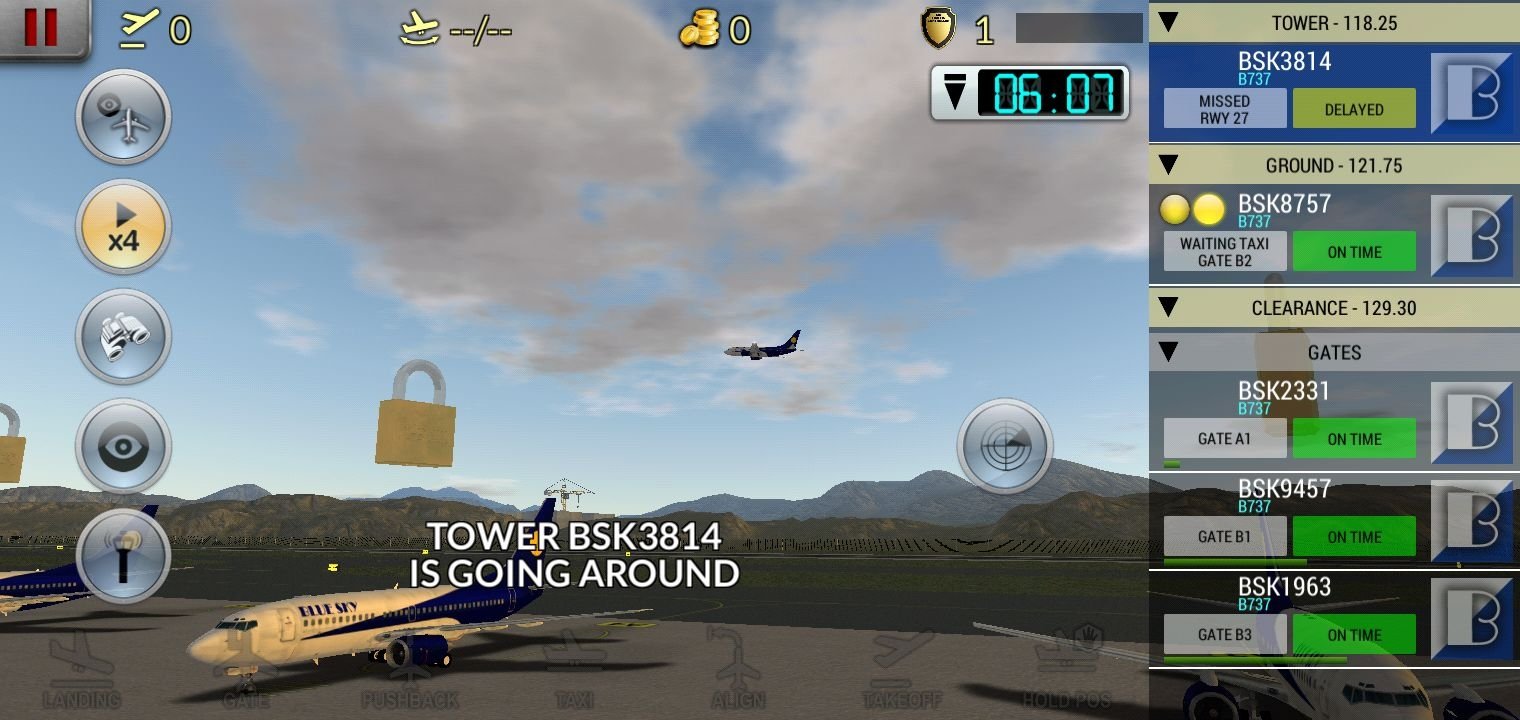
You’re sitting there, staring at a screen filled with little green icons, and suddenly everything goes wrong. A Boeing 747 is screaming down the glide slope for runway 28R while a tiny Cessna—clueless and slow—decides to poke its nose onto the active taxiway. In the world of unmatched air traffic control, this is the moment your pulse spikes. It isn't just a mobile game. It’s a chaotic exercise in spatial awareness that makes you realize why real-world controllers drink so much coffee.
Honestly, most flight sims focus on the cockpit. They want you to feel the leather of the captain's seat and the vibration of the throttles. But this one? It flips the script. You aren't the pilot. You're the voice in their ear, the god of the grid, and the only thing standing between a smooth landing and a multi-million dollar fireball on the tarmac.
What sets this sim apart from the arcade junk?
Most mobile "ATC games" are basically Reskin A or Reskin B. They use simplified paths and neon lines to guide you. Unmatched air traffic control feels different because it forces you to actually manage the radio. You aren't just clicking and dragging; you are issuing commands that feel—well, mostly—like the real thing. You've got to handle the pushback, the taxi clearances, the takeoffs, and the handoffs.
It's tedious. And that's exactly why it works.
If you've ever listened to a live feed from JFK or Heathrow on LiveATC.net, you know the cadence. It’s fast. It’s clipped. There is zero room for "um" or "uh." While the game simplifies the phraseology for a touch screen, the pressure remains authentic. You start with a quiet regional airport. A couple of turboprops, maybe a private jet. Easy. But as you unlock larger hubs, the complexity doesn't just increase—it explodes.
The mechanics of the madness
The core loop is simple but punishing. You have a radar view and a tower view. Most players spend their time in the radar view because, let’s be real, you can't see a plane five miles out from the tower windows very well on a 6-inch phone screen.
- You identify the incoming flight.
- You assign a runway based on wind (yes, wind matters).
- You manage the "stacks."
Spacing is everything. In the real world, the FAA has strict wake turbulence separation rules. If you put a heavy A380 right in front of a light Learjet, that Learjet is going to have a very bad day. Unmatched air traffic control mimics this tension. If you bunch them up too close, the "separation conflict" warnings start flashing red. It’s a sensory overload of beeps and blinking lights that genuinely mimics the "edge of your seat" feeling of a high-stakes job.
One thing that genuinely surprises people is the attention to the "ground game." Most people think ATC is just about the sky. Wrong. The ground is where the real headaches live. Managing taxiway intersections so two planes don't end up nose-to-nose like two stubborn goats on a bridge is a puzzle in itself. You have to anticipate. You have to look three moves ahead, like a chess player who is also responsible for three hundred lives.
Realism vs. Playability: The Balancing Act
Let's talk about the "unmatched" part of the name. Is it actually unmatched? In the mobile space, probably. If you compare it to Real ATC or Sector 33 (which was actually developed by NASA to teach math), this game leans more toward the "sim-lite" category. It’s more accessible than Tower!3D Pro on the PC, which requires you to actually speak the commands into a headset.
The developer, Vector3D Studios, has clearly spent time looking at how planes actually move. They don't just turn on a dime. They have inertia. They have slow spool-up times for engines. When you tell a heavy cargo plane to go around because the runway isn't clear, it takes time for that beast to climb back out. That lag is where the panic sets in.
I’ve seen players complain that the planes are "too slow" to respond.
That’s the point.
Real physics isn't instant. If you mess up your sequencing, you can't just "undo" it. You have to manage the crisis you created. This creates a psychological weight that most mobile games lack. You feel responsible for the virtual passengers.
The Gritty Details: Why You'll Probably Fail at First
The learning curve isn't a curve; it's a wall.
When you first start playing unmatched air traffic control, you're going to cause a collision. It’s inevitable. You’ll forget about a plane sitting on the threshold of Runway 09 while you’re distracted by a landing on 27. The game doesn't hold your hand. The interface is utilitarian—some might even say "ugly"—but it mimics the functional, no-nonsense aesthetic of actual Raytheon or Lockheed Martin air traffic systems.
- Customization: You can actually change the liveries. Seeing a real-world Delta or Emirates tail makes the stakes feel higher.
- Airport Variety: From island strips to massive international hubs, the geography changes how you think. An airport with crossing runways is a nightmare compared to parallel ones.
- Voice Commands: If you're feeling brave, you can use the voice integration. It’s hit-or-miss depending on your mic, but when it works, the immersion is incredible.
The game uses a "credits" system to unlock new airports and planes. Some people hate this. They want everything open from the start. But there’s a logic here: if the game gave you O'Hare International on day one, you'd quit within five minutes out of sheer frustration. You have to earn the right to handle the big birds.
Expert Insights: The Real ATC Perspective
I spoke with a former approach controller who tried the game. His take? "It captures the 'sequencing' itch." He noted that while the game skips the complex handoffs between 'Center' and 'Approach' and 'Tower' and 'Ground' (which are usually four different people in real life), it captures the essence of the "mental picture."
Controllers talk about the "picture" all the time. It’s the 3D map they build in their heads. When you play this sim, you start to see the picture. You stop seeing icons and start seeing altitudes and closing speeds. You begin to "hear" the gap between two planes.
The limitations? Well, the weather system is a bit basic. In reality, a massive thunderstorm doesn't just make things look dark; it shifts the entire flow of traffic for hundreds of miles. In the game, it’s mostly a visibility challenge. Also, the pilots in the game are much more polite than real pilots. You won't have a disgruntled captain arguing with you about a holding pattern—they just do what they're told.
Strategic Takeaways for New Controllers
If you're going to dive into this, don't just wing it. You need a strategy or you’ll end up with a screen full of red circles and a "Game Over" message.
First, master the departures. New players always obsess over the arrivals because they're "coming at you." But if you don't get your departures off the ground, your gates stay full. If your gates are full, your arrivals have nowhere to go. They’ll just sit on the taxiway, blocking everything else. It’s a literal gridlock.
Second, use your speed commands. You don't just have "stop" and "go." You can tell planes to slow down. If you have a line of five planes on final approach, slow the front one down to the minimum approach speed and keep the others staggered.
Third, don't be afraid to use the 'Go-Around'. If a landing looks sketchy, abort it. It’s better to have a frustrated pilot back in the pattern than a crash that ends your session.
Why this matters in 2026
We live in an era of automation. Most people think planes fly themselves (and to an extent, they do). But the human element of traffic management is still the bottleneck of the global economy. Playing unmatched air traffic control gives you a weirdly deep appreciation for the men and women sitting in dark rooms in TRACON facilities.
It turns out, keeping metal tubes from hitting each other at 500 miles per hour is actually pretty hard.
Whether you're a hardcore aviation geek or just someone who likes high-pressure puzzle games, there is something addictive about the flow. When you get into a rhythm—landing, taxi, gate, pushback, takeoff—it’s like conducting an orchestra. A very loud, very expensive orchestra.
Next Steps for Aspiring Controllers:
- Start Small: Don't buy the biggest airport immediately. Master the single-runway layouts first to understand timing.
- Learn the Phonetic Alphabet: If you're going to use voice commands, knowing "Alpha, Bravo, Charlie" is mandatory. It's not just for flavor; it's how the voice recognition is calibrated.
- Monitor the Winds: Always check the wind direction at the start of a session. Landing with a tailwind is a recipe for a runway excursion, both in the game and in real life.
- Study the Charts: If you really want to go pro, look up real-world SIDs (Standard Instrument Departures) and STARs (Standard Terminal Arrival Routes) for the airports in the game. The game doesn't require them, but following them makes the experience ten times more realistic.
The world of aviation is unforgiving. This game is, too. But that’s exactly why it’s so hard to put down. Just don't forget to blink.