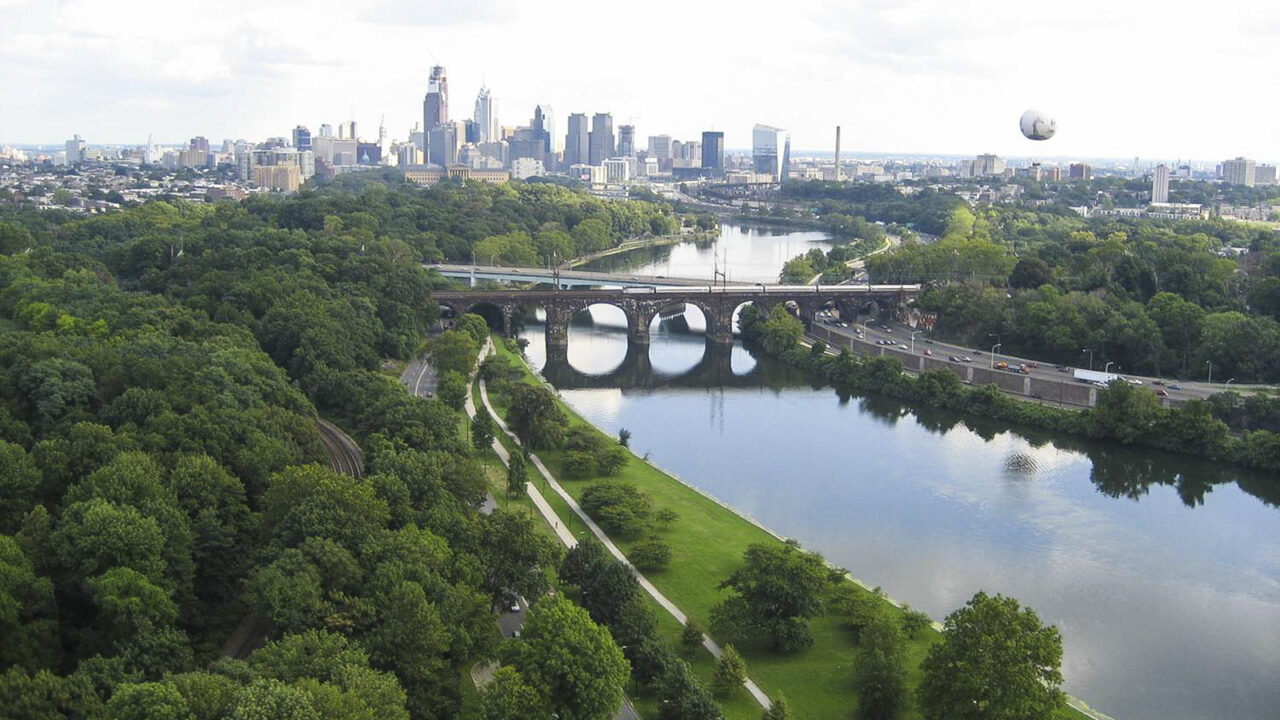
If you ask a tourist where to go in Philly, they’ll point you toward the Liberty Bell or maybe the Art Museum steps if they’ve seen Rocky too many times. But locals? We know the real soul of the city sits just across the Schuylkill River. West Fairmount Park Philadelphia is massive. Honestly, it’s so big—over 1,400 acres—that you can get genuinely lost in it, and not always in the "romantic stroll" kind of way. Most people think of Fairmount Park as one cohesive unit, but the West side is a completely different beast than the East. It’s rugged. It’s weird. It’s got a massive Japanese house in the middle of a forest and a concert venue that looks like a spaceship landed in a field.
You’ve probably driven past it on I-76 a thousand times, cursing the traffic while glancing at the Philadelphia Zoo or the Please Touch Museum. But that’s just the surface. This land was the site of the 1876 Centennial Exposition, the first official World's Fair in the United States. That event basically birthed the modern American identity, and the park still wears the scars and trophies of that era.
The Centennial Legacy is Everywhere (If You Know Where to Look)
Most people walk right past the history here without realizing they're stepping on the grounds of a global revolution. In 1876, nearly 10 million people flocked here. Think about that. Ten million people in an era of steam trains and horses. They came to see the Corliss Steam Engine and the hand of the Statue of Liberty, which was on display to raise money for its pedestal.
Today, the most glaring reminder is Memorial Hall. It’s gorgeous. It’s also one of the few buildings left standing from the Expo. Nowadays, it houses the Please Touch Museum, which is great for kids, but the architecture itself is the real draw for adults. The basement actually contains a massive scale model of the 1876 fairgrounds. You should go see it. It’s sort of haunting to see how dense this park used to be with Victorian "palaces" made of glass and steel that are just... gone now.
Then there’s the Ohio House. It’s literally built out of pink sandstone from Ohio. It served as the state's pavilion in 1876 and is one of the only other survivors. It’s a cafe now, or at least it tries to be every few years when the lease changes. It’s a weird feeling, sipping a latte in a building that was meant to be temporary 150 years ago.
Shofuso: A Slice of Kyoto in the Middle of Philly
You’re walking through typical Pennsylvania woods—oaks, maples, the occasional squirrel—and suddenly, you hit Shofuso Japanese Cultural Center. It feels like a glitch in the Matrix. This house wasn't built here; it was built in Nagoya in 1953 using traditional mid-17th-century techniques and then shipped to New York's MoMA before finally finding a permanent home in West Fairmount Park in 1958.
It's not just a "pretty building." It’s a legit Japanese house with a hinoki bark roof—the only one of its kind outside Japan.
- You have to take your shoes off.
- You can feed the koi. They are huge and aggressive.
- The murals inside were painted by Hiroshi Senju, inspired by the park’s waterfalls.
What's wild is that this site was originally the Japanese pavilion during the 1876 Centennial. So, while the current house is from the 50s, the "vibe" of this specific spot has been Japanese for over a century. It’s quiet. It’s the one place in the park where the noise of the Schuylkill Expressway finally fades into the background.
The Mann Center and the Summer Sound
If you want to talk about West Fairmount Park Philadelphia without mentioning The Mann Center for the Performing Arts, you’re missing half the story. It’s an amphitheater, but that description feels too small. It’s where the Philadelphia Orchestra spends its summers.
There is something deeply "Philly" about sitting on the lawn at The Mann, drinking a slightly overpriced beer, and watching the sunset hit the city skyline while a world-class orchestra plays Star Wars scores or a touring indie band is mid-set. The acoustics are surprisingly good for being outside. But word of advice: if you’re on the lawn, bring a real blanket. The grass gets damp the second the sun goes down.
Horticulture Center and the "Whispering" Statues
The Horticulture Center is another Centennial leftover, though the original glass Horticultural Hall was demolished in the 50s because it was falling apart. The new one is still cool, though. It’s an arboretum and a greenhouse, and it’s often used for fancy weddings.
Right outside is the Centennial Arboretum. It’s got trees that were planted back in the 1870s. If you’re a tree nerd, this is your Mecca. There are specimens there that you won't find anywhere else in the state.
And then there are the statues. West Fairmount Park is littered with them. The Smith Memorial Arch is a massive gateway to nothing in particular, built to honor Civil War heroes. It has these "whispering benches" where you can sit on one end, whisper into the stone, and someone on the other end can hear you perfectly. It actually works. Physics is cool.
The Belmont Plateau: The View Everyone Forgets
You’ve seen the skyline from the South Street Bridge. You’ve seen it from the Art Museum. But the Belmont Plateau view is the heavy hitter. This is the spot where Will Smith filmed the "Summertime" video. It’s where generations of Philly kids have gone to play frisbee, host family reunions, or just stare at the skyscrapers.
The "Plateau" is a wide-open grassy expanse that offers a panoramic look at Center City. It’s one of the few places in the city where you feel the scale of Philadelphia. To your left, the skyscrapers; to your right, the dense woods of the park. It’s a juxtaposition that defines the city.
It’s Not All Sunshine and Roses
Let's be real for a second. West Fairmount Park has some rough edges. It’s managed by Philadelphia Parks & Recreation, and like many things in a city with a tight budget, some parts feel a little neglected.
- Some trails aren't well-marked.
- Trash can be an issue after a big weekend.
- Public transit to the deeper parts of the park is, frankly, annoying. You’re better off biking or driving.
If you’re hiking the Chamounix Drive area, you’ll see the Chamounix Mansion, which is now a youth hostel. It’s a beautiful 1802 federal-style country house, but it’s tucked so far back that it feels isolated. Some people find that creepy; others find it a relief.
The "Secret" Spots You Should Actually Visit
Everyone goes to the Zoo. It’s the oldest zoo in America (opened in 1874), and the Victorian architecture is stunning. But if you want to avoid the crowds, head to Parkside. The neighborhood bordering the park is a masterclass in Victorian architecture. These huge, ornate houses were built for the wealthy elite who wanted to live next to the world's fairgrounds.
Then there’s Concourse Lake. It’s a small body of water near the Horticulture Center that was recently restored. It’s a prime spot for birdwatching. You’ll see Great Blue Herons, egrets, and more turtles than you can count. It’s a quiet pocket in a park that can sometimes feel too busy.
Why Does This Park Matter Now?
In 2026, as Philadelphia prepares for the 250th anniversary of the United States, West Fairmount Park is going to be under the microscope again. There’s a lot of talk about revitalization. Organizations like the Fairmount Park Conservancy are doing the heavy lifting to restore the trails and historical sites.
But it matters because it’s the "green lungs" of the city. While East Fairmount Park has the mansions (Mount Pleasant, Laurel Hill), West Fairmount Park has the space. It’s where the city breathes. It’s where you go when you need to forget you’re in the poorest big city in America and just want to look at a 150-year-old oak tree.
Practical Next Steps for Your Visit
Don't just wing it. If you’re heading out there, you need a plan because of the sheer size.
First, check the Shofuso schedule. They close for the winter and are only open seasonally (usually April through October). It’s worth the $14 or so for admission.
Second, park at the Horticulture Center. It’s central, usually has plenty of space, and it’s a good jumping-off point for both the Japanese House and the Centennial grounds.
Third, bring a bike. If you try to walk from the Zoo to the Belmont Plateau, you’re going to be exhausted before you even get halfway. The hills in West Fairmount are no joke.
Fourth, download an offline map. Cell service is surprisingly spotty in the wooded ravines near Chamounix, and as I mentioned, the trail markers aren't always your friend.
Finally, if you’re a history buff, visit the Cedar Grove and Sweetbriar mansions. They are smaller than the East Park mansions but offer a much more intimate look at how the 18th-century "upper crust" lived when they were trying to escape the yellow fever outbreaks in the city.
West Fairmount Park isn't a manicured, perfect space like Central Park. It’s a bit wilder, a bit weirder, and deeply layered with history. It’s a place where a 19th-century world's fair, a 17th-century Japanese house, and a 21st-century concert venue all occupy the same soil. That’s why it’s the best part of Philly. It’s messy and beautiful, just like the city itself.