You’ve seen it. Everyone has. That silver-and-blue pill floating over a stadium, looking like a slow-motion toy against the clouds. It’s iconic. But honestly, most people have no clue what happens once you climb that little ladder. They think it’s a giant balloon filled with air. It isn't. They think it’s whisper-quiet. It definitely isn't.
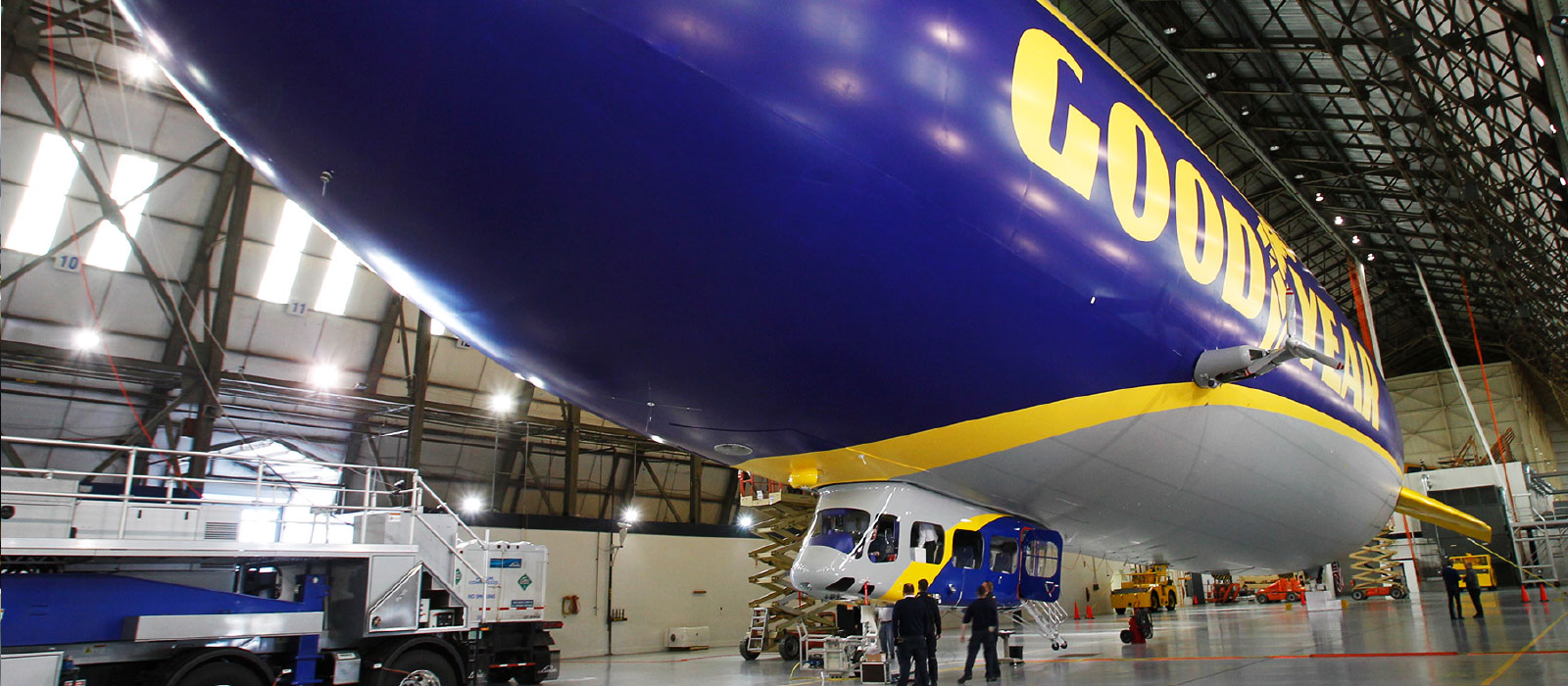
Step inside a Goodyear Blimp and the first thing that hits you is the size—or rather, the lack of it. The "Gondola," which is the technical term for the car hanging underneath, is surprisingly cramped. You aren't riding in a luxury cruise ship in the sky. It feels more like a cross between a city bus and a small Cessna, just with way better windows.
The current fleet—the Wingfoot One, Two, and Three—technically aren't even "blimps" in the old-school sense. They are semi-rigid airships. Old blimps were basically big bags of gas that would go limp if you let the helium out. These newer Zeppelin NT models have a high-tech internal frame made of carbon fiber and aluminum. It’s a massive difference. Because of that frame, the engines can be mounted on the sides and tail rather than just on the gondola. This makes the whole ride smoother, though you’re still very much at the mercy of the wind.
The Cockpit: Where the Magic (and Muscle) Happens
Forget what you know about airplane cockpits. There's no yoke. No steering wheel. In the older models, pilots used a literal wooden wheel next to their seat that looked like it belonged on an 18th-century pirate ship to control the elevators.
Modern pilots use a joystick.
It’s a fly-by-wire system now. The pilot sits in the front left, surrounded by glass. Visibility is insane. You can see straight down between your feet. For a pilot, this is the ultimate "VFR" (Visual Flight Rules) machine. They aren't staring at screens the whole time; they are looking at the world. But don't let the slow speed fool you. Flying one of these is an athletic event. Even with the new tech, you are essentially wrestling a 246-foot-long whale that wants to go wherever the breeze tells it to.
The noise is the second thing you notice. It’s a mechanical hum that vibrates through your seat. It isn't the deafening roar of a jet, but it’s constant. Pilots and passengers usually wear noise-canceling headsets so they can actually hear each other talk.
What It Feels Like to Float
Takeoff is weird. In a plane, you feel that "pushed back in your seat" sensation. In the blimp? You just sort of... lift. The ground crew—which is a massive operation of about 20 people—untethers the ship, and you rise. It’s buoyant.
Once you’re at cruising altitude, which is usually around 1,000 to 1,500 feet, the world looks different. You’re moving at maybe 35 or 40 miles per hour. At that speed, you can see people waving from their backyards. You can spot a dog chasing a ball. It’s intimate. Most aviation is about getting from A to B as fast as possible. The blimp is the opposite. It’s about the "during."
- The Sway: You don't just fly straight. You pitch. You yaw. It’s more like being on a boat than an airplane. If you get seasick, bring some ginger ale.
- The Windows: Many of them actually open. You can stick your hand out and feel the air at 1,000 feet. You can't do that in a Boeing 737.
- The Seats: There are only about 12 of them. They’re comfortable, sure, but the "cabin" is tiny. You can't really get up and pace around.
The Helium Myth and Technical Realities
People ask if the helium is flammable. No. That was the Hindenburg, and that was hydrogen. Helium is inert. It’s safe. But it’s also expensive and fickle. The gas inside the envelope expands and contracts based on temperature. If the sun comes out from behind a cloud, the helium heats up, the ship gets more "lift," and the pilot has to compensate. It’s a constant dance with thermodynamics.
Inside that massive envelope above your head, it’s not just a big empty space. There are "ballonets"—internal air bags. By pumping heavy air into these bags or venting it out, the pilot can control the weight and trim of the ship without wasting precious helium. It’s a low-tech solution to a high-tech buoyancy problem.
The View from the Camera Hole
If you’re lucky enough to be inside a Goodyear Blimp during a major sporting event, you’ll see the "broadcast hole." This is a specialized mount in the floor or side where the high-definition camera sits. This camera is stabilized by a gyro-system that costs more than a nice house in the suburbs.
The cameraman isn't just pointing a lens. They are working in tandem with the pilot. If the director wants a shot of the 50-yard line, the pilot has to crab-walk the ship sideways against the wind while the cameraman zooms in from a mile away. It’s a choreographed ballet between two people who are often sweating despite the cool air at altitude.
Why You Probably Won't Get a Ride
Here’s the cold, hard truth: You can't just buy a ticket. Goodyear doesn't sell rides to the public. To get inside, you usually have to be a member of the press, a corporate partner, or a winner of a very rare charity auction. Every year, thousands of people email Goodyear begging for a seat. Most get a polite "no."
This exclusivity adds to the mystique. When you see that shadow pass over your car on the highway, you're looking at one of the rarest experiences in aviation. There are only about 25 blimps left in the world. Compare that to the thousands of commercial planes in the air at any given second. You are more likely to meet a billionaire than you are to ride in a blimp.
Technical Specs You Should Know
The new Zeppelin NT models are roughly 246 feet long. That’s longer than a Boeing 747. Yet, they only carry a handful of people. It’s incredibly inefficient if you’re trying to move passengers, but incredibly efficient if you want to hover over a golf tournament for ten hours straight.
They use three engines—Vans Aircraft IO-360 engines—to be specific. These are 200-horsepower engines that can swivel. This "thrust vectoring" is what allows the ship to take off vertically and even hover in place, which the old-style blimps couldn't do nearly as well.
Actionable Insights for Blimp Spotters
If you want to experience the blimp without being a VIP, you have to be strategic.
- Track the Tail: Use flight tracking apps like FlightRadar24. Look for the tail numbers N1A (Wingfoot One), N2A (Wingfoot Two), or N3A (Wingfoot Three). If you see them circling at low altitudes (under 2,000 feet), they’re likely filming an event.
- Visit the Bases: There are three main bases in the U.S.: Pompano Beach (Florida), Carson (California), and Suffield (Ohio). You can't just wander onto the airfield, but you can often see them taking off or landing from nearby public roads. Watching the ground crew catch the "moring lines" is a spectacle in itself.
- Check the Schedule: Goodyear actually publishes a "Blimp Schedule" on their website. It tells you exactly which cities they’ll be in and which games they’re covering.
- Follow the Pilots: Many Goodyear pilots are active on social media. They post the "real" views from the cockpit that you won't see on the TV broadcast.
The blimp is a relic of an era when the journey mattered more than the destination. It’s slow, it’s loud, it’s cramped, and it’s absolutely magnificent. It represents a different way of looking at our world—not as a map to be zoomed across, but as a landscape to be savored. If you ever get the chance to step inside, don't worry about the noise or the tight squeeze. Just look down.
Key Takeaways for Your Next Sighting
- Look for the Engines: If they are on the sides and tail, it’s the new semi-rigid model.
- The Ground Crew is Key: Without the 20 people on the ground with ropes, the ship can't land safely.
- Weather is Everything: Blimps don't fly in heavy rain or high winds. If the weather looks "iffy," the blimp is staying in the hangar.
Understanding the mechanics makes the sight of it even better. It’s not just a balloon; it’s a masterclass in physics and patience.
Next Steps:
Go to the official Goodyear Blimp website and check their "Blimp Map" to see if a ship is scheduled to be in your airspace this month. If it is, download a flight tracker app and set an alert for the tail numbers N1A, N2A, or N3A so you can catch it as it arrives.