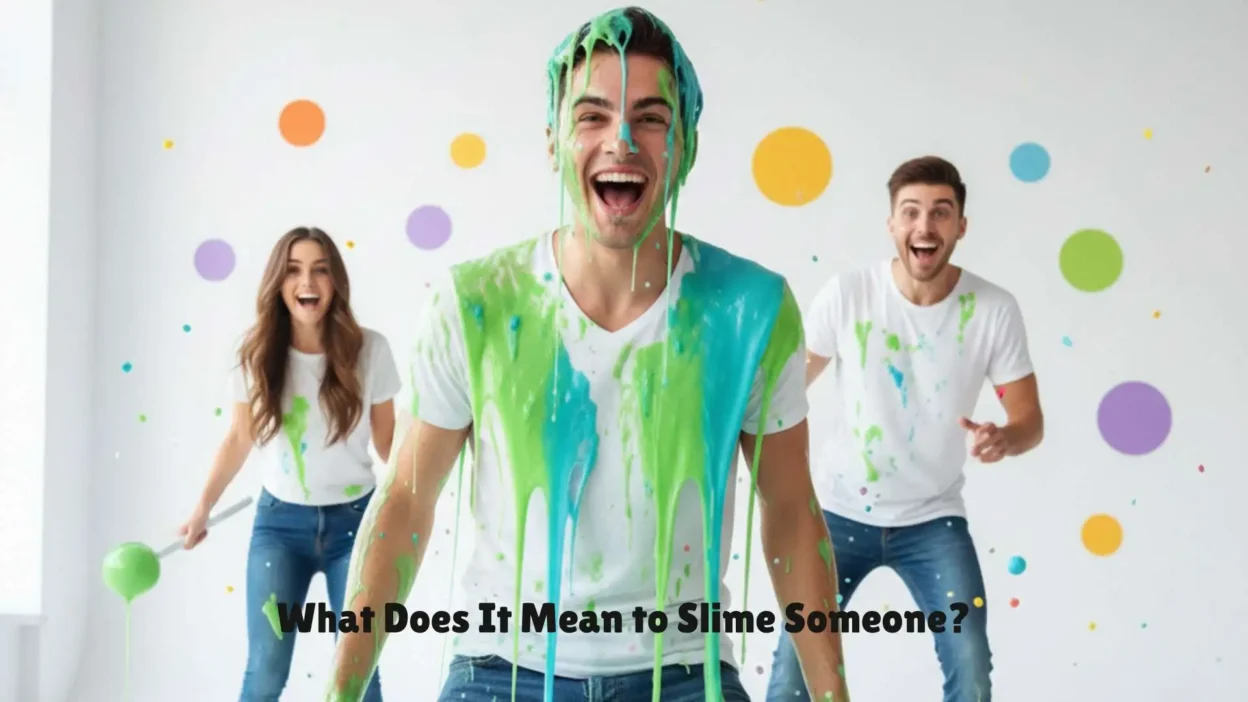
You’ve seen it. That neon-green, viscous liquid cascading over a celebrity’s head while they grin through the sticky mess. It’s iconic. But if you’re asking what does it mean to slime someone, the answer depends entirely on whether you’re talking about a 90s nostalgia trip, a Nickelodeon award show, or a much darker corner of modern internet slang.
It’s messy. Literally.
Most people associate "sliming" with the Nickelodeon Kids' Choice Awards. It’s a badge of honor there. You haven't truly made it in Hollywood until you've been drenched in that proprietary green goo. But language evolves fast. Today, if someone says they're going to "slime" you in a competitive gaming lobby or a heated Twitter thread, they aren't talking about vegetable-based thickener. They’re talking about betrayal, social sabotage, or "clout chasing" at your expense.
The Nickelodeon Origin: A Green Badge of Honor
The obsession started with a show called You Can't Do That on Television back in 1979. It was a Canadian sketch show that Nickelodeon eventually picked up. The premise was simple: if a cast member said "I don't know," a bucket of green sludge fell on them. It was a punishment. It was gross. Kids absolutely loved it.
By the time the 90s rolled around, being slimed transitioned from a penalty to a prestige move. Shows like Figure It Out and Double Dare made the substance a central character. Marc Summers, the legendary host of Double Dare, became the face of this messy era, though he ironically suffered from OCD and hated being dirty.
What is the slime actually made of? For years, it was a state secret. We now know the original recipe involved vanilla pudding, applesauce, green food coloring, and a little bit of oatmeal to give it that "chunky" texture that clung to hair. It had to be edible because, inevitably, some would get in the actors' mouths. Today’s version is a more synthetic, shelf-stable formula, but the visual impact remains the same.
When you see Katy Perry or Harrison Ford getting doused, it’s a PR masterstroke. It signals that the celebrity is "down to earth." They’re willing to look ridiculous for the fans. In this context, what does it mean to slime someone is essentially an act of playful initiation into the "cool" club of children's entertainment.
The Darker Shift: Street Slang and "Sliming" Out
Language doesn't stay in a vacuum. Around the mid-2010s, the term took a sharp turn into hip-hop culture and street slang, largely popularized by Atlanta-based rappers like Young Thug and the YSL (Young Stoner Life) crew.
In this world, a "slime" is a close friend—a "brother." It's an acronym often cited as "Street Life Intelligence Money Everything." However, the verb form—to slime someone—is significantly more cutthroat.
To slime someone in this context means to snake them. It's about betrayal.
If you "slime someone out," you're setting them up or robbing them. It’s cold. It’s calculated. It’s the polar opposite of the playful Nickelodeon splash. You’re essentially "greasing" the wheels for their downfall. This version of the term grew so prevalent that it started appearing in police indictments and court cases, most notably the high-profile YSL RICO trial in Georgia, where prosecutors spent hours dissecting lyrics and slang to prove criminal intent.
It’s a weird linguistic bridge. On one hand, you have 10-year-olds at a theme park wanting to get gunked. On the other, you have a term used to describe high-stakes betrayal in organized crime. Context is everything.
Gaming Culture and the "Slime" Meta
If you spend any time on Twitch or in Discord servers, you've probably heard a different variation. In the gaming community, especially in titles like Splatoon or Slime Rancher, the term is literal. But in competitive circles like Call of Duty or Valorant, "sliming" can refer to a specific type of movement or "gunking up" an opponent's strategy.
There is also the "Slime" persona. Take the popular streamer known as Slime (Anthony Bruno) from The Yard podcast. In this subculture, the word represents a specific aesthetic—cynical, irreverent, and chaotic.
Why We Are Still Obsessed With the Goo
Why does this concept persist? Biologically, humans have a fascination with "disgust." Psychologists often point to "benign masochism"—the joy of experiencing something unpleasant (like being covered in cold, sticky goop) because we know we are actually safe.
- Sensory Overload: It’s a visual explosion. In an era of polished Instagram filters, slime is raw and unpredictable.
- The Great Equalizer: You can be the highest-paid actor in the world, but once you're covered in green pudding, you look just as silly as a third-grader.
- The Nostalgia Loop: Millennials who grew up on GUTS and Legends of the Hidden Temple are now the ones producing content. They’re bringing the slime back because it triggers that dopamine hit of Saturday morning cartoons.
How to Handle Being "Slimed" (In Any Sense)
If you find yourself on the receiving end of a "sliming," your reaction dictates the outcome.
If it’s the physical kind—the Nickelodeon kind—lean in. The worst thing a celebrity can do is look annoyed. The "slime" is a gift of relevance. If you wipe it off with a scowl, you've lost the audience.
If it’s the slang kind—the betrayal—it’s time for a social audit. Being "slimed out" by a business partner or a friend usually means there were red flags you missed. In the digital age, this often looks like someone taking a private conversation and "sliming" it across social media for views. It’s the modern-day "tea spilling," but with more malicious intent.
The Logistics of a Physical Slime
Let’s say you’re actually planning to slime someone for a YouTube video or a school event. You can't just throw green paint. Paint is toxic, stains skin, and ruins equipment.
Most professionals use a mix of:
- Methylcellulose: This is a thickening agent used in everything from fast-food shakes to laxatives. It’s clear and incredibly slippery.
- Tempura Paint or Food Coloring: For that "radioactive" green hue.
- Water: To get the viscosity right.
Pro-tip: If you're the one getting slimed, rub a little bit of baby oil into your hairline beforehand. It prevents the green dye from staining your scalp for three days. Trust me on this.
What It Means for the Future of Slang
Words are slippery. "Slime" is a prime example of how a single syllable can travel from a Canadian TV set to the streets of Atlanta to a gaming house in Los Angeles, picking up new meanings like a rolling snowball.
Basically, if someone mentions sliming, check the room. If there are kids around, it’s probably a party. If you’re in a boardroom or a dark alley, it’s probably a warning.
To navigate this, pay attention to the prepositions. "Being slimed" (passive) is usually the fun version. "Sliming someone" (active) is where the "snake" behavior usually hides. It’s a nuance that matters.
Actionable Steps for the "Slime" Curious
If you're looking to use this term or engage with the culture, keep these three things in mind to avoid looking out of touch:
- Check the demographic. Don't use the slang version "Stay slime" in a corporate email unless you want a very confusing meeting with HR.
- Identify the intent. If a friend "slimes" you in a video game, they're likely just using a specialized character or ability. Don't take it personally.
- Prepare for the mess. If you're attending a live Nickelodeon event, bring a poncho. The "splash zone" is real, and that green dye is surprisingly resilient against standard laundry detergent.
The reality is that "sliming" has become a permanent fixture of the English lexicon because it perfectly describes two very human experiences: the joy of making a mess and the sting of being done dirty. Whether it's pudding or politics, getting slimed is something you won't soon forget.