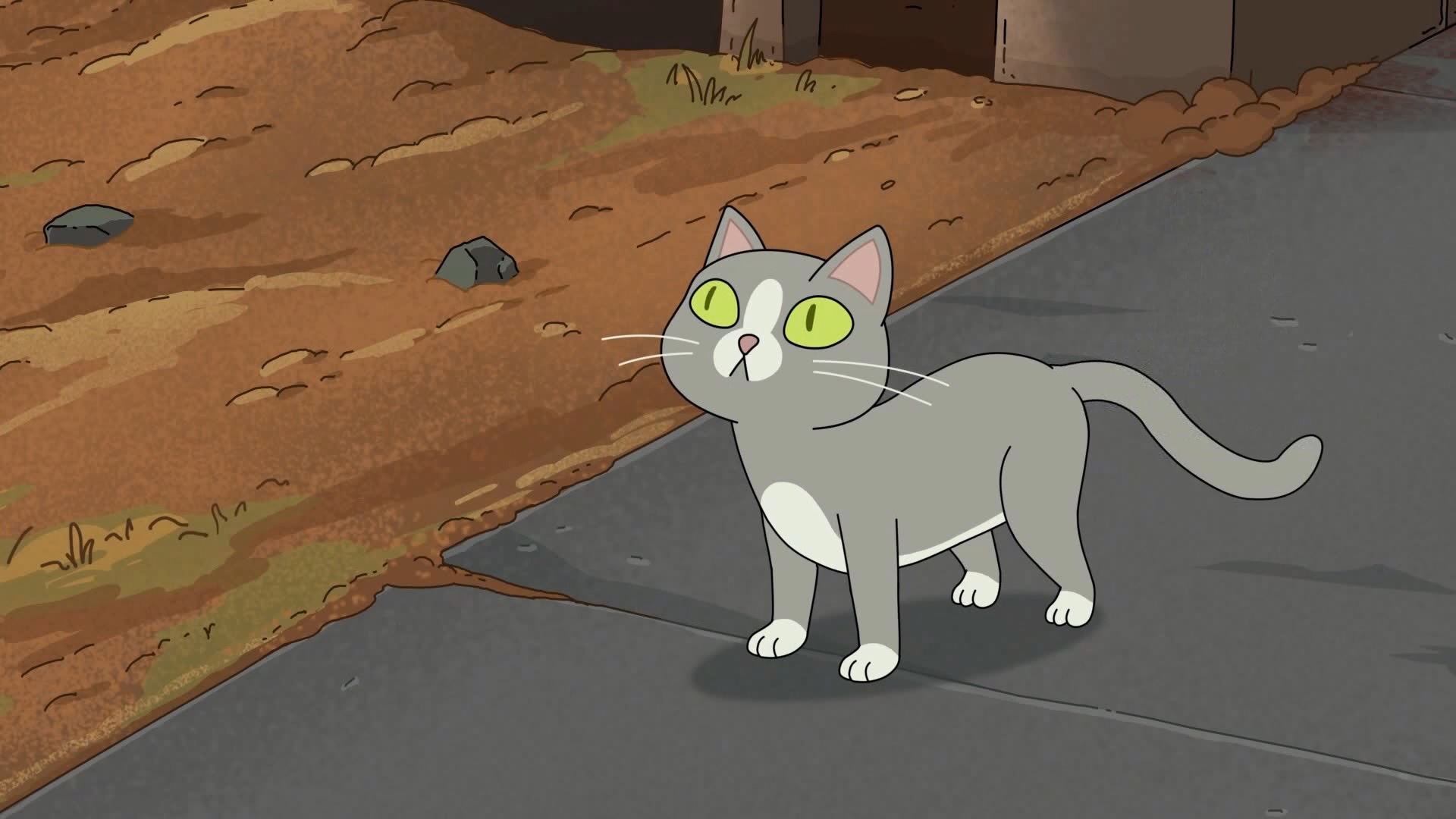
Season 4, Episode 4. "Claw and Hoarder: Special Ricktim's Mentology." Most people remember it for the uncomfortable dragon orgy, which, honestly, was a lot to take in. But the real curveball was the Rick and Morty talking cat. No explanation. No origin story. Just a cat that talks and a plotline that intentionally goes nowhere until it goes somewhere very, very dark.
It’s been years, and people still argue about it on Reddit. Why? Because Dan Harmon and Justin Roiland (back when he was still the voice of the show) pulled a fast move on the audience. They introduced a character that violated the fundamental rules of the show’s universe. Usually, Rick has an answer for everything. He knows the science. He knows the multiverse. But this cat? This cat broke Rick Sanchez.
The Rick and Morty Talking Cat: Why the Mystery is the Point
The cat shows up in Jerry’s bedroom. It’s voiced by Matthew Broderick, giving it this weirdly polite, slightly monotonous tone that makes everything it says feel suspicious. It wants to go to Florida. Why Florida? Because they don't ask questions there. They just party.
That’s the cat’s whole deal. "Don't ask questions. Just have fun."
In a show built on high-concept sci-fi and rigid (if chaotic) internal logic, a character demanding you stop asking questions is a meta-commentary. It's the writers poking the audience in the eye. You want a lore-heavy explanation for every background character? Too bad. Here is a cat that talks just because it does.
Jerry, being Jerry, eventually gets Rick involved. Rick is annoyed. He’s dismissive. But then he uses his tech to scan the cat’s mind. What they see isn't just "bad." It's psychologically scarring. Rick—a man who has witnessed the heat death of universes and committed casual genocide—is physically repulsed. He almost kills himself. He wipes Jerry’s memory because the truth is too much for a human mind to handle.
Breaking Down the Florida Obsession
The cat’s obsession with Florida serves a dual purpose. On the surface, it’s a joke about Florida being a lawless wasteland where no one cares about your past. It’s the perfect place for a talking cat to blend in. But deeper than that, Florida represents the "mindless entertainment" the show often mocks.
Think about it.
The cat is a distraction. It's a B-plot that has zero impact on the dragon-focused A-plot until the very end. By the time Rick and Jerry confront it on the beach, the audience is expecting a payoff. We’ve been trained by years of prestige TV to expect a reveal. Maybe it’s an alien? Maybe it’s a demon from another dimension?
Nope.
The writers chose to show us the reaction to the truth rather than the truth itself. This is a classic Lovecraftian trope. The "Eldritch Abomination" is only scary because we can't see it. Our imagination fills in the gaps with something far worse than any animator could draw. By showing Rick's genuine horror, the show elevates the talking cat from a gag to a legitimate monster.
What Was Really in the Cat’s Brain?
Theories are everywhere. Some fans suggest the cat is a manifestation of "The Truth," a concept explored in other sci-fi media where knowing the nature of reality leads to madness. Others think the cat committed some kind of intergalactic war crime or represented a level of cruelty that even Rick finds distasteful.
Writer Jeff Loveness actually spoke about this. He mentioned that the inspiration came from films like Event Horizon or the works of Clive Barker. The idea was to create something that shouldn't be explained because any explanation would be disappointing.
If it were a robot? Boring.
If it were a soul-sucking demon? Predictable.
By keeping the "Rick and Morty talking cat" footage off-screen, it remains the most disturbing thing in the series. We hear the screams. We see the shadows of what look like human faces or tortured figures on the scanner's reflection. It’s enough to suggest something visceral and wrong.
The Meta-Narrative of Dan Harmon’s Writing
Dan Harmon is famous for his "Story Circle." Every episode usually follows a strict path of a character entering a new world, adapting, paying a price, and returning changed. The cat subverts this. Jerry doesn't return changed—he returns with his memory wiped. He is reset to zero.
This reflects a frustration often voiced by the writing staff regarding fans who over-analyze every frame. Sometimes, a talking cat is just a talking cat. Or, more accurately, sometimes the mystery is more valuable than the answer. The cat literally tells Jerry, "You're overthinking it." That is the writers talking directly to the fans who spend four hours a day on YouTube breakdown channels.
Honestly, it's kind of brilliant. It’s a troll.
How the Cat Changed the Show's Stakes
Before the Rick and Morty talking cat, we assumed Rick was the ultimate authority on "darkness." We saw him lose Unity. We saw him try to end it all in the garage. We thought we knew his limit.
This episode shifted the goalposts.
It established that there are things in the multiverse—or perhaps outside of it—that are too grim even for Rick C-137. It added a layer of cosmic horror to the show that hadn't been fully explored. It wasn't just "science gone wrong" or "aliens are jerks." It was "there are fundamental horrors in existence that logic cannot fix."
- The Reaction: Rick’s immediate instinct is to kill the cat.
- The Mercy: He lets it go, which is rare for him.
- The Trauma: He has to shield Jerry.
This shows a rare moment of Rick's "humanity," or at least his protective instinct toward his son-in-law. He knows Jerry’s simple mind would simply shatter. It’s one of the few times Rick acts as a buffer between the universe’s cruelty and his family, rather than being the source of that cruelty.
Key Takeaways from the Episode
If you're looking for the "answer," you're looking for the wrong thing. The value of this specific plotline is in its refusal to provide closure. Here is what we actually know for a fact:
- The cat is not from Earth.
- It possesses a history or a nature that is visually and audibly horrific.
- It has an almost supernatural ability to manipulate people into "not asking questions."
- Rick Sanchez considers its existence a "bad thing" that he doesn't want to deal with.
Most of the time, Rick wants to study things. He wants to bottle them or weaponize them. With the cat, he just wants it gone. That speaks volumes.
Moving Forward: Why We Won't See the Cat Again
Don’t expect a comeback. The talking cat served its purpose. It was a one-off experiment in tone and meta-commentary. Bringing it back would require explaining it, and explaining it would ruin the joke. The Rick and Morty talking cat works because it is a closed loop of nonsense and terror.
The show has moved on to bigger arcs—Rick’s rivalry with "Prime Rick," the collapse of the Citadel, and the evolution of Morty’s independence. A cat that wants to go to Florida is small potatoes compared to the "Omega Weapon." But in terms of pure, unsettling vibes, the cat remains the champion of the series.
Actionable Insights for Fans and Creators
If you’re a writer or a storyteller, there’s a massive lesson here: The Unseen is Always Scarier. When you define a monster, you give it limits. You give it a height, a weight, and a weakness. When you leave a monster in the "off-screen" space—like the cat’s past—it becomes infinite. It becomes whatever the viewer fears most.
For fans, the lesson is simpler: stop looking for the "Grand Unified Theory" of every background character. Some things are just there to make you feel uncomfortable.
Next Steps for Your Rewatch:
Go back and watch the episode, but pay attention to the audio during the "reveal" scene. The sound design is where the real clues are. You can hear the faint sounds of a crowd, perhaps a stadium, and something that sounds like metallic grinding. It’s much more specific than just "screaming."
Also, look at Rick’s face. Usually, when Rick is scared, he’s frantic. Here, he’s disgusted. There’s a difference. Disgust implies a moral or existential revulsion that goes beyond mere physical danger.
If you want to dive deeper into the inspirations, look up the "Short Story of the Year" tropes or the concept of the "Noodle Incident"—a trope where a past event is alluded to but never explained, making it more memorable than any actual flashback could be. The Rick and Morty talking cat is the ultimate "Noodle Incident." It’s a masterclass in leaving the audience wanting more while simultaneously making them glad they didn't get it.