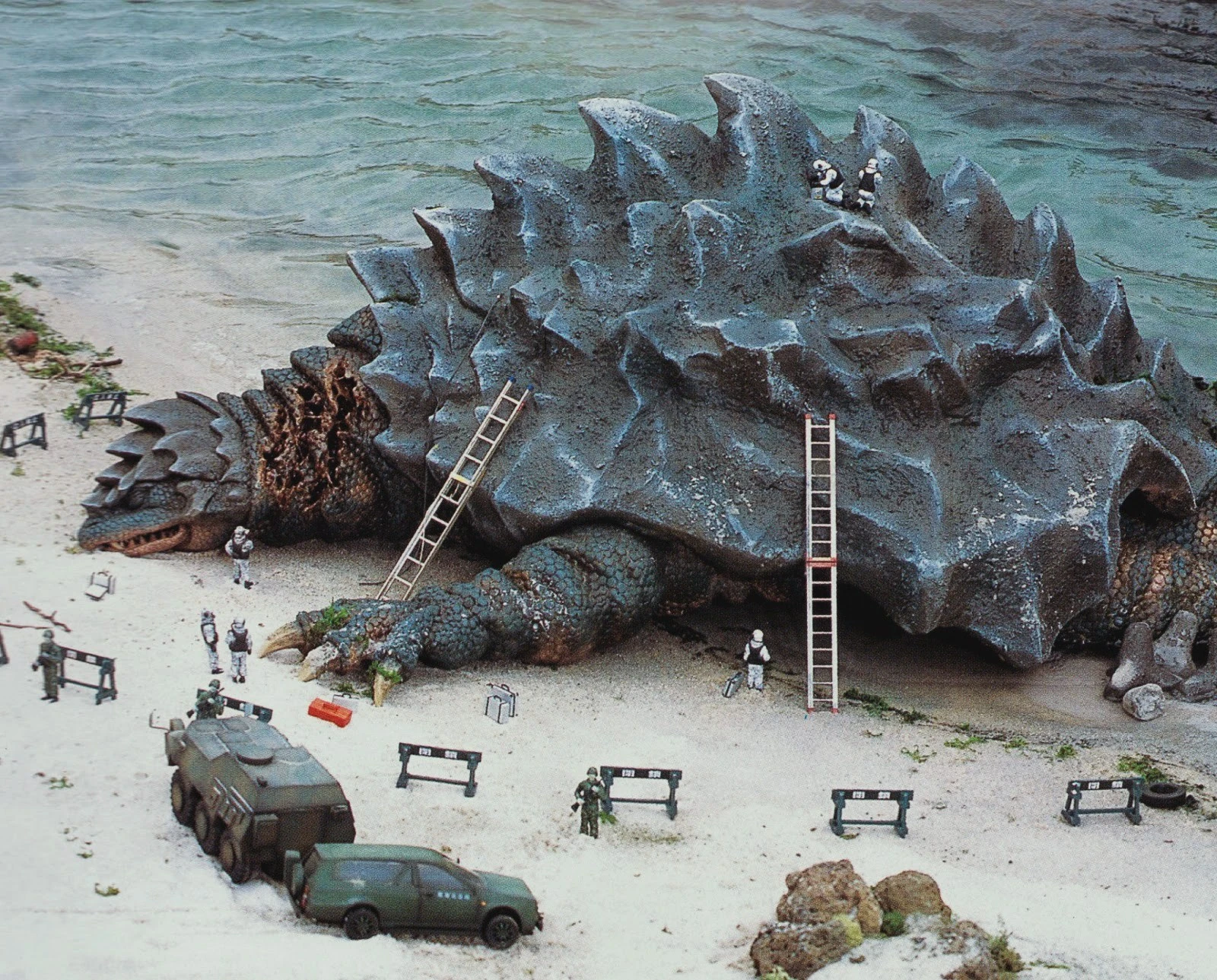
So, the hero finally won. The city is a wreck, the dust is settling, and right in the middle of downtown sits several thousand tons of rotting, radioactive, or chemically volatile meat. Everyone cheers when the monster falls, but nobody thinks about the smell. Or the flies. Honestly, the logistical nightmare of what to do with a dead kaiju is usually more expensive than the actual battle.
If you look at the history of giant monster cinema—from the 1954 Godzilla to the more modern "Monsterverse" or the gritty realism of Shin Godzilla—the aftermath is rarely just about rebuilding skyscrapers. It’s about hazardous waste management on a scale the EPA isn't remotely prepared for.
Think about a beached whale. When a whale dies on a beach, the internal gases build up until it literally explodes, showering onlookers in blubber. Now, scale that up to the size of a football stadium. You aren't just looking at a carcass; you're looking at a biological ticking time bomb that could level three city blocks just by decomposing.
The Immediate Biological Threat: Rot, Radiation, and Parasites
The very first problem with a dead kaiju is the blood. In Pacific Rim, we see "Kaiju Blue," a substance so toxic it contaminates the soil and makes the air unbreathable. This isn't just a movie trope. If a creature of that mass has a metabolism capable of supporting its own weight, its blood chemistry is likely incredibly acidic or pressurized.
Once the heart stops, that blood begins to pool.
If you're dealing with something like Godzilla, you also have the radiation issue. In the 2016 film Shin Godzilla, the Japanese government has to treat the remains as a nuclear meltdown site. You can't just bring in a bulldozer. You need lead-lined containment, cooling systems, and a literal army of scientists.
Then there are the parasites. Real-world biology tells us that every large organism is an ecosystem. Deep-sea whales have bone-eating worms. A kaiju likely has "macro-parasites"—creatures the size of dogs or ponies that lived in its scales. When the host dies, these things get hungry. They leave the body. They enter the subway tunnels. Suddenly, the "dead" monster is spawning a secondary infestation that’s arguably harder to catch than the big guy was.
Who Actually Cleans This Up?
In most fictional universes, this falls to a specialized government agency. In the Monsterverse, it’s Monarch. In the Godzilla films of the 70s and 80s, it’s usually the JSDF. But let's get real about the business side of it.
The Privatization of Kaiju Disposal
The 2024 anime Kaiju No. 8 actually gives us the most realistic look at this. It features professional disposal crews. They don't wear capes; they wear hazmat suits and carry chainsaws.
It’s basically industrial butchery. You have to break the body down into manageable chunks. If you leave a 20,000-ton leg sitting in the sun, the stench alone will depopulate a city faster than the monster did. You need heavy-duty cranes, diamond-tipped saws to get through reinforced bone, and a fleet of barges to carry the pieces out to sea or to specialized incineration plants.
The cost? Trillions.
Scientific Salvage and Corporate Greed
Usually, the body doesn't just get thrown away. Every piece of a dead kaiju is a goldmine for biotech companies. We see this in Pacific Rim with the character Hannibal Chau, who runs a black market for kaiju organs.
- Bone Powder: Marketed as a folk medicine or high-strength construction material.
- Brain Tissue: Used for neural-syncing research.
- Skin/Hide: Potential for biological armor or extreme-environment clothing.
There is a massive conflict of interest here. If a dead kaiju is worth more than its weight in gold, do governments actually want them to stop appearing? It’s a dark thought, but "disaster capitalism" thrives on this kind of cleanup.
The Mechanical Approach: Can You Just Blow It Up?
Basically, no. Never do this.
In 1970, authorities in Florence, Oregon, tried to blow up a dead sperm whale with a half-ton of dynamite. They thought it would disintegrate. Instead, it sent massive chunks of rotting blubber raining down on bystanders and crushing cars.
Now imagine doing that with something that has radioactive properties or toxic spores.
If you use explosives on a kaiju, you are just turning a localized problem into an atmospheric one. You’re aerosolizing the toxins. The best way to handle what to do with a dead kaiju is slow, methodical containment. You freeze it. In Shin Godzilla, they use a coagulant to freeze the creature’s blood flow, essentially turning it into a giant, unmoving statue. This allows the city to be rebuilt around the monster while scientists slowly chip away at it over decades.
Ecological Impact and the "Whalefall" Effect
When a whale dies and sinks to the bottom of the ocean, it creates a "whalefall." This is a localized surge in life where entire new species thrive on the carcass for up to a hundred years.
A dead kaiju on land would do something similar, but it wouldn't be pretty.
The soil pH would change. Local flora would likely mutate or die off. You might see a "Godzilla Forest" spring up, where the plants have adapted to the high radiation levels. It’s an ecological terraforming event. This is why "leaving it where it lies" is never an option. The corpse becomes its own biome, and usually, that biome isn't friendly to humans.
Actionable Steps for Post-Monster Management
If you find yourself in a scenario where a giant entity has been neutralized in your zip code, there are actual logistical protocols that would likely be followed based on current hazardous material and urban recovery standards.
- Evacuation Zone Maintenance: Do not return to your home just because the fighting stopped. The off-gassing phase of decomposition is the most dangerous.
- Water Supply Verification: Kaiju fluids leach into the groundwater almost immediately. Ensure the local municipal supply has been cleared of "biologicals."
- Legal Claims: If you’re a business owner, the "Act of God" clause in your insurance is going to be your biggest hurdle. Kaiju attacks are often legally classified as "unforeseeable atmospheric or biological events," which can leave you high and dry.
- Secondary Infestation Monitoring: Keep an eye out for "scavenger" species. If the monster had ticks the size of hubcaps, they are looking for a new host.
The reality is that killing the monster is the easy part. The real work starts when the cameras stop rolling and the heavy machinery moves in. Managing a dead kaiju is a multi-generational project that blends nuclear physics, industrial butchery, and high-stakes environmental law. It’s dirty, it’s dangerous, and it’s a job nobody wants but everyone has to pay for.
The best-case scenario? The monster falls in the deep ocean. Out of sight, out of mind, and let the bone-eating worms handle the rest. But if it falls on Broadway? You’ve got a hundred-year cleanup on your hands.