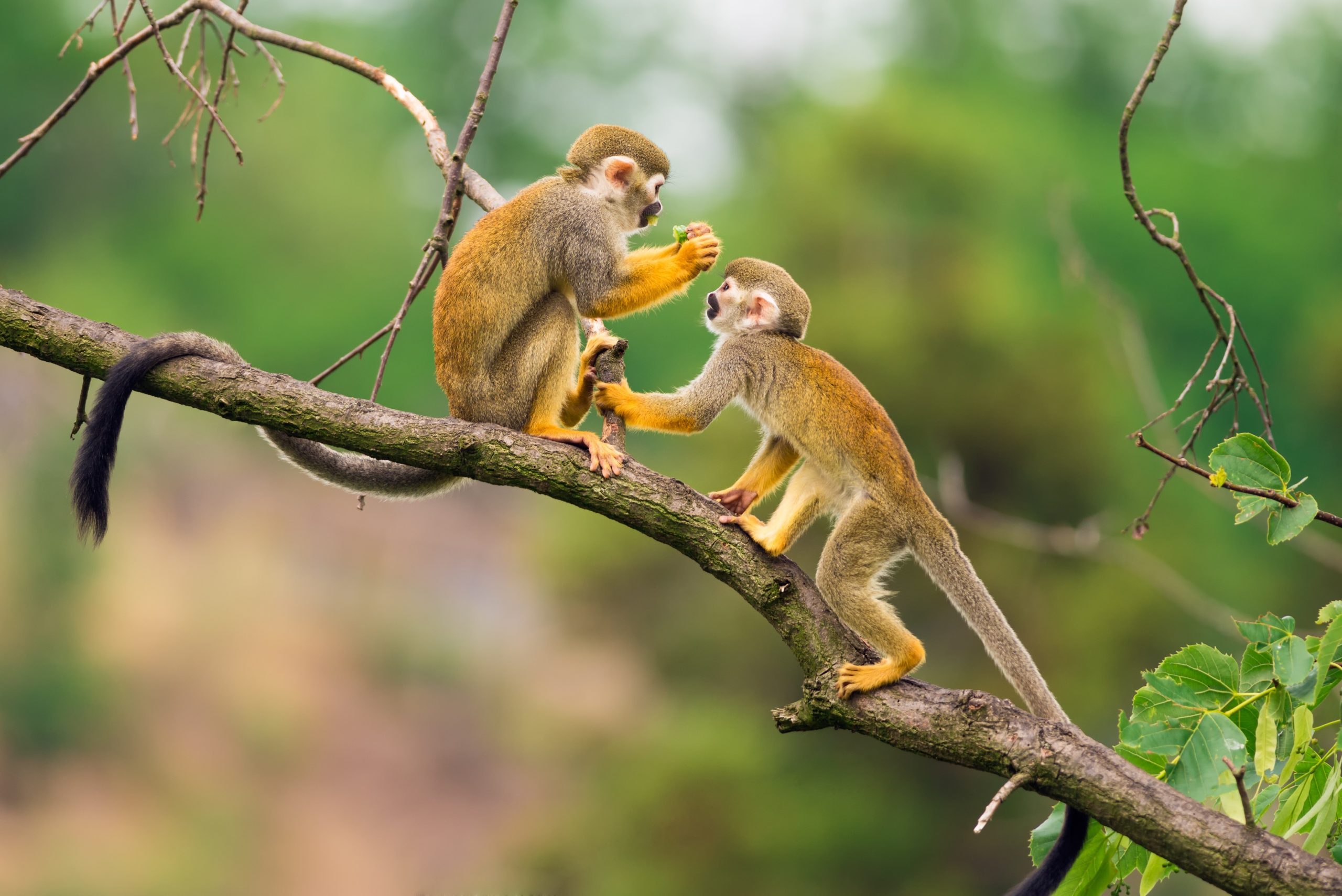
Most people think they know what a monkey is until they see a lemur or a chimpanzee and get the terminology all tangled up. It happens. You’re at the zoo, you see something swinging by its tail, and you call it a monkey. Then a kid corrects you because it’s actually an ape. Or a prosimian. It's kinda confusing, honestly. When you ask what types of monkeys are there, you aren’t just asking for a list of names. You’re asking about a massive evolutionary split that happened millions of years ago, dividing the "monkey" world into two very distinct camps: the New World and the Old World.
Biology isn't always neat. Primatologists like Russell Mittermeier have spent decades mapping these creatures, and the deeper you look, the more specific it gets. We aren't just talking about "brown ones" and "small ones." We’re talking about animals with waterproof fur, others with "suitcases" in their cheeks, and some that literally have a fifth limb.
The Big Split: Old World vs. New World
The easiest way to start answering what types of monkeys are there is to look at where they live. Geography is the great divider here. If it’s from Central or South America, it’s a New World monkey (Platyrrhini). If it’s from Africa or Asia, it’s an Old World monkey (Cercopithecidae).
It’s not just about the map, though.
Look at the nose. No, seriously. New World monkeys have flat noses with nostrils that point sideways. Old World monkeys have narrow noses where the nostrils point down. It’s a tiny detail, but it’s the gold standard for classification. Also, if you see a monkey hanging by its tail like a gymnast, it’s definitely a New Worlder. Old World monkeys can't do that. Their tails are for balance, not for gripping. They also have "sitting pads"—hard, calloused skin on their butts called ischial callosities—which let them sleep on thin branches without falling off. New World monkeys missed out on that evolutionary luxury.
The Acrobatics of New World Monkeys
These guys are the innovators of the canopy. Living in the lush rainforests of the Americas, they’ve adapted in some wild ways.
The Spider Monkey is the most famous example. They are basically four legs and a tail that acts like a hand. They don't even have thumbs. Evolution decided they didn't need them because thumbs get in the way when you're swinging through the trees at high speeds. Then you've got the Howler Monkeys. If you’ve ever been to Belize or Costa Rica at dawn, you know the sound. It’s a guttural, terrifying roar that can carry for three miles. It’s all thanks to an enlarged hyoid bone in their throat that acts like a resonator.
And we can't forget the tiny ones.
- Marmosets and Tamarins: These are the smallest of the bunch. The Pygmy Marmoset is basically the size of a stick of butter. They are weird because they usually give birth to twins, and the dads do most of the heavy lifting when it comes to childcare.
- Capuchins: These are the "organ grinder" monkeys. They are terrifyingly smart. In places like Brazil’s Serra da Capivara National Park, researchers have watched them use stone tools to crack nuts. They’ve been doing it for thousands of years, creating what some call a "non-human Stone Age."
The Gritty World of Old World Monkeys
Old World monkeys are often more terrestrial. They spend a lot of time on the ground, which means they’ve had to get tougher.
Baboons are the bruisers of this category. There are five main species, including the Chacma and the Olive baboon. They live in complex, often brutal social hierarchies. They don't have prehensile tails, but they have dog-like muzzles and huge canine teeth. Honestly, a male baboon is one of the most intimidating animals you’ll encounter in the African savannah.
Then there are the Macaoques. These are the most widely distributed primates after humans. You find them in the snowy mountains of Japan (the famous "Snow Monkeys" who bathe in hot springs) and in the middle of bustling cities in India. They are survivors. They have cheek pouches—literally built-in grocery bags—where they can stuff food quickly to eat later in a safer spot.
The Weird and the Wonderful
Nature loves a wildcard.
Take the Proboscis Monkey from Borneo. The males have these massive, pendulous noses that look like a mistake. But to a female Proboscis monkey, that nose is the peak of masculine beauty. It also helps amplify their warning calls. Or consider the Mandrill. Charles Darwin famously wrote that no other member of the whole class of mammals is colored in so extraordinary a manner as the adult male mandrill. With their bright blue and red faces, they look like they’ve been painted for a festival.
Why Apes Aren't Monkeys (And Why It Matters)
This is the hill most biologists will die on. When people ask what types of monkeys are there, they often include Chimpanzees, Gorillas, and Orangutans.
Stop. Those are apes.
The easiest way to tell? Look for a tail. If it doesn't have a tail, it’s almost certainly an ape (with a couple of rare, weird exceptions like the Barbary Macaque). Apes also have much larger brains relative to their body size and a different shoulder structure that allows them to swing through trees in a way most monkeys can't. While monkeys are our cousins, apes are our siblings. It’s a different branch of the family tree entirely.
The Conservation Crisis
We can't talk about these species without acknowledging that many are disappearing. The Tonkin Snub-nosed Monkey in Vietnam is down to just a few hundred individuals. Habitat loss from logging and the illegal pet trade are wrecking populations. When a forest is fragmented, monkey troops get isolated. They can’t find mates outside their small group, which leads to inbreeding and a slow slide toward extinction.
The Lion-tailed Macaque in India is another one on the brink. They live in the Western Ghats, a "biodiversity hotspot," but their home is being chopped up into tea and coffee plantations. Protecting these animals isn't just about "saving the monkeys." It’s about saving the ecosystems they manage. Monkeys are "gardeners of the forest." They eat fruit, travel miles, and poop out seeds, effectively planting the next generation of trees.
Actionable Steps for Primate Enthusiasts
If you’re interested in diving deeper into the world of primates, don't just watch viral videos. Viral clips of monkeys in clothes or "smiling" for the camera often hide a dark reality of animal abuse or the illegal pet trade.
- Support the Right Organizations: Groups like the International Primate Protection League (IPPL) or the Jane Goodall Institute work on the ground to protect habitats.
- Check Your Labels: Palm oil production is one of the biggest drivers of deforestation in Southeast Asia, home to dozens of macaque and langur species. Look for "RSPO Certified" palm oil to ensure your snacks aren't destroying a monkey's home.
- Visit Accredited Sanctuaries: If you want to see them in person, skip the roadside zoos. Look for facilities accredited by the Global Federation of Animal Sanctuaries (GFAS).
- Citizen Science: Use apps like iNaturalist. If you’re traveling and see a monkey, snap a photo and upload it. Scientists use this data to track species ranges and population health in real-time.
Understanding what types of monkeys are there is the first step toward appreciating the sheer complexity of our closest relatives. From the snow-covered peaks of Japan to the flooded forests of the Amazon, these animals have solved the problem of survival in a thousand different, fascinating ways. They are smart, social, and occasionally a little bit chaotic. Much like us.