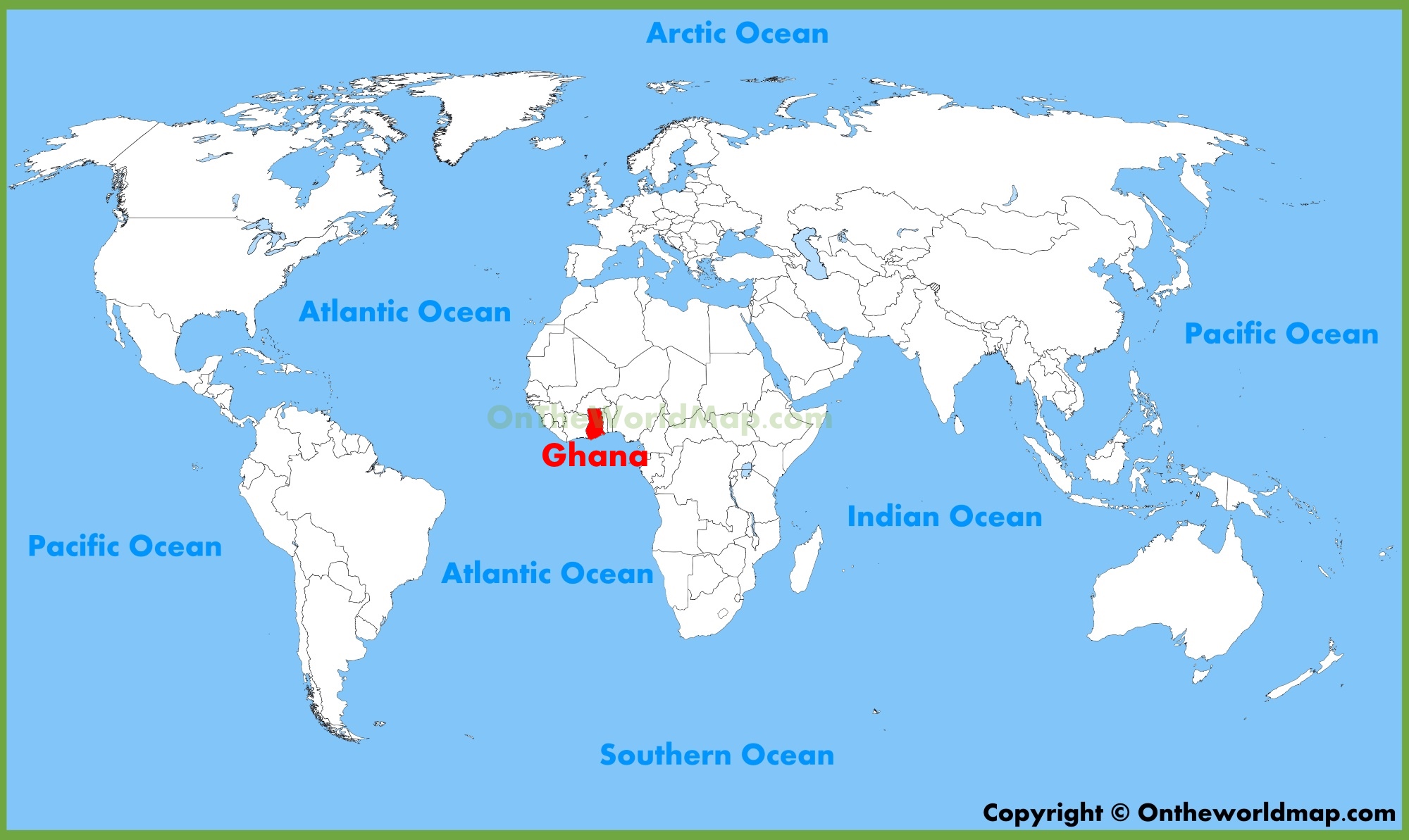
Ever looked at a map of Africa and felt like all the countries just start to blur together? Honestly, it’s understandable. But if you’re looking for where is ghana on the map, you’re actually looking for the center of the world. No, really.
Ghana is tucked into the "armpit" of West Africa. It sits right on the Gulf of Guinea, facing the Atlantic Ocean to the south. If you find the spot where the Equator and the Prime Meridian would cross if they were real lines drawn on the ocean floor, you're basically looking at Ghana's front porch.
The Mathematical "Center" of the Earth
Let’s get technical for a second, but only because it's kinda cool. Ghana is the closest landmark to the point where 0° latitude meets 0° longitude. That "Null Island" spot in the ocean is just a few hundred miles south of the Ghanaian coast.
Because of this, the Greenwich Meridian actually passes right through the city of Tema, which is just a short drive from the capital, Accra. You can literally stand in a spot where you are halfway between the east and the west of the entire planet. Not many places can claim that.
Who Are the Neighbors?
If you're trying to pin down where is ghana on the map relative to other countries, just remember the "French Sandwich." Ghana is a former British colony, but it is surrounded on three sides by French-speaking nations:
- To the West: Côte d'Ivoire (Ivory Coast).
- To the North: Burkina Faso.
- To the East: Togo.
- To the South: Nothing but the Atlantic Ocean.
It’s roughly the size of the United Kingdom or slightly smaller than the state of Oregon. But don't let the size fool you. It’s the eighth largest country in West Africa by landmass, and it’s packed with way more diversity than you’d expect for its footprint.
Landscapes You’ll Find on the Map
The geography changes pretty fast when you head north from the coast. Most people think of Ghana as just tropical rainforest, and while that's true for the middle belt, the map actually splits into a few distinct zones.
Down south, you’ve got the low plains. It’s sandy, palm-fringed, and humid. Then you hit the Ashanti Uplands, which is where most of the country's famous cocoa and timber come from. This is the lush, green heart of the nation.
As you keep going north, the trees start to thin out. You hit the Volta Basin, dominated by Lake Volta. If you look at a satellite map, you cannot miss this lake—it’s one of the largest man-made reservoirs in the world. It looks like a massive blue jagged tooth right in the middle of the country.
Finally, in the far north, it turns into savanna. This is the land of baobab trees and elephants. It’s drier, flatter, and can get incredibly hot, especially when the Harmattan winds blow down from the Sahara.
Major Pinpoints: Accra and Beyond
If you were to drop a pin on a digital map to find the life of the country, it would land on Accra. Located at approximately 5° 33' N and 0° 11' W, it’s the coastal capital and a massive hub for West African business.
But the map doesn't end there:
- Kumasi: Located in the central forest region, this is the historic seat of the Ashanti Kingdom. It’s the place to go if you want to see the legendary Kente weavers.
- Tamale: Way up north, acting as the gateway to the savanna and Mole National Park.
- Cape Coast: Home to those hauntingly beautiful (and tragic) white-washed slave castles that sit right on the edge of the surf.
Why Does Its Location Matter?
Location is destiny, right? Being on the coast made Ghana a major player in global trade for centuries—first with gold (it was literally called the Gold Coast), then the slave trade, and now as a powerhouse for cocoa and oil.
It’s also surprisingly stable. In a region that has seen its fair share of turmoil, Ghana is often called an "island of peace." Geographically, it’s lucky; it doesn’t deal with many major natural disasters like hurricanes or massive earthquakes, though the Accra area does sit on a fault line that occasionally gives the city a little rattle.
How to Find Ghana Fast
If you’re staring at a world map and want to find it in three seconds:
- Find Africa.
- Look for the big "bulge" on the left side.
- Follow the bottom of that bulge until you see the Gulf of Guinea.
- Look for the rectangular-ish country with a big blue lake (Lake Volta) inside it.
That’s it. You’ve found Ghana.
Actionable Insights for Travelers and Geographers
- Check the Seasons: Because it's so close to the Equator, Ghana doesn't have "summer" or "winter." It has wet and dry seasons. Visit between November and March if you want to avoid the heaviest rains.
- Coordinate Your Visit: If you’re a geography nerd, head to the Meridian Stone in Tema. It’s a literal marker of the Prime Meridian.
- Navigation Tip: Google Maps works decently well in the major cities, but once you head into the rural Volta or Northern regions, don't be surprised if "turn left at the big tree" is the most accurate direction you get from locals.
- Border Crossing: If you plan to cross into Togo or Côte d'Ivoire, make sure your yellow fever vaccination card is handy. Border guards check that before they even look at your passport.
Understanding where is ghana on the map is the first step to realizing why this country is often the first "introductory" country people visit when they want to experience Africa. It's accessible, it's central, and it’s right at the heart of the world's grid.