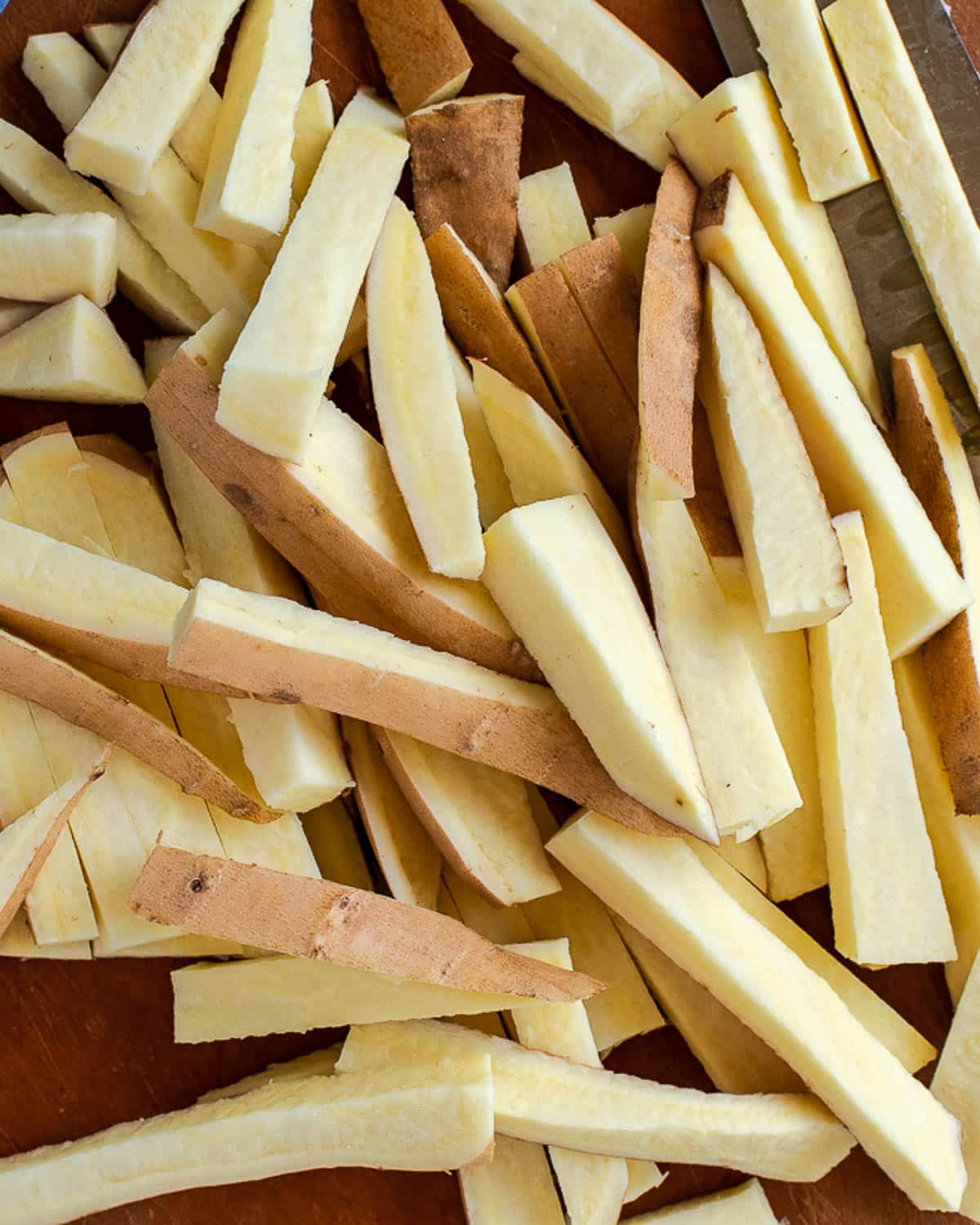
You’re standing in the produce aisle, staring at a bin of what looks like dusty, pale rocks. They aren't pretty. They lack that vibrant, neon-orange glow of the classic Garnet or Jewel varieties we all associate with Thanksgiving. But if you walk past them, you’re making a massive mistake. These are white sweet potatoes—specifically the O'Henry or the Hannah variety—and they make the best fries you will ever eat in your life. Period.
Most people don't even know they exist. Or, if they do, they assume they’re just "regular" potatoes in disguise. They aren't. They sit in this weird, perfect middle ground between a starchy Russet and a sugary sweet potato.
The Chemistry of the Crunch
Why do white sweet potato fries outperform the orange ones? It comes down to water content and starch structure. Orange sweet potatoes are "moist-fleshed." When you heat them, their high sugar content caramelizes quickly, but their high water content turns the inside to mush. You’ve been there. You pull a tray out of the oven, and they’re limp. Sad.
White sweet potatoes are different.
They are "dry-fleshed." They have a density that mimics a Burbank Russet but with a complex, nutty sweetness that develops as the starch breaks down. When you fry or bake these, the exterior dehydrates into a rigid, glass-like crust while the inside stays fluffy. It’s a textural miracle.
Honestly, the culinary world has been sleeping on the Hannah sweet potato for too long. While the USDA classifies dozens of varieties, the commercial market usually ignores the white-fleshed cultivars because they don't look "iconic." But if you ask a chef at a high-end bistro why their fries taste different, there’s a good chance they’re using a white-fleshed tuber.
Finding the Right Tuber
Not all pale potatoes are created equal. You have to be careful here because you might accidentally grab a Japanese Sweet Potato (Murasaki). Those have purple skin and white flesh. They are delicious—don't get me wrong—but they are incredibly starchy, almost like a chestnut. They’re great for roasting whole, but for fries? They can get a bit too "mealy."
For the perfect white sweet potato fries, you want the Hannah.
How to Spot a Hannah
- Skin: Light tan, relatively smooth, almost like a fingerling potato but much larger.
- Shape: Long and tapered.
- Flesh: Creamy white when raw, turning slightly yellow when cooked.
You might also see the O'Henry. It’s actually a natural mutation of the Beauregard (the standard orange one). It kept the shape but lost the beta-carotene. Because it lost that pigment, it gained a much more stable starch profile. It’s weird how nature works like that.
The Air Fryer vs. Deep Fryer Debate
Let’s get real. Everyone wants to talk about air frying because it’s "healthier." And yeah, it works. But if you want the gold standard, you have to talk about oil temperature.
If you're using an air fryer, the secret to white sweet potato fries is a light coating of cornstarch. Just a dusting. Because these potatoes have less moisture than orange ones, they don't need a 20-minute soak to remove surface starch, but a little extra help on the outside creates those jagged, crunchy bits that hold onto salt.
However, if you’re going for the authentic experience, you need a neutral oil with a high smoke point. Avocado oil is great if you’re feeling fancy; peanut oil is the industry standard for a reason. You want to fry them at 325°F for a "blanch" (cooking the inside) and then crank it to 375°F for the "finish" (shattering crispiness).
Most people mess this up by crowding the pan. If the temperature drops, the potato absorbs the oil. Then you’re just eating grease sticks. Don't do that.
Nutritional Reality Check
People buy sweet potatoes because they think they’re a "superfood." Is the white version just as good? Sorta.
You’re losing the massive hit of Vitamin A (beta-carotene) that gives the orange ones their color. That’s the trade-off. However, you’re still getting a significant amount of Vitamin C, potassium, and B6. According to the USDA FoodData Central, a medium sweet potato (regardless of color) packs about 4 grams of fiber.
The glycemic index is where things get interesting. Because white sweet potato fries are more fibrous and starchy than their orange cousins, they sometimes feel more satiating. They don't give you that immediate sugar spike followed by a crash. They’re a slow burn.
Why Your Fries Are Soggier Than They Should Be
If you've tried making these and ended up with a pile of limp tan sticks, you probably skipped the most important step: the dry-off.
Even though white sweet potatoes are "drier," they still release steam. If you take them out of the oil or the oven and immediately pile them into a bowl, that steam has nowhere to go. It hits the cold air, turns back into water, and ruins your crust.
Use a wire rack. Seriously.
Letting air circulate under the fries for just sixty seconds makes the difference between a "good" fry and a "restaurant-quality" fry.
The Flavor Profile
What do they actually taste like?
Imagine a traditional French fry. Now, add a hint of honey. Now, add a toasted almond finish. That’s the white sweet potato. It’s sophisticated. It doesn't need a mountain of sugar or cinnamon—in fact, putting cinnamon on these is a crime.
They pair incredibly well with savory, acidic dips.
- A sharp garlic aioli.
- Spicy sriracha mayo.
- Even a chimichurri.
The sweetness is subtle enough that it doesn't fight with savory flavors; it enhances them. It’s why you’re seeing these pop up more in "New American" gastropubs. They’re a blank canvas that actually has a personality.
Sourcing and Seasonality
You aren't going to find these at every corner bodega. Most chain grocery stores carry the orange ones year-round because they have a massive shelf life and a predictable supply chain.
To find the good stuff, you usually have to hit up a farmer's market in the fall or a specialty grocer like Whole Foods or Sprouts. They’re typically harvested in late summer and hit the bins in September through January.
When you buy them, look for "heavy" potatoes. If they feel light or have soft spots, the starch is already converting to simple sugars and the structure is breaking down. You want them rock hard.
A Better Way to Prep
Don't peel them.
The skin on a Hannah or O'Henry is incredibly thin. When you fry it, the skin becomes part of the crunch. It adds an earthy depth that you lose if you strip it away. Just scrub them with a stiff brush under cold water.
Cut them into "batonnet" style—about 1/4 inch thick. If you go too thin, like shoestrings, they can burn because of the natural sugars. If you go too thick, like steak fries, the middle might feel a bit too dense.
Making This Your New Standard
We’ve been conditioned to think "sweet potato = orange." It’s a marketing win for the North Carolina Sweet Potato Commission, but it’s a culinary loss for the rest of us.
Once you try white sweet potato fries, it’s really hard to go back. The texture is superior. The prep is easier because they hold their shape better. They don't turn into a sugary sludge in the oven.
If you want to master this at home, start simple.
Grab two large Hannah sweet potatoes. Slice them into even sticks. Toss them in a bowl with two tablespoons of oil and a heavy pinch of kosher salt. Arrange them on a baking sheet—make sure they aren't touching! Bake at 425°F for about 25 minutes, flipping them halfway through.
Watch them closely in the last five minutes. They go from "perfectly tan" to "burnt" faster than a regular potato because of that sugar content.
Your Actionable Cheat Sheet
- Identify: Look for tan skin and white flesh (Hannah or O’Henry).
- Prep: Wash, don't peel. Cut into 1/4-inch sticks.
- Coating: A tiny bit of cornstarch or arrowroot powder helps if baking.
- Spacing: Use two pans if you have to. Crowding is the enemy of crisp.
- Cooling: Use a wire rack to prevent steaming.
Forget the orange mush. Go find the ugly, pale potatoes in the corner of the bin. They are the secret to the best fries you’ll ever make in your own kitchen. You’ll know you got it right when you hear that distinct "snap" when you bite into the first one.
Next Steps for Your Kitchen:
Head to your local specialty grocer and specifically ask for Hannah Sweet Potatoes. If they don't have them, look for the Murasaki (purple skin), but remember to soak those for 30 minutes in cold water first to manage the higher starch levels. Once you have your tubers, skip the ketchup and whip up a quick dip using Greek yogurt, lemon juice, and minced garlic to complement the nutty sweetness of the fries.