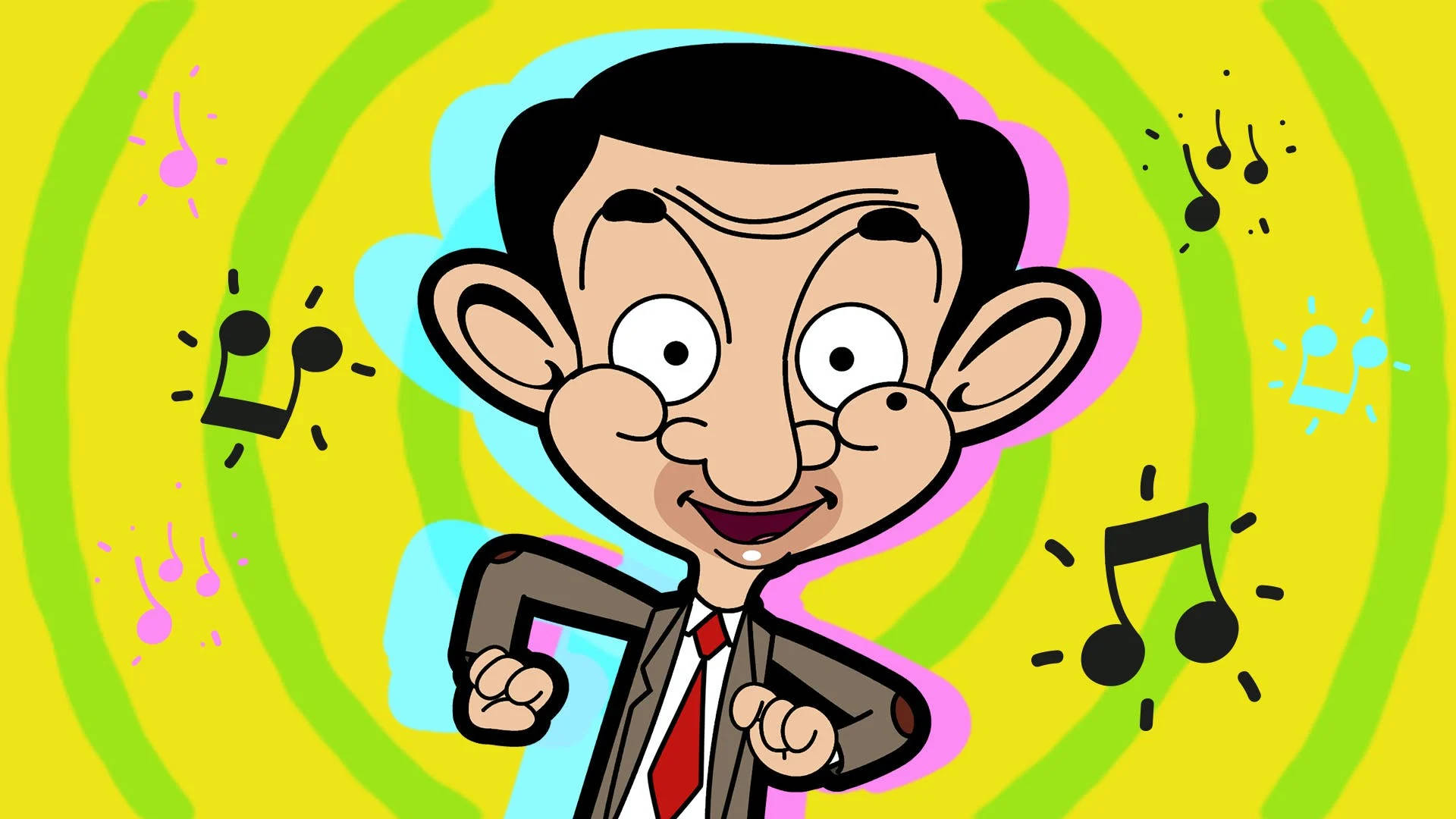
Rowan Atkinson didn't need a lot of people. That’s the first thing you realize when you look back at the original live-action run of the show. While modern sitcoms thrive on massive ensembles and "will-they-won't-they" dynamics between six different best friends, the characters in Mr Bean are almost non-existent. It’s a show about a man who is essentially an alien living in a London flat, and yet, the few people (and objects) who inhabit his world are etched into our collective memory.
Think about it. There are only 15 original live-action episodes. That’s it. In those episodes, we rarely see the same face twice, except for a silent bear and a very patient girlfriend. This lack of a supporting cast was actually a stroke of genius. It forced the comedy to be purely situational and physical. It made Bean the center of a very small, very strange universe.
The silent partner: Teddy
Honestly, if we’re talking about the most important characters in Mr Bean, we have to start with a stuffed animal. Teddy is Bean’s best friend. He’s a dark brown, knitted bear with button eyes and sausage-shaped limbs. But to Bean, he’s alive.
Teddy is often the victim of Bean’s unintentional cruelty. He’s been decapitated, used as a paint brush, and shrunk in the wash. Yet, Bean is fiercely protective of him. There’s a strange, almost touching complexity to their relationship. In "Merry Christmas, Mr. Bean," Bean gives Teddy a pair of drawing pins to use as "eyes" for Christmas. It’s weird. It’s slightly disturbing. But it’s also the most human we ever see the main character.
Teddy represents Bean’s internal monologue. Because Bean doesn’t talk much—limiting himself to grunts and the occasional mumble—his interactions with Teddy show us what he’s thinking. When he puts Teddy to bed or makes him "watch" television, we see a man who is desperately trying to navigate adulthood with the logic of a five-year-old.
Irma Gobb: The woman with infinite patience
Irma Gobb, played by the brilliant Matilda Ziegler, is the only recurring human character who actually has a name and a consistent presence. She’s "the girlfriend," though that term feels a bit loose. Irma appeared in only three of the original episodes: "The Curse of Mr. Bean," "Mr. Bean Goes to Town," and "Merry Christmas, Mr. Bean."
Poor Irma.
She represents the bridge between Bean’s chaotic world and reality. She wants a normal relationship. She wants to go to the cinema, hold hands, and get an engagement ring. Instead, she gets a man who falls asleep during a horror movie and buys her a literal picture frame—not the photo inside—for Christmas.
Ziegler’s performance is understated. She has to do a lot of heavy lifting with just her facial expressions. Watching her face go from hope to utter disappointment is the emotional core of the series. Most people forget that Irma actually left him. After the disastrous Christmas dinner where Bean fails to propose, she walks out. It’s a rare moment of genuine consequence in a show that usually resets every episode.
The Three-Wheeled Nemesis: The Reliant Regal
You can't discuss the characters in Mr Bean without mentioning the light blue Reliant Regal Supervan III. It’s not a person, obviously. But the show treats it like a recurring villain.
Every time Bean is driving his iconic lime-green Mini, he somehow manages to run this poor blue van off the road. It’s a running gag that never gets old. The van is tipped over, forced out of parking spaces, and generally bullied.
- The van’s registration is GRA 26X.
- It is a three-wheeled vehicle, which makes it notoriously unstable.
- It serves as the "straight man" to Bean’s Mini.
The rivalry is one-sided. The driver of the van is never actually seen in the original series, which adds to the comedy. It’s just a faceless victim of Bean’s reckless, selfish driving. It’s a piece of physical comedy gold because it requires zero dialogue to understand the joke. Bean hates that van, and we have no idea why.
The "Guest" Characters: One-off obstacles
Most of the characters in Mr Bean are just obstacles. They are the "normal" people who have the misfortune of crossing paths with him. These characters don't have names; they are defined by their roles: The Phobic Man at the swimming pool, The Waiter at the fancy restaurant, or The Queen of England (or at least, a very stressed-out lookalike).
One of the most famous encounters is with the "Man in the Park" played by Roger Lloyd-Pack (famous for playing Trigger in Only Fools and Horses). In the episode "The Curse of Mr. Bean," Lloyd-Pack plays a man trying to eat his lunch while Bean attempts to make a sandwich next to him using a credit card to spread butter and his socks to dry lettuce.
The brilliance of these one-off characters lies in their reaction. They aren't "wacky." They are grounded. They react the way you or I would—with confusion, slight disgust, and eventually, a desire to get as far away as possible. This grounding is what makes Bean's behavior so funny. If everyone in the show were crazy, Bean wouldn't be special. He needs the "normals" to bounce off of.
The Animated Series Expansion
When the show transitioned to the animated series in 2002, the roster of characters in Mr Bean expanded significantly. This was a necessity. You can’t sustain a long-running cartoon with only one person and a bear.
Mrs. Wicket
The landlady. She is a formidable, grumpy woman who owns the flat Bean lives in. She’s often accompanied by her evil cat, Scrapper. Mrs. Wicket adds a layer of conflict that the original series lacked. In the live-action show, Bean seemed to exist in a vacuum. In the cartoon, he has someone to answer to. She represents authority, and Bean, as usual, is the rebellious child trying to avoid getting in trouble.
Scrapper
Every hero needs a foil, and in the animated world, Scrapper is it. He’s a one-eyed, ginger cat who hates Bean and Teddy. The dynamic here is classic slapstick—think Tom and Jerry but with more British awkwardness.
The Bruisers
These are the neighbors from hell. They are a large, boisterous family that serves as a direct contrast to Bean’s solitary, quiet life. They are loud, they are messy, and they drive Bean absolutely insane.
Why the lack of characters works
There is a psychological reason why the limited number of characters in Mr Bean helped the show go global. By stripping away dialogue and a complex supporting cast, the creators made the show universal. You don't need to understand British culture or the English language to understand a man trying to change into swimming trunks without taking off his trousers.
The secondary characters are just props in Bean's world. They represent the rules of society—queuing, etiquette, politeness—that Bean constantly breaks. Whether it’s the man at the bus stop or the ticket inspector on a train, these characters exist to show us where the boundaries are, right before Bean steps over them.
Real-world impact and E-E-A-T
According to various interviews with Rowan Atkinson and lead writer Richard Curtis, the character of Mr. Bean was inspired by Monsieur Hulot, created by French comedian Jacques Tati. Like Hulot, Bean is a man of few words who finds himself at odds with the modern world.
The decision to keep the cast small was intentional. Atkinson has often described Bean as "a child in a man's body." Children don't usually have deep, complex social circles; they have their toys, their immediate caregivers, and a world of strangers they don't quite understand. By focusing almost entirely on Bean, the show maintains this childlike perspective.
Critics like those at the British Film Institute (BFI) have noted that the "loneliness" of the character is what makes him both funny and slightly tragic. He is the ultimate outsider. If he had a group of friends like the cast of Friends or Seinfeld, the magic would be lost. He has to be alone for the comedy to function.
What you can learn from Bean's social world
If you're a fan or a student of comedy, there are a few "actionable" takeaways from how these characters are structured:
- Economy of Characters: You don't need a huge cast to tell a great story. Sometimes, one person and a silent object (Teddy) are enough to build a world.
- The Power of the Reaction: The "straight man" is just as important as the comedian. The horror on Irma Gobb's face is what makes Bean's actions funny.
- Universal Archetypes: By using recognizable types (the grumpy landlady, the rival driver, the patient girlfriend), you can communicate across language barriers.
If you want to dive deeper into the world of Mr. Bean, the best next step isn't just re-watching the episodes. Watch the 1997 film Bean: The Ultimate Disaster Movie. It introduces a whole new set of characters, like the Langley family in California, and shows how the character reacts when he’s forced into a much larger, more talkative social environment. It’s a fascinating experiment in taking a "silent" character and putting him in a "loud" world.
Alternatively, look up the sketches from the 2012 London Olympics opening ceremony. It shows how Bean—and his antagonistic relationship with everyone else on stage—remains one of Britain’s most successful cultural exports. He doesn't need a script. He just needs someone to look at him with a confused expression.
Ultimately, the characters in Mr. Bean serve a single purpose: to be the anvil upon which Bean strikes his comedic hammer. They are the "normal" world, and he is the glitch in the system.