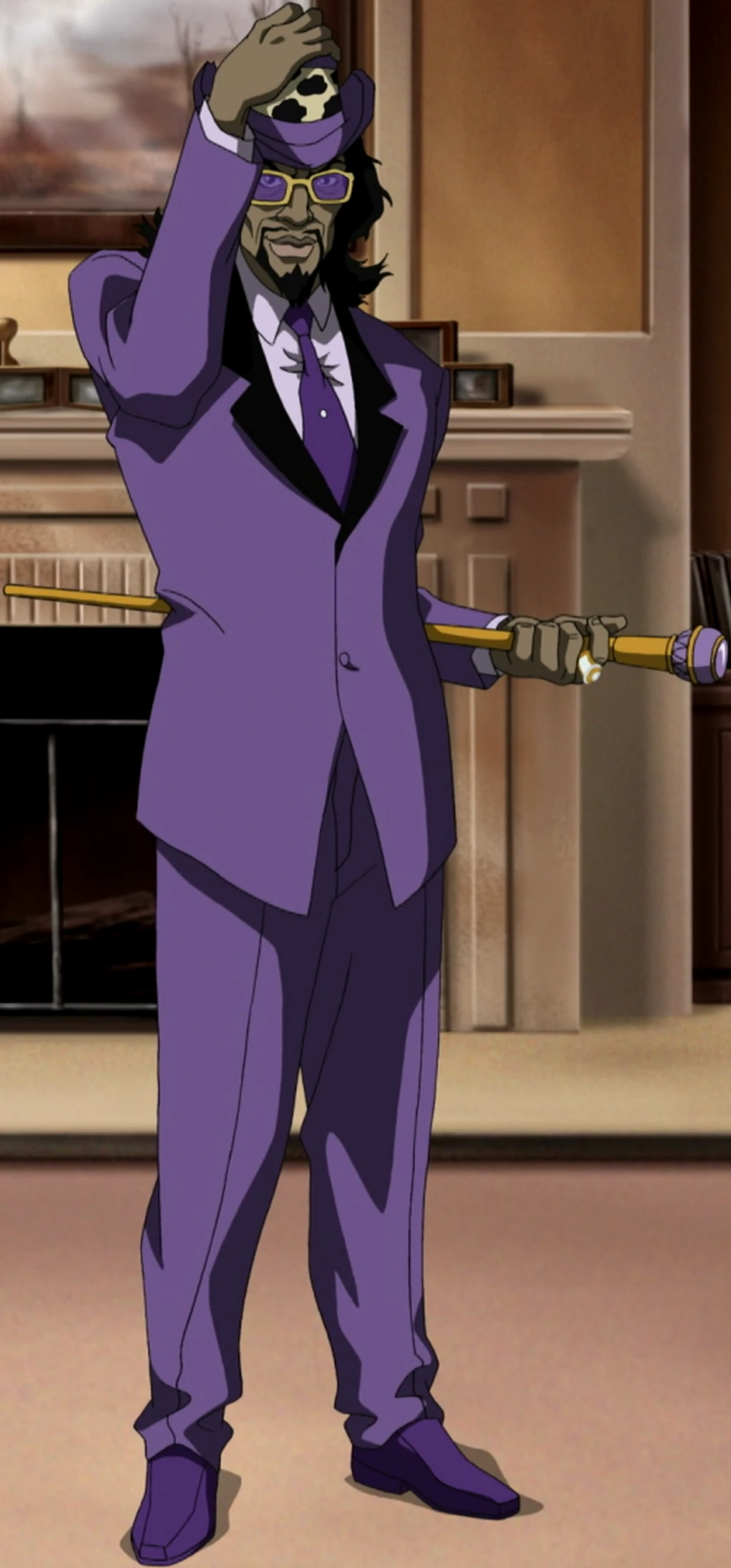
He isn't just a caricature. When you first see A Pimp Named Slickback slide onto the screen in The Boondocks, usually accompanied by a dramatic, soulful orchestral sting, it's easy to laugh and move on. He’s loud. He wears purple. He has a perm that defies the laws of physics. But if you actually sit down and watch the way Aaron McGruder wrote this character, you start to realize he’s functioning as a bizarre, pimp-styled philosopher.
Most people get him wrong. They think he’s just a one-note joke about pimp culture.
Honestly, he's the show's most consistent voice of "uncomfortable truth." While Huey Freeman represents the radical intellectual and Riley represents the misguided youth, Slickback represents a very specific, hyper-capitalist obsession with branding and identity. He is a man who literally cannot function if you don't say his full name. Every time.
It’s Like Tribe Called Quest
You have to say the whole thing. "Yes, the whole thing." It’s one of the most famous bits in Adult Swim history. When Tom Dubois tries to call him "Slickback," the immediate correction isn't just a gag—it’s a commentary on respect and the construction of a persona.
Think about it.
In a world where everyone is trying to fit in, A Pimp Named Slickback demands the world bend to his specific, albeit ridiculous, nomenclature. Katt Williams, who voiced the character, brought a frantic, high-pitched sincerity to the role that made the absurdity feel grounded. If Katt hadn't voiced him, the character probably would have fallen flat. Williams used his own stand-up energy to turn a guest character into a cultural mainstay.
The Psychology of the "Pimp Slap"
There is a specific episode, "Guess Hoe's Coming to Dinner," where we really see the "Slickback" philosophy in action. He isn't just there to be a criminal. He acts as a mirror to the Freeman family's own dysfunction.
Is he a "bad" guy?
By any traditional moral metric, absolutely. He’s a pimp. But in the universe of The Boondocks, where everyone is a little bit compromised, Slickback is the only one who is 100% honest about what he is. He doesn't pretend to be a pillar of the community. He doesn't hide his motives. There’s a weird kind of integrity in his total lack of traditional integrity.
McGruder used him to satirize the way society gravitates toward charismatic toxicity. We know he's "bad," yet we can't stop watching. It’s the same reason people watched Tiger King or follow certain controversial influencers today. Charisma masks a lot of sins.
Why the Name Matters So Much
Language is power.
By demanding the full title—A Pimp Named Slickback—he is forcing people to acknowledge his profession and his identity simultaneously. You can't talk to him without acknowledging he is a pimp. It’s a power move. It’s a way of reclaiming a slur or a stigmatized identity and making it a prerequisite for conversation.
If you look at the scripts, the repetition of the name creates a rhythmic, almost hypnotic effect. It breaks the flow of normal dialogue. It forces the other characters (and the audience) to stop and recognize his presence.
He’s the antithesis of the "invisible man."
The Katt Williams Factor
We have to talk about the voice acting. Katt Williams wasn't just reading lines. He was ad-libbing and infusing the character with a specific type of "pimp logic" that he’d explored in his comedy specials like The Pimp Chronicles Pt. 1.
There’s a legendary story among the show's production crew about the recording sessions. Williams would show up in character—not literally, but the energy was there. He understood that Slickback wasn't just a guy who sold sex; he was a guy who sold belief. He sold the idea that he was the coolest person in the room.
The character's design, with the silk shirts and the perfectly laid hair, was a collaboration between McGruder’s vision of satirical Black Americana and Williams’ specific brand of street-smart flamboyantism. It shouldn't work. It should be too much. But somehow, it’s perfect.
Satire vs. Glorification
Does The Boondocks glorify the lifestyle?
Not really.
If you watch how Slickback is treated by Huey, it’s clear he’s a ridiculous figure. Huey barely tolerates him. Granddad is terrified/impressed by him. The comedy comes from the friction between Slickback’s "heightened reality" and the "depressing reality" of the Freeman's suburban life in Woodcrest.
The show uses him to poke fun at the "pimp aesthetic" that became mainstream in the early 2000s. Remember when Snoop Dogg was doing the pimp persona? Or when "P.I.M.P." by 50 Cent was the biggest song in the world? Slickback was a response to that. He was a way for McGruder to say, "Look how absurd this actually is when you put it in a cul-de-sac."
The Enduring Legacy of the "Prayer"
"Lord, please pray for the soul of this bitch..."
The "Pimp's Prayer" is perhaps the most quoted, memed, and remixed moment in the entire series. It’s blasphemous, hilarious, and deeply cynical. It encapsulates the character's entire worldview: using the structures of "good" (religion, prayer, community) to serve "bad" (pimping, manipulation).
It’s a masterclass in subversion.
People still use clips of that prayer in TikToks and Reels today, often without even knowing the full context of the show. That’s the mark of a character that has transcended its medium. He’s no longer just a cartoon character; he’s a shorthand for a specific type of confident, colorful absurdity.
What We Can Actually Learn
If we strip away the purple suit and the "slap-happy" antics, what's left?
A lesson in branding.
Seriously. A Pimp Named Slickback is a case study in consistent brand identity. He never breaks character. He never lets someone shorten his name. He has a specific "uniform." He has a clear mission statement (however questionable it may be).
In a digital age where everyone is trying to "build a personal brand," Slickback is an accidental pioneer. He understood that in a crowded room, the person with the most defined identity wins. Even if that identity is "A Pimp Named Slickback."
Real-World Impact and Controversy
Of course, the character isn't without his critics. Over the years, some have argued that Slickback leans too heavily into negative stereotypes. They argue that even as satire, the character reinforces harmful tropes about Black masculinity and the exploitation of women.
It’s a fair point.
However, supporters of the show argue that The Boondocks is an "equal opportunity offender." The show mocks everyone—white liberals, Black radicals, corporate executives, and street hustlers. To remove Slickback would be to sanitize a show that was never meant to be clean. He exists to make you uncomfortable. If you aren't at least a little bit bothered by him, you might be missing the point.
The nuance lies in the fact that he's never the "hero." He's a chaotic neutral force that blows into a situation, wreaks havoc, and leaves.
Actionable Insights for Fans and Creators
If you’re a writer, a creator, or just someone who loves deep-diving into character studies, there are a few things to take away from the Slickback phenomenon:
- Commit to the Bit: The reason the name gag works is because the show never lets it go. Consistency is the key to comedy.
- Contrast is King: Putting a flamboyant pimp in a boring, grey suburb is an automatic source of conflict and humor. Always look for the "fish out of water" angle.
- Voice Matters: Imagine Slickback with a deep, gravelly voice. It wouldn't be funny. The high-pitched, fast-talking energy of Katt Williams is 50% of the character's DNA.
- Satire Needs a Target: Slickback isn't just making fun of pimps; he's making fun of the people who are fascinated by them.
Moving Forward with the Slickback Legacy
As we look back at the legacy of The Boondocks, especially with rumors of reboots or spiritual successors always floating around, A Pimp Named Slickback remains the litmus test for the show's edge. You can't have The Boondocks without that level of unapologetic, sharp-tongued satire.
He is a reminder of a time when television was willing to be deeply, wildly incorrect in order to make a larger point about culture.
To understand him, you have to look past the perm. You have to look at the way he challenges every character he meets to define themselves. In his own twisted way, he’s asking the Freemans—and us—who we really are when the costumes come off.
Just make sure you say the whole name when you answer.