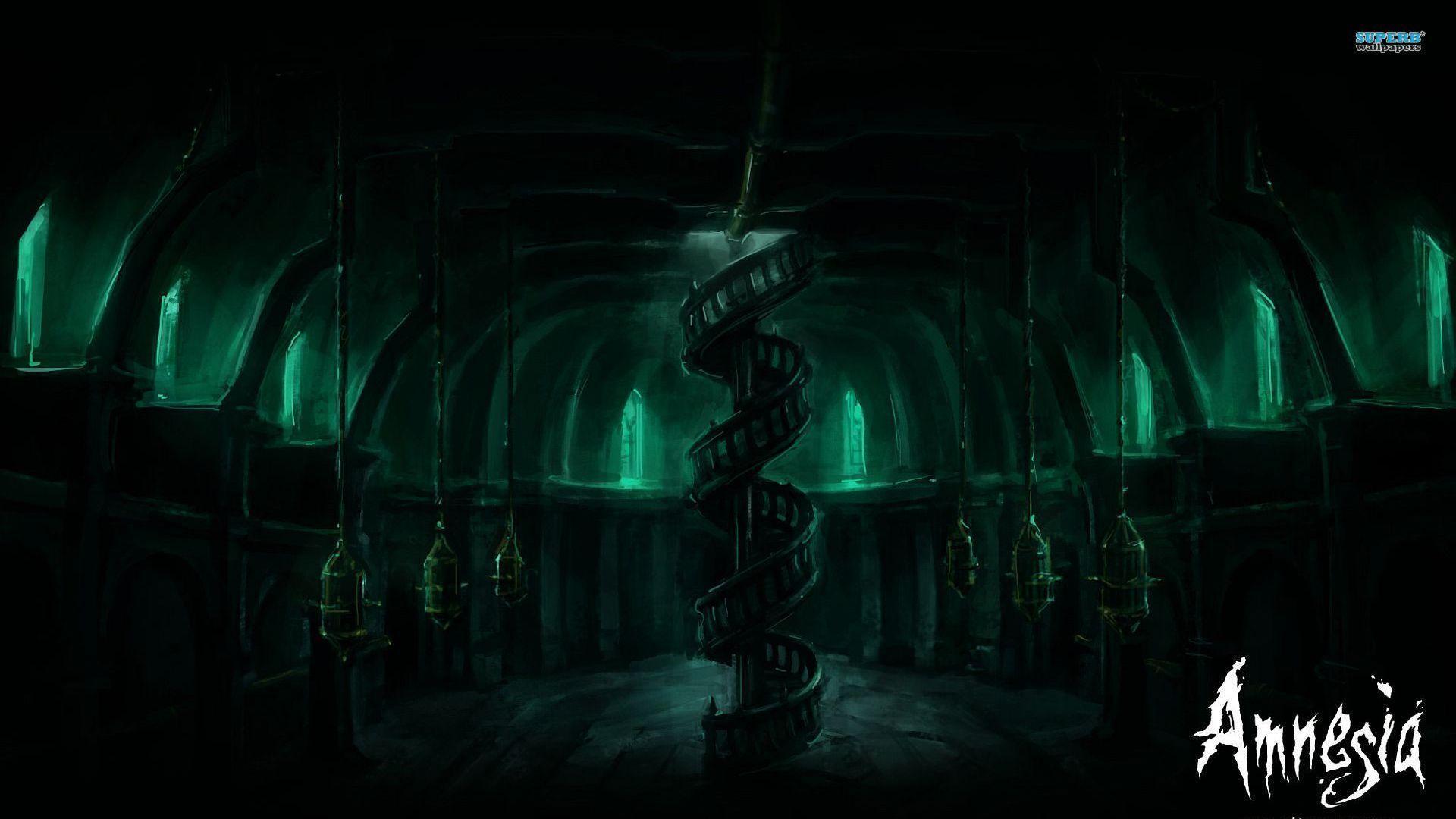
You’re crouched behind a wooden crate in a damp, flickering cellar. Your heart is actually thumping against your ribs. Not just the character's heart—yours. You hear it. A wet, dragging sound followed by a guttural, wheezing moan that sounds like someone trying to breathe through a throat full of gravel. This is the primal terror of Amnesia The Dark Descent monsters. It isn’t about the jump scares. It’s about the vulnerability. Honestly, Frictional Games changed the entire horror genre in 2010 by realizing that giving the player a shotgun actually makes things less scary. When you can’t fight back, the world becomes a very different place.
Brenna Hillier once noted that Amnesia’s brilliance lies in its "sanity" mechanic, which essentially punishes you for looking at the very things you’re terrified of. It’s a cruel loop. You need to see where the threat is to survive, but staring at it literally makes your vision blur and your character collapse. It forces a frantic, sideways glance style of play that mimics real-world panic.
The Grunts: More Than Just Disfigured Faces
The Servants are the bread and butter of the nightmare. Most people just call them "the Grunts." They have these horrifying, unhinged jaws that look like they’ve been surgically detached and then left to dangle. It’s gruesome. They wander the halls of Brennenburg Castle with a sort of mindless, shuffling purpose.
They aren't smart in the way modern AI is, but they don't need to be. Their pathing is just unpredictable enough to feel organic. If one spots you, the music shifts into this frantic, high-pitched orchestral screech that triggers an immediate "flight" response. You aren't thinking about game mechanics anymore. You’re thinking about that closet in the corner and whether you can reach it before the door behind you shatters.
The Grunt is a masterpiece of "uncanny valley" design. It looks human enough to be recognizable but distorted enough to be revolting. Interestingly, Thomas Grip, the creative director at Frictional Games, has talked about how the limited resources of the studio actually helped. Because they couldn't make 50 different types of enemies, they had to make the ones they had feel omnipresent. The Grunt works because he represents the "ordinary" horror of the castle. He is the foot soldier of your descent into madness.
That One Invisible Monster in the Water
Let’s talk about the Kaernk. You probably just know it as "the water monster." It is easily one of the most stressful encounters in gaming history.
Basically, you’re in a flooded basement. You can’t see the monster. You only see the splashes it makes as it sprints toward you. Splash. Splash. Splash. It’s fast. If you’re standing in the water, you’re dead. You find yourself jumping between floating crates and discarded furniture like a high-stakes game of "the floor is lava," except the lava has teeth and wants to eat your legs.
The Kaernk is a brilliant bit of budget-friendly game design that accidentally became legendary. By not showing the monster, Frictional let your brain do the heavy lifting. Your imagination will always conjure up something scarier than a 3D modeler can build. It’s the Jaws effect. What you don't see is infinitely more terrifying than what you do. Even when you throw a piece of raw meat to distract it, you only see the water churning. It's subtle. It's mean. It's perfect.
The Brute: When Things Get Serious
If the Grunt is a nuisance, the Brute is a death sentence. You usually run into these guys later in the game, specifically in the Morgue and the Sewers. They look like they’ve been put through a meat grinder and then stitched back together with rusted metal plates. They have a blade for an arm.
One hit? You're basically done.
The Brutes don't just wander; they patrol with a terrifying efficiency. They represent the escalation of Alexander’s cruelty. While the Grunts feel like failed experiments, the Brutes feel like successful ones—killing machines designed to keep the "gatherers" in line. Most players remember the Sewer section as the peak of their anxiety. The lighting is non-existent, your tinderboxes are running low, and the metallic clink of a Brute’s blade hitting the floor somewhere in the darkness is enough to make anyone Alt-F4.
Why the Shadow is the Real Villain
People often forget that the biggest "monster" in the game isn't actually a creature you can hide from in a wardrobe. It’s the Shadow.
It is an eldritch, red fleshy growth that pursues Daniel throughout the castle. It’s the physical manifestation of the Orb’s guardian. You can’t hide from it because it’s a force of nature. It’s the game’s way of saying "move faster." It creates a sense of "cosmic horror" that elevates the game beyond a simple slasher flick. You aren't just running from monsters; you’re running from a fundamental law of the universe that you broke.
- The Shadow destroys the environment. It blocks paths and forces you into the arms of other creatures.
- It’s a timer. You can't just sit in a safe room forever.
- The visual cues are visceral. The red, pulsating walls look like the castle itself is bleeding or infected.
The Mechanics of Fear: Lights, Sanity, and Sound
You can't talk about Amnesia The Dark Descent monsters without talking about the light. Oil is your most precious resource.
When you run out of oil, you're forced to stay in the dark. In the dark, your sanity drops. When your sanity drops, Daniel starts hallucinating. He hears cockroaches crawling over his skin. He sees things that aren't there. He starts to pant and whimper. This noise attracts the actual monsters. It is a perfectly designed "pressure cooker" system.
There is a psychological depth here that most horror games miss. The game uses a "fear system" that tracks how long you've been in the dark or looking at enemies. If you hit the lowest level, you collapse. You’re vulnerable. You’re forced to crawl while the monsters are still out there. It’s a mechanic that reinforces the theme of the game: you are not a hero. You are a victim of your own past and your own curiosity.
Addressing the "Stupid AI" Myth
Some modern critics look back and say the AI is simple. They aren't wrong, technically. If you stand on a table, the Grunt might struggle to reach you. But that misses the point.
The monsters in Amnesia aren't meant to be tactical geniuses. They are manifestations of dread. They are "triggers" for a psychological experience. When you are playing in a dark room with headphones on, you aren't thinking about the pathing nodes of the AI. You are thinking about the fact that something is breathing behind that door. The simplicity of the monsters' behavior actually makes them feel more relentless and animalistic. They don't bargain. They don't wait. They just hunt.
Practical Steps for Surviving the Dark
If you’re revisiting Brennenburg or playing for the first time, you need a strategy. This isn't Resident Evil.
Lean, don't peek. Use the lean keys to look around corners without exposing your whole body. The monsters have a cone of vision, and the less of you they see, the better.
Close doors behind you. Always. It buys you seconds. If a monster has to break down a door to get to you, that’s time you can use to find a hiding spot or get to the next zone.
Don't hoard tinderboxes. Use them in hub areas where you’ll be backtracking. There’s nothing worse than being lost in a maze you’ve already cleared because you were too stingy with your matches to light a wall torch.
Manage your line of sight. If you hear a monster, crouch and look at the floor. It feels counter-intuitive, but keeping your eyes off the creature keeps Daniel sane and quiet.
The monsters of Amnesia changed how we think about horror because they took away our power. They forced us to be afraid of the dark again, just like we were when we were kids. They reminded us that sometimes, the only thing you can do is run and hide. And honestly? That's way more fun than winning.
To truly understand the legacy of these creatures, your next step should be to explore the "Hard Mode" added in later updates. It removes the auto-saves and makes the monsters faster and more perceptive, turning the game into a pure test of nerves. Alternatively, checking out the developer commentary tracks within the game provides incredible insight into how they used sound design to make a few simple 3D models feel like an unstoppable army of nightmares.