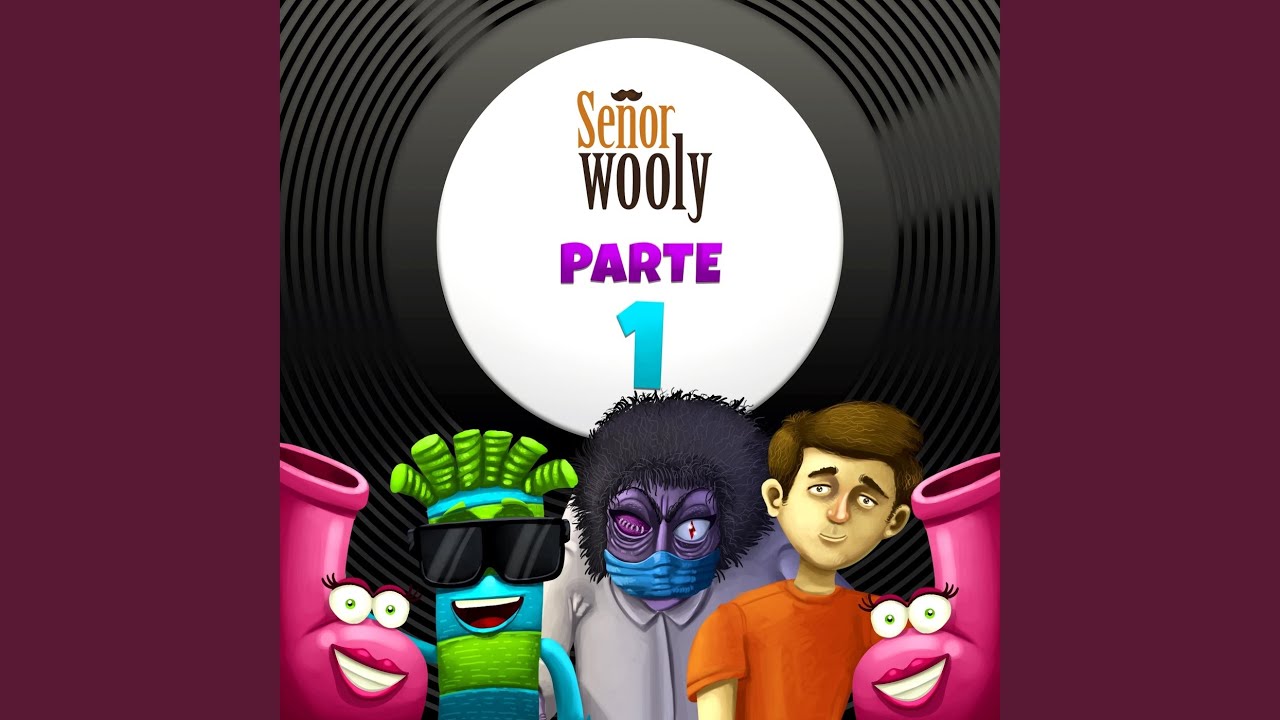
If you spent any time in a high school Spanish classroom over the last two decades, you know him. He’s green. He’s striped. He’s surprisingly dramatic for an inanimate object. We're talking about Billy, the scarf that defied the laws of physics and fashion to become a linguistic icon. Honestly, Billy la Bufanda lyrics are probably more deeply embedded in your brain than the actual conjugation of the subjunctive mood. It’s weird, right? A scarf that goes to the pharmacy to buy cough drops shouldn't be this culturally significant, yet here we are.
Jim Wooldridge—better known to the world as Señor Wooly—basically cracked the code for educational engagement back in 2007. Before he came along, most Spanish "songs" were dry, repetitive chants about where the library is. Wooly changed that by leaning into the absurd. He realized that if you make a song about a scarf falling in love with a pair of boots, students might actually pay attention. And they did. They really did.
The narrative genius behind Billy la Bufanda lyrics
The story starts simple. "Soy Billy. Soy una bufanda." It's foundational Spanish. But then it gets dark. Or at least, as dark as a song for teenagers can get. Billy isn't just a scarf; he's a scarf with a fragile ego and a penchant for high-stakes drama. The Billy la Bufanda lyrics follow a very specific trajectory: introduction, the realization of his own beauty, and the inevitable conflict of his environment.
He’s pretty. He’s very pretty. "Soy muy guapo," he tells us. But then the wind happens. The wind is the primary antagonist in the Billy cinematic universe. It blows him off the neck of his "owner" (a tall, somewhat oblivious man) and sends him spiraling into a world he wasn't prepared for.
What makes the lyrics work isn't just the vocabulary. It's the repetition. "La farmacia," "las botas," "el suelo." These aren't just words; they are plot points. When Billy ends up on the floor of a pharmacy, it's a tragedy. When he sees "Las Botas" (The Boots), it's a romance. The lyrics use high-frequency structures like va a (he goes to) and ve (he sees) in a way that feels like a story rather than a grammar drill. That’s the secret sauce.
Why "Billy y las Botas" changed the game
Most people think there’s just one song. There isn't. The Billy saga is a trilogy, and each installment ups the ante. In the first song, we're introduced to his vanity. By the second, "Billy y las Botas," we see a scarf in the throes of unrequited love. He’s obsessed with a pair of boots he saw in the pharmacy. It’s ridiculous. It’s also brilliant.
The Billy la Bufanda lyrics in this sequel move from simple descriptions to emotional expression. He calls out to them. He dreams of them. He’s a scarf, mind you. He doesn't have a heart, but he has feelings. This is where Señor Wooly excels—using the absurd to teach the "yo" and "tú" forms.
- Billy sees the boots.
- He wants to be with the boots.
- The boots are, well, boots. They don't say much back.
You’ve got to appreciate the linguistic layering here. While you're laughing at a green scarf trying to flirt with footwear, you’re subconsciously absorbing the difference between puedo and puedes. It’s stealth learning at its finest.
The dark turn in the pharmacy
The setting of the pharmacy is a recurring motif. Why a pharmacy? Why not a park? Probably because "farmacia" is a cognate that's easy for English speakers to recognize, but also because it adds to the surrealism. There is a specific line about Billy being on the floor: "Billy está en el suelo." It’s a low point. Literally.
For a scarf who prides himself on being "muy guapo," being on the floor of a public building is the ultimate humiliation. This creates empathy. Weirdly, 14-year-olds relate to a scarf feeling out of place and embarrassed. That’s why the Billy la Bufanda lyrics resonate. They tap into that universal feeling of being "on the floor" while trying to look your best.
Breaking down the vocabulary: It’s more than just "Guapo"
If we look at the actual text, the lexical density is surprisingly high for a "kids' song." We see a heavy emphasis on:
- Adjectives of vanity: Guapo, bonito, elegante.
- Locations: La farmacia, el parque, la mano.
- Prepositions of place: En, debajo de, encima de.
- Verbs of movement: Va, corre, vuela.
The genius of the songwriting lies in the "earworm" factor. You can’t just hear "Billy, Billy, Billy" once and forget it. It haunts you. In a good way. Teachers love it because it provides "comprehensible input." This is a term coined by linguist Stephen Krashen, suggesting that we learn languages best when we understand the message, even if we don't know every single word.
Because the video for Billy la Bufanda is so literal, students don't need a translation. They see the scarf. They see him looking in a mirror. They hear "guapo." The connection is instant. No dictionary required.
The cultural impact of a striped accessory
It’s been nearly twenty years. People who learned Spanish with Billy are now teaching Spanish with Billy. There are memes. There is fan art. There are entire Reddit threads dedicated to debating whether Billy is a hero or a narcissist. Most people lean toward narcissist, but he’s a lovable one.
The Billy la Bufanda lyrics have become a sort of secret handshake for a specific generation of students. If you say "Soy muy guapo" in a certain rhythm, and someone else finishes the line, you know exactly where they were in 2012. It’s a shared cultural touchstone that bridges the gap between different school districts and even different countries.
Beyond the first song: The tragedy of Billy la Bufanda 3
In the third installment, things get real. We see the consequences of Billy’s obsession. Without spoiling the "plot" for the uninitiated, let’s just say that being a scarf has its limitations. The lyrics become more complex, dealing with themes of identity and the passage of time.
He isn't the same scarf he was in song one. He’s seen things. He’s been through the wash, literally and figuratively. The repetition of "Yo soy Billy" takes on a more somber tone. It’s no longer a boast; it’s an affirmation of existence in a world that sees him as just a piece of wool.
How to use these lyrics to actually improve your Spanish
Don't just sing along. Use the Billy la Bufanda lyrics as a template for your own sentences.
If Billy can be "guapo," what else can he be?
- Billy está triste. (Billy is sad.)
- Billy tiene hambre. (Billy is hungry—unlikely, but grammatically correct!)
- Billy quiere las botas. (Billy wants the boots.)
Substitute the nouns. Swap "bufanda" for "camisa" or "sombrero." The structure of these songs is designed to be a "plug-and-play" system for language learners. That’s why it’s so effective. It gives you the skeleton of the language, and you just have to put the meat on the bones.
Honestly, the best way to internalize this is to watch the videos without subtitles. Try to transcribe the lyrics yourself. You’ll find that your ear picks up the "b" and "v" sounds—which are often identical in Spanish—much more clearly when you're focused on Billy's frantic journey to find his boots.
The legacy of the green scarf
So, why does he still matter? Why are we still talking about a scarf in 2026? It’s because the Billy la Bufanda lyrics represent a shift in how we think about education. We stopped pretending that learning has to be boring. We embraced the weird. We accepted that a singing scarf is a better teacher than a 500-page textbook.
Billy is a reminder that language is alive. It’s not just rules and charts; it’s stories. Even if those stories involve a pharmacy, a gust of wind, and a pair of boots that never loved him back.
If you want to master the Billy saga, start by categorizing the verbs in the first song. Separate the ser (to be - permanent) from the estar (to be - temporary). Billy is a scarf (permanent - es), but he is on the floor (temporary - está). This is the single hardest concept for English speakers, and Billy teaches it in three minutes.
Go listen to the song again. Look at the lyrics with fresh eyes. You’ll realize that beneath the silly animation and the catchy beat, there is a masterclass in Spanish grammar waiting to be unraveled. Just watch out for the wind. It’s a monster.
Practical Next Steps for Fans and Learners:
- Analyze the Verbs: Print out the lyrics and highlight every instance of ser vs. estar. It’s the most practical way to see those rules in action.
- Watch the Sequels: Most people stop at the first song. The real linguistic meat is in "Billy y las Botas" parts 2 and 3.
- Practice Retelling: Try to explain the "plot" of Billy’s life in Spanish to someone else. If you can describe his journey from the man's neck to the pharmacy floor, you’ve mastered the past tense.
- Check the Official Source: Head over to Señor Wooly’s site if you’re a teacher or a serious student; the "Learning Nuggets" there break down the specific grammar used in the lyrics.