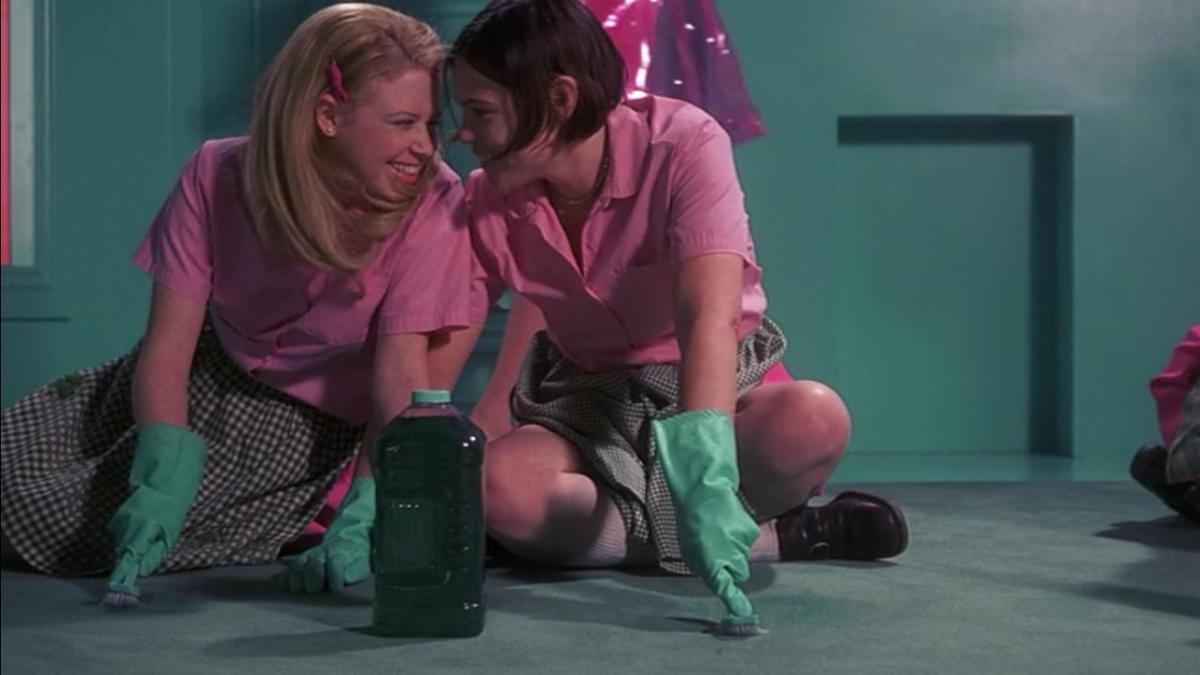
Honestly, it’s kind of wild to think about how critics initially trashed But I'm a Cheerleader. When it first hit theaters in 1999, people didn't really know what to do with it. The colors were too bright. The satire was too loud. It felt like a cartoon, but it was tackling a subject as dark and heavy as conversion therapy. Now, decades later, Jamie Babbit’s cult classic is basically the blueprint for how to tell a queer story without drowning in misery.
It’s a masterpiece. Seriously.
If you haven’t seen it, the plot is pretty straightforward but deeply weird. Megan Bloomfield—played by a perfect Natasha Lyonne—is a high school cheerleader who loves tofu and hates kissing her boyfriend. Her parents and friends stage an intervention because they’re convinced she’s a lesbian. They ship her off to True Directions, a residential conversion therapy camp led by Mary Brown (Cathy Moriarty) and an "ex-gay" counselor named Mike (RuPaul Charles, out of drag). It’s there that Megan meets Graham, played by Clea DuVall, and finally realizes that, yeah, everyone was right. She is a lesbian. And she’s totally fine with it.
The Satire That Everyone Missed
At the time, reviewers at outlets like Variety and The New York Times found the film's aesthetic "garish" or "shallow." They were wrong. What they missed was that the artificiality was the entire point. Babbit used a saturated, candy-colored palette—all pinks and blues—to mimic the rigid gender roles the camp was trying to force onto these kids.
The production design by Marina Sigel is intentional. The girls wear pink. They learn how to vacuum and change diapers. The boys wear blue and learn how to chop wood. It’s a literal manifestation of the "gender performance" that Judith Butler talks about in academic circles, but turned into a high-camp comedy.
Everything about the True Directions camp is fake. The grass is too green. The house looks like a plastic dollhouse. By making the environment look so manufactured, Babbit was showing us that "heteronormativity" is the thing that’s unnatural—not the kids who were sent there. It’s a brilliant reversal. While most LGBTQ+ films of that era were gritty, grainy, and tragic, But I'm a Cheerleader used a Barbie-world aesthetic to mock the absurdity of trying to "cure" someone’s identity.
Why RuPaul and Natasha Lyonne Worked So Well
Casting is everything here.
Natasha Lyonne has this incredible ability to look perpetually confused yet deeply grounded. Her journey from "I’m just a good girl who likes pom-poms" to "I am a butch-leaning lesbian who loves Graham" is handled with so much sincerity that it keeps the movie from drifting into pure caricature.
And then there’s RuPaul. This was 1999. Drag Race didn’t exist. Seeing RuPaul out of drag, playing a man trying to teach other men how to be "masculine," is a layer of meta-commentary that still hits. He’s teaching them how to walk "manly" and how to use tools, all while the audience knows exactly who he is. It adds a level of irony that makes the camp scenes even funnier—and sadder, when you think about the real-world implications of those programs.
The chemistry between Lyonne and DuVall is legendary. In fact, it was so good that they’ve remained close friends and collaborators for decades, eventually working together on projects like The Intervention and Russian Doll. You can’t fake that kind of screen presence. When they’re cleaning the kitchen together and the tension starts to build, it feels more real than any of the "straight" romances the film parodies.
The Real Dark Side of the Comedy
We have to talk about the fact that conversion therapy is still a very real, very dangerous thing. When But I'm a Cheerleader was made, the "Ex-Gay" movement was a huge part of the American cultural conversation. Organizations like Exodus International were gaining mainstream traction.
Babbit took a risk by making a comedy about a topic that literally ruins lives.
Some people argue that the film is too lighthearted for such a grim subject. But there’s a specific scene—when a character is kicked out of their home and has nowhere to go—that grounds the movie. It reminds you that while Megan’s story has a happy, cheerleading-dance-sequence ending, the stakes for these kids are life and death. The humor isn't meant to diminish the trauma; it’s meant to weaponize it against the people causing it. It makes the "counselors" look like the idiots they are.
The Legacy of the "Camp" Aesthetic
You can see the DNA of this movie everywhere now.
Shows like Sex Education or movies like Bottoms owe a massive debt to the visual style of But I'm a Cheerleader. It gave filmmakers permission to be colorful and queer without needing to be "preachy" or "depressing." It’s part of a lineage of camp that includes John Waters and Todd Haynes, but with a specific 90s indie-pop sensibility.
The soundtrack is also a total time capsule. You’ve got Dressy Bessy, The Murmurs, and Saint Etienne. It’s the sound of the Lilith Fair era mixed with lo-fi indie rock. It perfectly captures that feeling of being a teenager in a suburban basement, trying to figure out who you are while the world tells you to be something else.
Why You Should Revisit It Now
If you haven't watched it in a few years, it holds up surprisingly well. The jokes land. The satire of the "Stepford-wife" femininity is still biting. Most importantly, it’s one of the few queer films from that era that actually grants its protagonist a happy ending.
In the late 90s, "Bury Your Gays" was a standard trope. If you were gay in a movie, you usually died, went to prison, or ended up alone. Megan Bloomfield gets the girl. She gets to perform a ridiculous, heartfelt cheer to win back her lover. It’s cheesy, it’s over-the-top, and it’s exactly what the audience needed.
The movie is a reminder that joy is a form of resistance.
By refusing to be a tragedy, But I'm a Cheerleader became a permanent fixture in the queer canon. It told a generation of kids that they weren't broken—the system trying to "fix" them was.
Next Steps for the Ultimate Rewatch
To truly appreciate the film's impact, you should look into the "New Queer Cinema" movement of the 90s. Directors like Cheryl Dunye and Gregg Araki were breaking all the rules, and Jamie Babbit was right there with them.
- Check the Director’s Cut: Lionsgate released a 20th Anniversary 4K restoration that looks incredible. The colors pop exactly the way Babbit intended.
- Watch the "Making Of" Featurettes: Hearing Clea DuVall and Natasha Lyonne talk about their friendship adds a whole new layer to their on-screen romance.
- Research the Legislation: While the film is a comedy, many states are still fighting to ban conversion therapy for minors. Organizations like The Trevor Project provide real-world context on the issues the film satirizes.
Whether you're a long-time fan or a newcomer, the film remains a vibrant, defiant piece of art. It’s loud, it’s proud, and it’s still one of the best things to come out of the 90s indie scene.
Go watch it again. Bring some tofu.