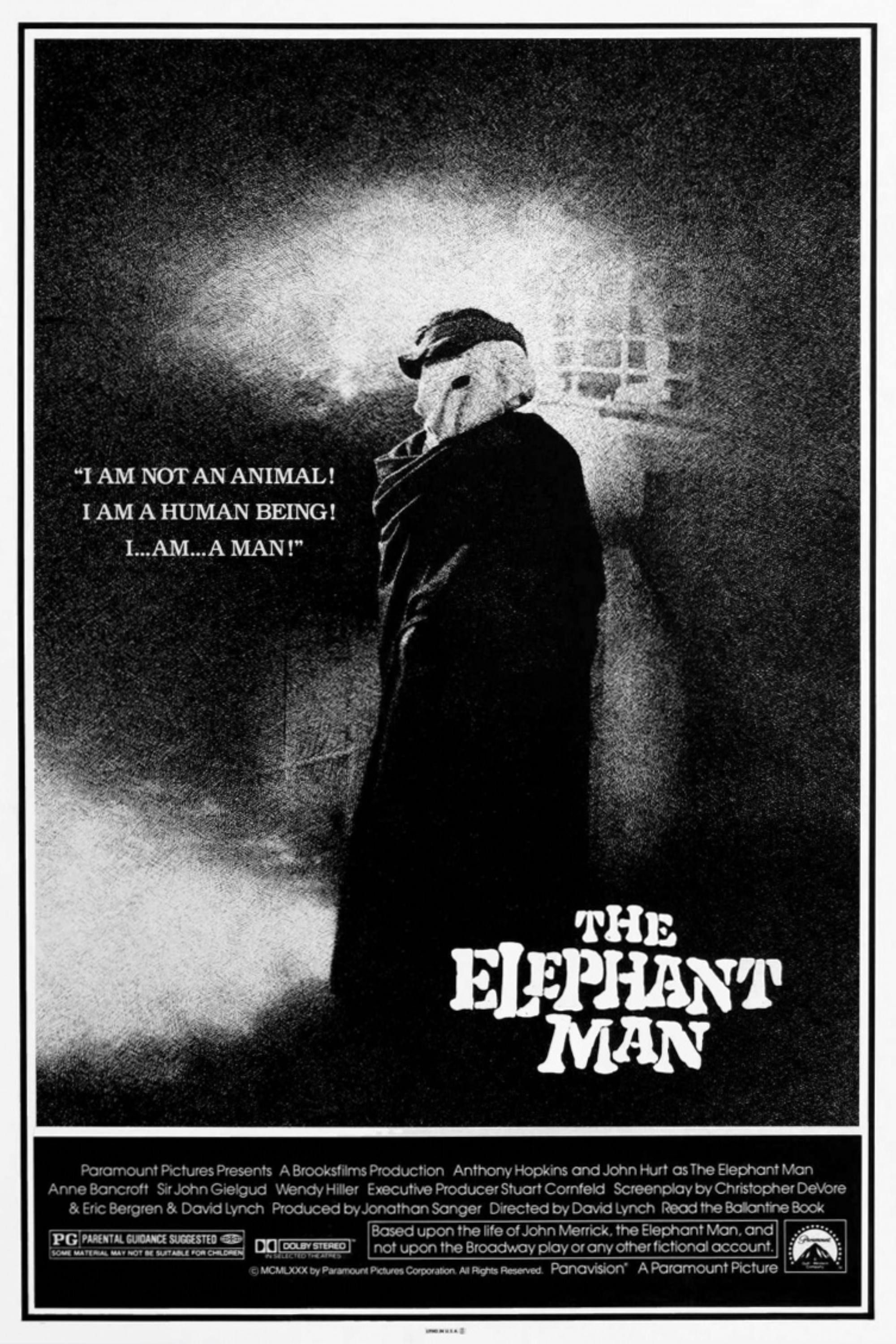
People usually think of David Lynch as the "weird guy." You know the vibe—dream sequences, dancing dwarves, and coffee that’s "damn fine" but also probably haunted. So, when Mel Brooks hired him to direct The Elephant Man, it felt like a massive gamble. This wasn't some avant-garde experiment in a basement; it was a high-budget historical drama about Joseph Merrick (renamed John in the film), a man who lived with severe physical deformities in Victorian England. It’s a heartbreaking story. Honestly, it’s one of the few movies that can make a grown man sob in a public theater.
Lynch was coming off Eraserhead, a film that is basically a nightmare caught on celluloid. Most people expected him to turn Merrick’s life into a freak show. Instead, he did something better. He made it human. He took a story that could have been cheap "misery porn" and turned it into a meditation on dignity.
The Surprising Origins of the David Lynch Elephant Man Collaboration
It’s kinda hilarious that Mel Brooks was the one who made this happen. Brooks, the king of comedy, saw Eraserhead and reportedly told Lynch, "You’re a madman, I love you!" He knew that to tell the story of John Merrick, you needed someone who understood the "other."
Lynch didn't want to make a standard biopic. He was obsessed with the industrial soot of London. He wanted the sound of the film to feel heavy—all those rhythmic, mechanical thuds and hissing steam. It’s that industrial atmosphere that makes the Victorian setting feel so claustrophobic. You feel the grit in your teeth.
The film stars John Hurt as Merrick and Anthony Hopkins as Frederick Treves, the surgeon who "discovers" him. Hopkins is stoic, but you can see the guilt eating him alive. He wonders if he’s any better than the circus barkers. Is he just a different kind of exploiter? That’s the core of the David Lynch Elephant Man experience—the blurred line between science and spectacle.
Why the Makeup Was a Nightmare (Literally)
Christopher Tucker was the guy responsible for the prosthetic makeup. It’s legendary stuff. He actually used plaster casts of Joseph Merrick’s body, which are still kept at the Royal London Hospital. Because Lynch wanted total accuracy, the makeup took seven or eight hours to apply every single day. Imagine sitting in a chair for eight hours before you even start your job. John Hurt was a trooper, but he famously said, "I think they finally managed to make me hate acting."
The result was stunning. Even by 2026 standards, the practical effects in this movie hold up better than most CGI. You aren't looking at a monster; you’re looking at a man trapped inside a cage of bone and skin.
- The head piece alone weighed several pounds.
- Hurt had to eat through a straw.
- He couldn't lie down during the day.
- The makeup was so convincing it actually led to the creation of the Best Makeup category at the Academy Awards.
That last part is a true story. The Oscars didn't have a makeup category in 1980. People were so outraged that Tucker wasn't recognized that the Academy literally changed the rules the following year.
The Sound of Darkness
If you watch a David Lynch film, you have to listen. Most directors treat sound as an afterthought. Lynch treats it like a character. In The Elephant Man, the background noise is constant. It’s a low-frequency hum. It feels like the world is breathing on you.
There’s this scene where Merrick is being chased through a train station. The sound of the crowd is distorted and terrifying. It puts you right in his head. You feel the panic. You feel the confusion. When he finally screams, "I am not an elephant! I am a human being!" the silence that follows is deafening. It’s a masterclass in tension.
Was it Factually Accurate?
Well, yes and no. It’s a movie, not a textbook.
- The real Joseph Merrick was actually quite articulate, though his speech was difficult to understand.
- The film portrays the "Night Porter" at the hospital as a villain who charges people to look at Merrick. This was a bit of dramatic license, though Merrick certainly dealt with plenty of jerks in real life.
- The ending is heavily stylized.
Lynch isn't interested in a dry recitation of dates. He’s interested in the soul. The real Frederick Treves wrote a book about Merrick, and Lynch leans heavily into the emotional truth of that relationship. Treves genuinely cared for him, but he also struggled with the ethics of his profession. The movie nails that nuance.
The Legacy of the 1980 Masterpiece
People still talk about this movie because it’s a perfect bridge. It bridges the gap between commercial Hollywood and "weird" art-house cinema. It proved that Lynch could play by the rules and still produce something deeply personal. Without this success, we might never have gotten Blue Velvet or Twin Peaks.
It also changed how we look at disability on screen. It’s not about pity. It’s about the fact that Merrick had a richer inner life than the "normal" people around him. He built a model of a cathedral. He read poetry. He was a gentleman in a world that treated him like a beast.
Honestly, if you haven't seen it in 4K yet, you’re missing out. The black-and-white cinematography by Freddie Francis is gorgeous. It looks like a moving photograph from the 19th century. The shadows are deep, and the highlights are crisp. It’s just beautiful.
How to Appreciate The Elephant Man Today
To truly get the most out of this film, don't just watch it on your phone. This is a "lights off, sound up" experience.
- Watch the Freddie Francis Cinematography: Notice how he uses light to soften Merrick’s features when he’s in a safe space.
- Listen for the "Lynchian" Drones: Pay attention to the factory sounds that permeate the London scenes.
- Compare to the Real History: Read Frederick Treves' original 1923 book, The Elephant Man and Other Reminiscences. It provides a fascinating contrast to the film's narrative.
- Check out the 4K Restoration: The Criterion Collection release is widely considered the definitive version for both visual and audio quality.
If you want to understand modern cinema, you have to understand this film. It’s the moment the "madman" became a master. Take the time to sit with it. It’s uncomfortable, it’s heavy, and it’s absolutely essential. Look for the way Lynch uses the opening and closing dream sequences—that's the "real" Lynch showing through the historical drama. It’s a reminder that even in our darkest moments, there’s a strange, cosmic beauty to existence.
Go find the Blu-ray or stream the restored version. Pay attention to the texture of the film. It's a tactile experience that stays with you long after the credits roll. There is no other movie quite like it, and there probably never will be again.