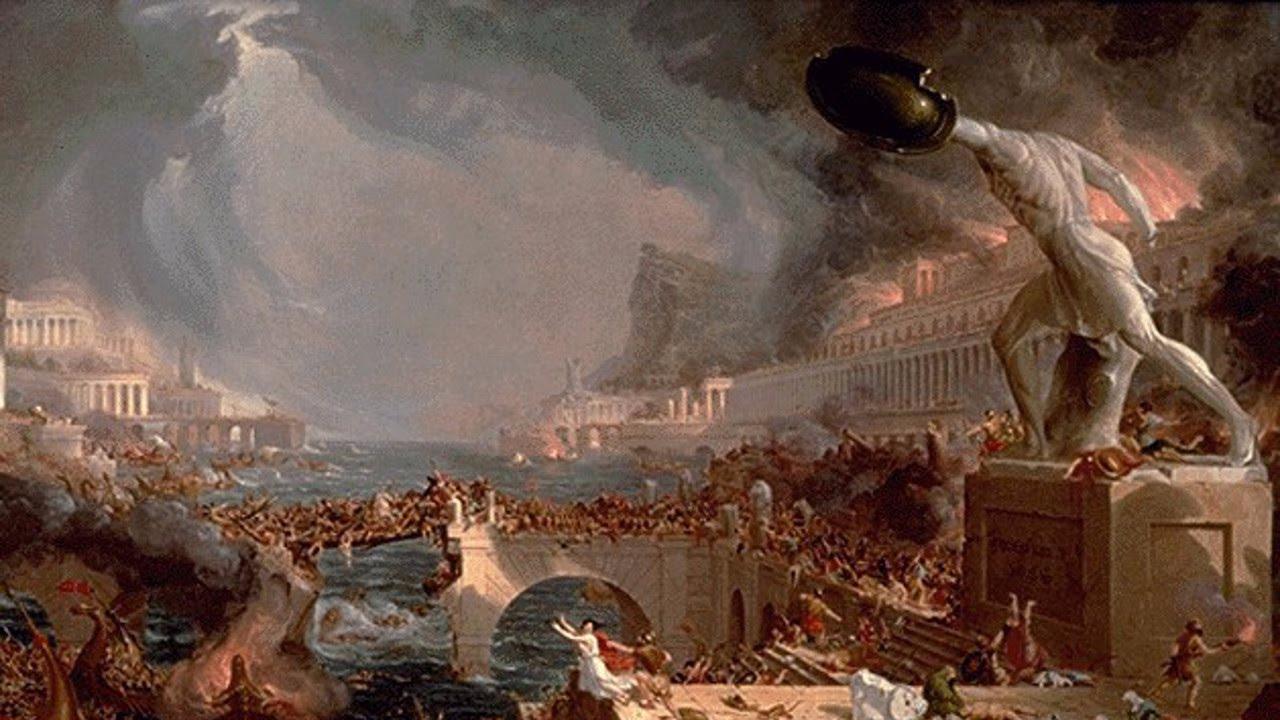
History isn't a straight line. People often talk about the "fall" of the Roman Empire like it was a single, dramatic Tuesday in September where everyone just packed up and left. It wasn't. Honestly, if you were a farmer living in the Italian countryside in 476 AD, you probably didn't even notice the world had "ended." You still had taxes to pay. You still had crops to harvest. But something massive did shift, and understanding why did ancient rome fall is basically like performing an autopsy on the most complex political organism the world had ever seen.
It was messy.
Edward Gibbon, the guy who wrote the massive multi-volume series on this back in the 18th century, blamed "immoderate greatness." Essentially, Rome got too big for its own good. But modern historians like Peter Heather or Bryan Ward-Perkins argue it was less about internal rot and more about a series of external shocks that the system just couldn't absorb anymore. Think of it like a house with termites that gets hit by a hurricane. The termites were the problem, sure, but the hurricane did the heavy lifting.
The Myth of the "One Big Reason"
Everyone wants a smoking gun. Was it lead pipes? Christianity? Lazy citizens?
Probably none of the above, at least not in isolation. The lead poisoning theory, popularized by researchers like Jerome Nriagu in the 1980s, has mostly been debunked. While there was lead in the water, the calcium buildup in Roman aqueducts acted as a natural seal. Romans weren't wandering around in a toxic haze of cognitive decline.
Instead, look at the money. Rome’s economy was a giant Ponzi scheme based on conquest. When the legions stopped bringing in new gold and slaves from conquered territories, the state started debasing its currency. By the time of the "Crisis of the Third Century," the silver content in the denarius had plummeted. It went from being almost pure silver to basically a copper coin dipped in silver. Inflation went nuts. When you can’t pay your soldiers in real money, they start looking for a better boss.
The Barbarian "Immigration" Problem
Here is where it gets spicy. For centuries, Rome "Romanized" the people on its borders. They weren't all mindless savages in furs; many were sophisticated groups who wanted in on the Roman dream. But in the 4th and 5th centuries, the Huns—a nomadic group from Central Asia—started pushing Germanic tribes like the Visigoths and Vandals westward.
It was a refugee crisis.
In 378 AD, at the Battle of Adrianople, the Eastern Roman Emperor Valens was killed by the very Goths he had let into the empire. This was a turning point. It showed that the "barbarians" weren't just raiding; they were winning. They weren't trying to destroy Rome; they wanted to be Rome, or at least have a piece of its tax revenue. When Alaric sacked Rome in 410 AD, it wasn't the end of the government, but it was a massive psychological blow. The "Eternal City" was vulnerable.
The Logistics of a Dying Giant
Rome was a logistics company that also happened to have a religion and a senate.
To keep the borders secure, you needed hundreds of thousands of men. To feed those men, you needed grain from North Africa and Egypt. When the Vandals—led by the brilliant and ruthless King Genseric—captured Carthage in 439 AD, they cut off the grain supply to Rome.
Imagine if someone cut off the internet and the grocery stores in New York City simultaneously.
That is why did ancient rome fall in a practical sense. Without North Africa, the Western Empire lost its breadbasket and its biggest tax base. The city of Rome’s population plummeted. People left because there was no food. They went to the countryside to work for local lords, which eventually paved the way for the feudal system we see in the Middle Ages.
Military Outsourcing Gone Wrong
By the end, the Roman army wasn't very Roman.
The state started hiring entire barbarian tribes to fight other barbarian tribes. They called them foederati. It sounds efficient on paper. You save money on training and recruitment. But loyalty is a fickle thing when it’s bought with promises of land that the government doesn't actually control. Odoacer, the man who finally deposed the last Western Emperor, Romulus Augustulus, was himself a Germanic officer in the Roman military. He didn't see himself as an invader; he saw himself as a disgruntled employee taking over the firm.
The East-West Divide
We often forget that half of Rome didn't fall.
Constantine had moved the capital to Constantinople (modern-day Istanbul) in 330 AD. The Eastern Empire—what we call the Byzantine Empire—was wealthier, more urbanized, and much easier to defend. While the West was crumbling under the weight of invasions and economic collapse, the East was thriving.
They had better walls. They had more money. They had more people.
When the West "fell" in 476, the East just kept going for another thousand years. This creates a weird nuance in history. If the Roman government continued to exist in Constantinople until 1453, did Rome actually fall? Technically, no. But the Latin-speaking, Mediterranean-centered world of the Caesars was definitely dead.
Why did ancient rome fall? Because of Complexity.
Scientist Joseph Tainter wrote a fascinating book called The Collapse of Complex Societies. His take? Rome became too complex to be sustainable.
The "marginal return on investment" for their social complexity started to drop. Every time they had a problem, they added a new layer of bureaucracy or a new tax. Eventually, the cost of maintaining the empire was higher than the benefits of being in it. For many peasants, it was actually cheaper and safer to live under a "barbarian" king than under the crushing tax regime of the late Roman Empire.
It's a sobering thought.
Success creates its own baggage. The Roman infrastructure—the roads, the mail system, the legal codes—required a level of central funding that the debased economy could no longer support. When the central hub stopped providing value, the spokes of the wheel just fell off.
The Role of Climate and Plague
Nature played a hand, too.
Recent studies of ice cores and tree rings suggest that the "Roman Climatic Optimum"—a period of warm, stable weather that helped Roman agriculture thrive—ended around the 2nd century. This was followed by the "Late Antique Little Ice Age." Shorter growing seasons meant less food.
Then came the pests.
The Antonine Plague (likely smallpox) in the 2nd century and later the Plague of Justinian in the 6th century wiped out huge percentages of the population. You can't run an empire without people. You can't tax ghosts. The loss of manpower made it nearly impossible to harvest crops or man the walls against the Persians in the East or the Franks in the West.
Lessons for the Modern World
So, what do we do with this?
Studying why did ancient rome fall isn't just for history buffs in dusty libraries. It’s a blueprint of what happens when a system ignores its structural weaknesses for too long.
- Diversify your dependencies. Rome relied too heavily on grain from one region (Africa) and soldiers from another (Germanic tribes). When those links broke, everything broke.
- Currency matters. You can't print or debase your way out of a fundamental economic shift without consequences.
- Infrastructure isn't "set and forget." It requires constant, expensive upkeep. If the tax base shrinks, the physical world literally starts to crumble.
- Social cohesion is a resource. When the average citizen feels that the government is just a machine for taking their money, they stop caring if that government survives.
How to Explore This Further
If you want to get deeper into the weeds of the late Roman world, stop looking at "Great Man" history and start looking at the archaeology.
- Read Peter Heather’s "The Fall of the Roman Empire." It’s a brilliant, modern take that focuses on the "hurricane" of barbarian invasions.
- Check out the "Fall of Rome" podcast by Patrick Wyman. He does an incredible job of explaining the economic and social shifts in a way that feels incredibly human.
- Look at the coins. If you ever visit a museum with a Roman collection, look at the difference between a gold solidus from the early empire and the pathetic copper coins of the late 4th century. The story is right there in the metal.
- Visit Trier or Arles. These were "frontier" capitals. They show you how Rome tried to adapt by moving the power closer to the action, a desperate move that ultimately couldn't save the heart of the empire.
History is a warning, not a script. Rome didn't end because of one mistake; it ended because it lost the ability to fix its mistakes.