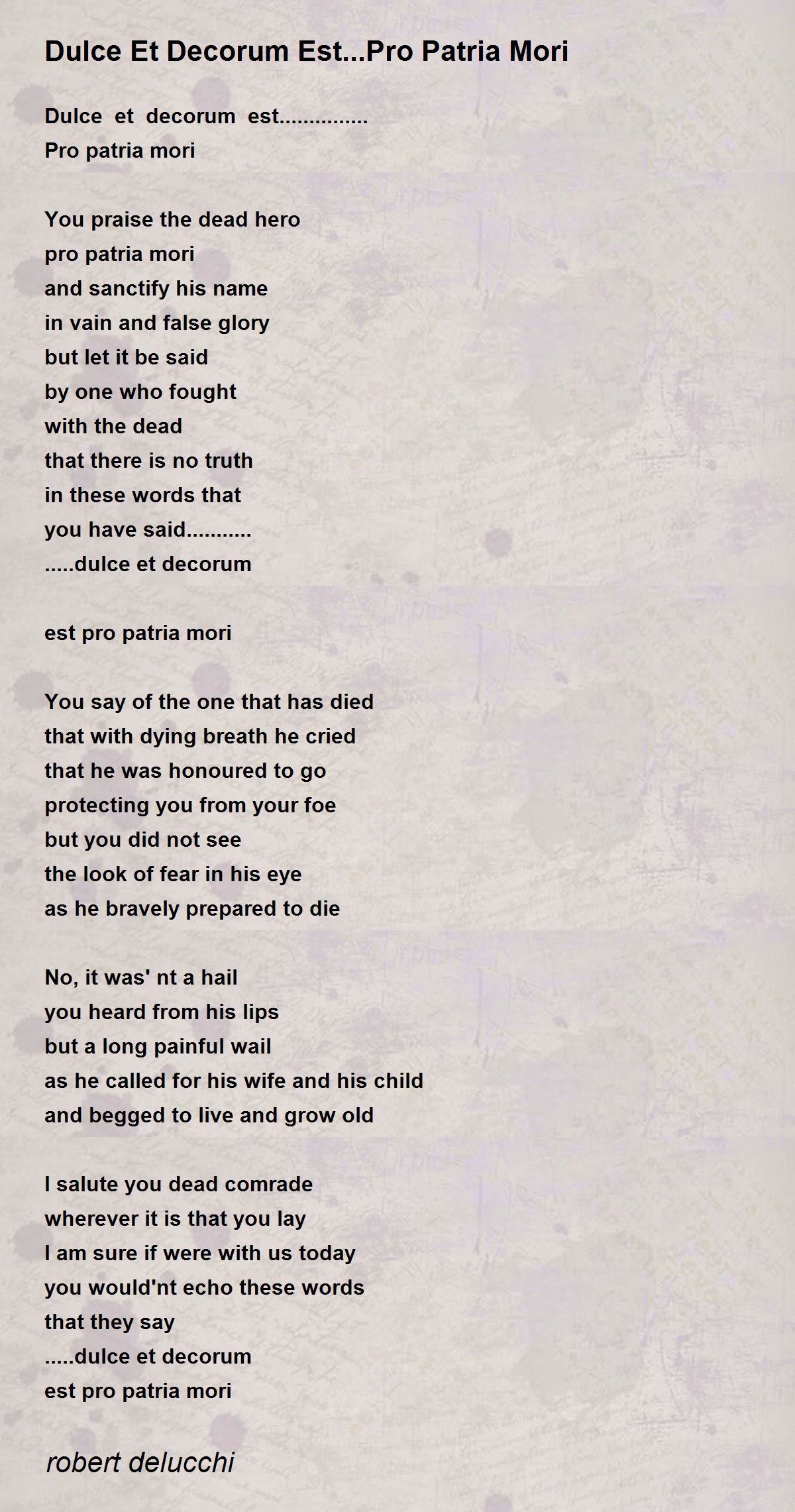
Wilfred Owen didn't write for your textbook. He wrote because he was pissed off. Honestly, if you read Dulce et Decorum Est and don't feel a bit sick to your stomach, you probably missed the point entirely. It’s not just a "war poem." It’s a 28-line scream. Back in 1917, while Owen was recovering from shell shock at Craiglockhart War Hospital in Edinburgh, he started putting together these verses that would eventually dismantle centuries of romanticized military "glory." He wasn't some distant observer. He was a soldier who had seen his friends' lungs turn into a "froth-corrupted" mess after a gas attack.
Most people encounter this poem in high school and assume it’s just about the horrors of World War I. That’s part of it, sure. But the real meat of the thing is the visceral, almost nasty way Owen attacks the people back home—the poets and politicians who stayed warm and dry while encouraging teenage boys to go get slaughtered. He’s calling them out. Specifically, he was aiming at Jessie Pope, a civilian writer who published catchy, upbeat jingoistic verses encouraging young men to enlist. Owen’s original draft even included a dedication to her, though he later softened it to "a certain Poetess" before it was eventually removed. He wanted her to see the blood. He wanted the readers to smell the "sour cud."
The Gritty Reality Behind the Latin Lie
The title itself is a trap. Dulce et decorum est pro patria mori. It’s a line from the Roman poet Horace. It basically translates to "It is sweet and fitting to die for one's country." For hundreds of years, this was the ultimate tagline for nationalism. It’s what you told kids to get them to pick up a rifle. Owen calls it "The Old Lie." He doesn't just disagree with Horace; he treats the sentiment like a poison.
The poem opens with a rhythmic, heavy slog. "Bent double, like old beggars under sacks." These aren't the square-jawed, polished heroes you see on recruitment posters. They’re "knock-kneed," coughing like "hags," and "drunk with fatigue." Owen uses these specific, ugly words to strip away the dignity of war. You’ve got to imagine the sheer physical exhaustion of the Western Front. The mud wasn't just dirt; it was a waist-deep, freezing slurry of clay, human remains, and waste. When he says they "marched asleep," he isn't being metaphorical. Soldiers actually fell asleep while walking because their bodies simply quit.
Then, the tone shifts.
The word "Gas!" breaks the rhythm like a gunshot. "Gas! GAS! Quick, boys!" It’s an ecstatic, panicked fumble. This refers to chlorine or phosgene gas, which the German forces first used effectively at Ypres. It wasn't a quick death. It was a chemical reaction that turned the water in your lungs into acid. You essentially drowned on dry land. Owen describes one soldier who didn't get his "clumsy helmet" on in time. He watches this man through the "misty panes" of his own gas mask, seeing him "floundering like a man in fire or lime."
Why Owen’s Imagery Still Disturbs Us Today
If you look at the middle of the poem, the perspective shifts from the past tense to a haunting, recurring present. "In all my dreams, before my helpless sight / He plunges at me, guttering, choking, drowning." This is the core of Owen’s trauma. He isn't just recounting an event; he’s describing a flashback. Today, we’d call this a textbook symptom of PTSD. In 1917, they called it "neurasthenia" or "shell shock."
Owen’s doctor at Craiglockhart, Arthur Brock, actually encouraged him to write poetry as a form of "ergotherapy"—a way to process the horrific images stuck in his brain. This is why the poem feels so claustrophobic and vivid. He isn't trying to be "artistic" for the sake of it. He’s trying to get the ghost out of his head.
The sounds of the poem are just as important as the visuals. Look at the "v" and "f" sounds in the final stanza: "white eyes writhing," "hanging face," "froth-corrupted." These are soft, wet, sickening sounds. They mimic the noise of a man struggling to breathe through fluid. It’s sensory overload. When he describes the "blood / Come gargling from the froth-corrupted lungs," he’s forcing the reader to witness the physical reality of a gas casualty. It’s an assault on the senses. It’s supposed to be uncomfortable.
The Targeted Attack on Jessie Pope
We have to talk about the ending. This is where Owen stops being a poet and starts being a prosecutor. He addresses the reader directly: "My friend, you would not tell with such high zest / To children ardent for some desperate glory..."
That "My friend" is dripping with sarcasm. He’s talking to the people who cheered for the war from the sidelines. He’s talking to the parents who felt proud sending their sons off to die. By calling the Latin phrase a "lie," he’s accusing the entire British establishment of being complicit in a mass delusion.
It’s worth noting that Owen himself wasn't a pacifist in the traditional sense. He went back to the front. He actually won the Military Cross for bravery after he returned to action. He led his men, he fought, and he eventually died in action on November 4, 1918—just one week before the Armistice was signed. His mother received the telegram of his death while the bells were ringing to celebrate the end of the war. That’s the kind of irony that feels too cruel to be real, but it happened.
What Most People Get Wrong About the Poem
A common misconception is that Owen hated his country or hated being a soldier. That’s not really backed up by his letters or his actions. He felt a deep, intense loyalty to his men—what he called "the camaraderie of the trenches." He went back to the front because he felt he couldn't justify writing about the soldiers' suffering if he wasn't sharing it.
The poem isn't an attack on the soldiers; it’s an attack on the rhetoric of war.
- The "Glory" Myth: Owen proves that there is no glory in a gas mask.
- The "Sweetness" of Death: He shows that dying for your country is often ugly, lonely, and terrifying.
- The Generational Gap: He highlights the chasm between the old men who start wars and the young men who end up as "food for powder."
Another thing to consider is the technical mastery here. Owen was a student of Keats. He knew how to write beautiful, flowery Victorian verse. He chose not to. He uses a loose iambic pentameter, but he breaks it constantly with harsh caesuras (pauses) and jagged line breaks. He’s using the tools of "high art" to describe something low and guttural. It’s a deliberate subversion of the form.
Actionable Insights: How to Read (and Use) the Poem Today
If you’re studying this for a class or just trying to understand why it’s a staple of English literature, don't just look for metaphors. Look for the "why."
1. Track the "Movement" of the Poem
The poem moves from a wide-angle shot (the soldiers marching) to a medium shot (the gas attack) to a close-up (the dying man’s face) and finally to a direct address (the "Old Lie"). This cinematic structure is why it remains so effective for modern readers.
2. Compare it to Rupert Brooke
To see why Owen was so radical, read Rupert Brooke’s "The Soldier" (the one that starts "If I should die, think only this of me..."). Brooke died early in the war of sepsis and never saw the worst of the trenches. His poem represents the "desperate glory" Owen was fighting against. Comparing the two is the fastest way to understand the shift in 20th-century thought.
3. Recognize the Influence on Modern Media
You can see the DNA of Dulce et Decorum Est in almost every realistic war movie ever made. From the opening beach scene in Saving Private Ryan to the long takes in 1917, the focus on physical grime and the "un-heroic" nature of combat starts here.
4. Check the Manuscripts
If you ever get the chance, look at the digitized copies of Owen’s original drafts at the British Library. You can see his frantic cross-outs and revisions. Seeing how he struggled to find the word "clumsy" or how he refined the "froth-corrupted" line makes the poem feel much more human. It wasn't handed down by a god; it was labored over by a terrified 24-year-old.
The poem basically serves as a permanent warning. Whenever you hear a leader using grand, abstract language to justify sending people into harm's way, Owen’s voice is there in the background, reminding you that there is nothing "sweet" about a man "guttering" in the mud. He took the "high zest" of the recruiters and threw it back in their faces. That’s why we’re still talking about it over a century later. It’s raw, it’s honest, and unfortunately, it’s still relevant.
To really grasp the weight of the poem, read it aloud. Don't rush. Feel the "sludge" and the "trudge" in the first few lines. Notice how your breath catches during the gas scene. Owen didn't write this to be read silently in a library; he wrote it to haunt you. If you want to dive deeper, look into the letters he wrote to his mother, Susan Owen. They provide a devastating look at the man behind the masterpiece and show just how much of his poetry was ripped straight from his daily reality.