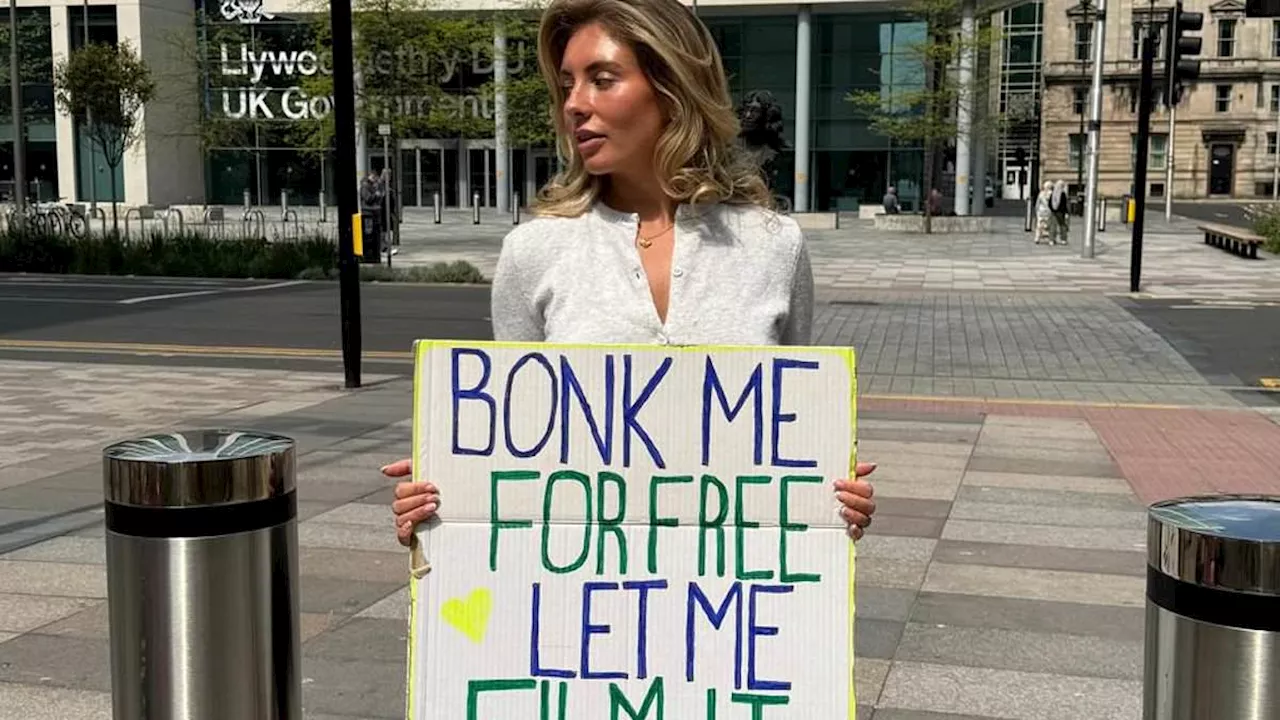
You've probably seen the name floating around TikTok or X lately, usually accompanied by a mix of confusion, outrage, and genuine curiosity. It’s the Bonnie Blue glass box game, a phrase that sounds like some weird indie horror flick but is actually rooted in a very real, very controversial promotional stunt involving adult creator Bonnie Blue. It’s messy. It’s loud. And honestly, it’s a perfect case study in how modern "clout" culture collides with public spaces.
The whole thing kicked off when Bonnie Blue—an Australian creator who previously made headlines for her "schoolies" tour—decided to take her brand to the streets of the UK. She didn't just walk around with a flyer. She hopped inside a literal glass box.
People were losing their minds.
What the Bonnie Blue glass box game actually is (and isn't)
Let’s get the facts straight because the internet loves to telephone-game these things into something they aren't. The "game" wasn't a digital app or a literal board game. It was a live, physical activation where Bonnie Blue sat inside a transparent enclosure in high-traffic areas, like outside football stadiums or busy city centers. The goal? To get people to interact, subscribe to her platform, or simply film the spectacle to drive her social media metrics through the roof.
It’s basic marketing turned up to eleven.
Think back to those old-school street performers or David Blaine stunts. Same energy, different industry. She used the glass box as a barrier that somehow made the interaction feel more "exclusive" while being completely public. It was designed to be filmed. It was designed to be viral.
The "game" part comes from the interaction. Fans or passersby would approach the box, sometimes paying for a quick interaction or just trying to get a selfie through the glass. It created this weird, fishbowl effect where the crowd became part of the performance.
Why the UK went into a frenzy over this
It wasn't all just "likes" and "shares." The Bonnie Blue glass box game hit a massive wall of resistance, specifically when she showed up near football grounds. For example, her appearance near Anfield in Liverpool caused an absolute stir. Local authorities and residents weren't exactly thrilled about an adult content creator setting up a transparent booth right where families and kids walk to see a match.
The backlash was instant.
Some called it a public indecency issue. Others argued it was just a clever use of public space for advertising. The police eventually had to get involved in several instances, citing "breach of the peace" or public order concerns. You’ve got to wonder what the pitch meeting for this looked like. "Hey, let's put a controversial figure in a box and see how long it takes for a riot to start."
It worked, though. Her name was everywhere.
The logistics of a glass box stunt
How do you even pull this off? You need a trailer, a custom-built acrylic or glass enclosure, and a security team that doesn't mind getting yelled at by strangers. It’s not cheap. The glass box itself has to be reinforced because, let’s be real, people are unpredictable.
During the tour, the box moved from city to city. It became a sort of "where is she now?" tracker on social media. People would post live updates like they were spotting a rare Pokémon.
- Location scouting: Usually near stadiums or nightlife hubs.
- Security: Heavily present to manage the crowds.
- Duration: Often short-lived before police moved the setup along.
The legal grey area of public adult promotion
This is where it gets kind of technical. In the UK, and most of the West, there are very specific laws about "outraging public decency." Does sitting in a box, fully clothed, while promoting an adult site count? It’s a legal tightrope.
Bonnie Blue wasn't performing explicit acts in the box. If she were, she’d have been arrested in five minutes. Instead, she was "brand building." Because she stayed within the letter of the law regarding clothing and behavior, it became a headache for councils. They couldn't necessarily bust her for the content of her job, only for the obstruction of the sidewalk or the lack of a specific street-trading permit.
It’s a loophole.
It’s the same loophole used by those "Bikini Baristas" or controversial billboard campaigns. If you don't cross the line into "obscene," you’re basically just an annoying person in a box. And being annoying isn't a crime.
Why this matters for the future of "Creators"
We are entering an era where the digital world is desperate to break into the physical one. We see it with YouTuber pop-up shops and streamer meet-and-greets that turn into North Hollywood-style shut-downs. The Bonnie Blue glass box game is just the adult industry's version of that.
It highlights a massive shift in how people view "fame." It’s no longer about being liked; it’s about being seen. Even the people who showed up to boo her were contributing to the "game." Every angry tweet, every "look at this trash" TikTok—it all fuels the algorithm.
She basically gamified outrage.
Separating the rumors from the reality
You might have heard that people were "playing" a game where they could win time with her. Mostly false. While her platform (the one starting with O) has its own set of rules and interactions, the physical glass box was primarily a "look but don't touch" marketing billboard.
There were rumors of "challenges" involved, but these were largely fabricated by commenters trying to add spice to the story. The reality was much more mundane: it was a woman in a box with a QR code.
That’s it.
The "game" was the spectacle itself. The "win" for her was the subscription count. The "win" for the public was a viral video they could post to their own feeds. Everyone got a piece of the clout pie, even if the pie tasted a bit like exhaust fumes and controversy.
What happened when the box stopped moving?
Eventually, the heat gets too high. Between the police pressure and the logistical nightmare of hauling a glass room across the country, the tour eventually wound down. But the blueprint is there now. Don't be surprised if you see other creators—not just in the adult space, but gamers and "influencers"—using similar tactics.
The glass box is a metaphor. It’s the screen we all stare at every day, just made physical.
Actionable Takeaways
If you're following the Bonnie Blue glass box game or looking at it from a marketing perspective, here is the reality of what just happened:
- Understand the "Outrage Economy": Negative attention often converts just as well as positive attention if the goal is raw traffic. Bonnie Blue didn't care if people liked the box; she cared that they talked about it.
- Know Local By-laws: If you're ever planning a stunt like this, "Public Order" acts are the biggest hurdle. Most of these events end because of permits, not because of the content.
- The Digital-Physical Bridge: QR codes on physical objects in high-traffic areas are currently the most effective way to funnel "offline" people into "online" subscribers.
- Security is Non-Negotiable: Any stunt that involves a controversial figure in a public space requires professional, high-level security to prevent "protest" from turning into "physical confrontation."
The next time you see a transparent box in the middle of a city square, you'll know exactly what's going on. It's not a game. It's an ad. And you, just by looking at it, are playing your part.