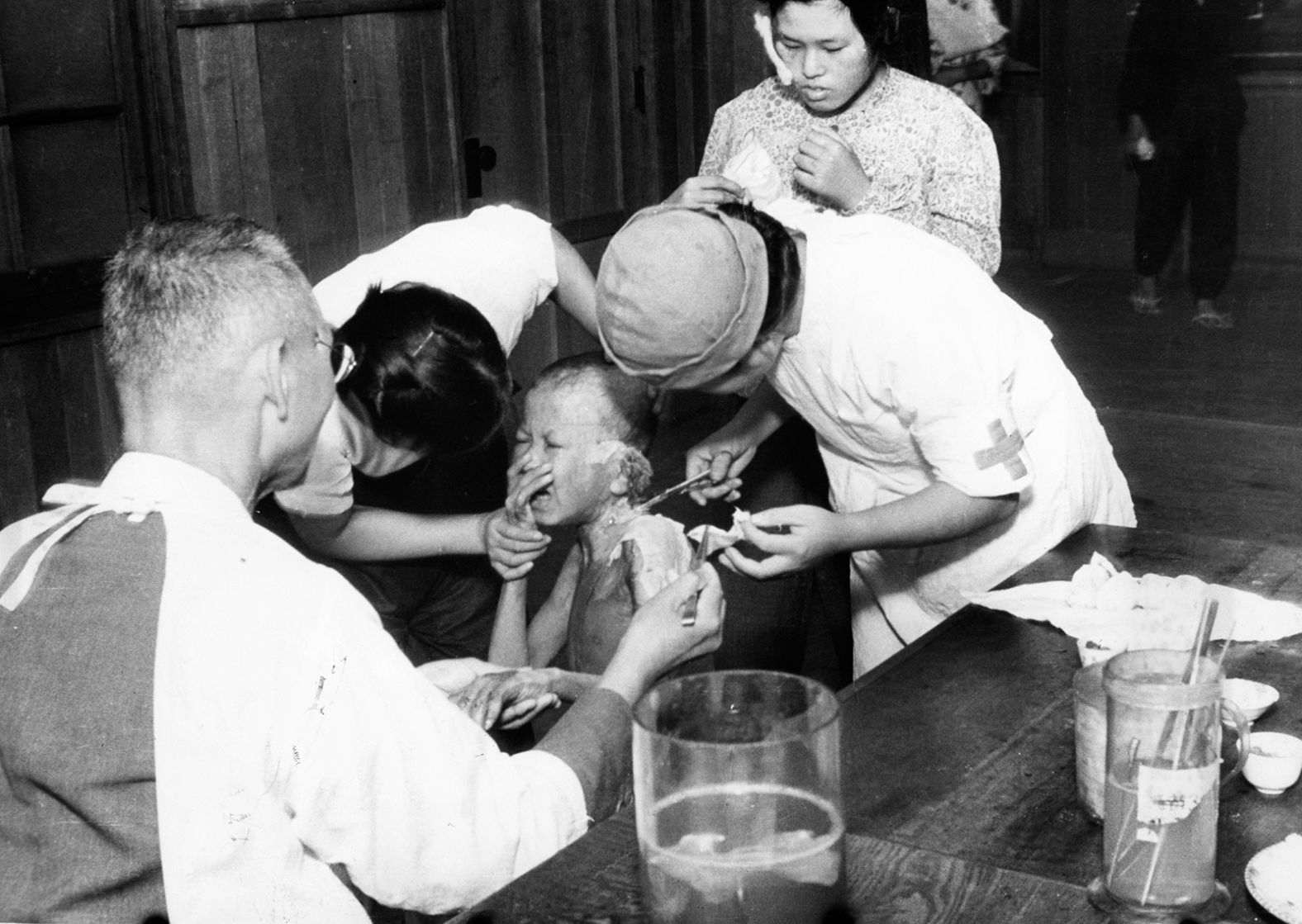
It was 8:15 AM. A Monday. People were heading to work, kids were settling into classrooms, and then the world basically ripped open. When the "Little Boy" atomic bomb detonated over Hiroshima on August 6, 1945, it didn't just destroy a city; it created a visual record of suffering that most of us honestly can’t even comprehend. We talk about history in textbooks, but hiroshima bomb victims pictures tell a story that words usually fail to capture. They aren't just historical artifacts. They are warnings.
The images are brutal.
You’ve probably seen the famous mushroom cloud photo taken from the Enola Gay. It’s clinical. Detached. But the photos taken on the ground—often by survivors using salvaged cameras—are a whole different reality. They show the "keloid" scars, the tattered clothing fused to skin, and the haunting "shadows" left behind where people once stood. Looking at them feels intrusive, yet necessary.
The photographers who risked everything to document the aftermath
Most of the early photos we have weren't taken by professional news crews with high-end gear. They were taken by people like Yoshito Matsushige. He was a photographer for the Chugoku Shimbun. On the day of the blast, he was only a couple of kilometers from the hypocenter. He had his camera. He saw the devastation. But he later admitted that for hours, he couldn't bring himself to press the shutter. It felt too cruel. Eventually, he took just five pictures. Five. Those five images are some of the only visual records from the actual day of the bombing. They show people huddled by the Miyuki Bridge, skin hanging from their bodies, trying to process a nightmare that didn't have a name yet.
The US military eventually arrived and took their own photos, but many of those were classified for years. They wanted to study the effects of radiation, not necessarily show the world the human cost. This created a weird gap in history where the most visceral hiroshima bomb victims pictures were kept in vaults while the public only saw the "clean" aerial shots of rubble.
Understanding the "Shadows" of Hiroshima
One of the most chilling types of imagery from that day isn't actually a photo of a person. It’s a "shadow." When the thermal flash hit, it was so hot—thousands of degrees—that it literally bleached the concrete and stone around the city. If a person was sitting on a set of stairs or standing against a wall, their body shielded the surface behind them from the radiation.
The result? A dark silhouette of a human being burned into the ground.
One of the most famous examples is the "Human Shadow Etched in Stone" at the Sumitomo Bank branch. Someone was sitting on the steps waiting for the bank to open. In a fraction of a second, they were gone. Only their shadow remained. When you see pictures of these shadows, it hits you differently than a graphic wound. It’s the visual representation of a life being deleted. It's haunting.
Why these images were censored for years
For a long time, the world didn't see the full extent of the horror. During the Allied occupation of Japan, there was a lot of "Code for Press in Japan" stuff going on. Basically, censorship. The US government didn't want the "moral high ground" of the war's end to be muddied by photos of children with radiation sickness. They confiscated film. They restricted what Japanese journalists could publish.
It wasn't until the 1950s, particularly after the occupation ended, that magazines like Life and various Japanese publications began showing the world what it actually looked like to survive an atomic blast. We started seeing the "Hibakusha"—the survivors. We saw the permanent scarring and the way the radiation affected their health years later. These weren't just "war photos." They were medical evidence of a new kind of hell.
The trauma of the Hibakusha
Being a victim in Hiroshima didn't end when the fire stopped. The pictures taken in the weeks and months after show people dealing with "A-bomb disease." Their hair fell out. Purple spots appeared on their skin. Doctors at the time were baffled because they’d never seen anything like it.
The photos of these survivors are heavy with a specific kind of dignity. Take Sadako Sasaki, for instance. She was two when the bomb fell. She survived the initial blast but later developed leukemia. While there aren't many "graphic" photos of her, the images of her paper cranes—her attempt to fold 1,000 of them to gain a wish for life—became a different kind of visual record. It’s a softer, but equally heartbreaking, side of the victim narrative.
What most people get wrong about the visual record
There’s a common misconception that there are thousands of high-def photos of the immediate aftermath. There aren't. Most of what we see are black and white, grainy, and often damaged. The heat and radiation actually ruined a lot of the film that was in the city.
Also, many people confuse pictures from the firebombing of Tokyo with Hiroshima. While both were horrific, the "look" of Hiroshima was unique because of the "black rain." Shortly after the explosion, highly radioactive soot and dust mixed with water vapor in the atmosphere and fell as thick, oily black rain. There are a few rare photos of people with this black residue streaking down their faces. It wasn't just rain; it was liquid poison.
The ethical debate over showing the most graphic images
Should we even be looking at these? It's a fair question. Some of the hiroshima bomb victims pictures are so graphic—showing severe burns and the literal melting of features—that museums like the Hiroshima Peace Memorial Museum have to be very careful about how they display them. There's a fine line between "educating the public" and "exploiting trauma."
But the survivors themselves, the Hibakusha, have often been the loudest voices in favor of showing the truth. They don't want the world to forget. They know that if the images are tucked away or "sanitized," the risk of it happening again goes up. They use their own bodies and their own family photos as a form of activism.
The technical side: Restoring the past
In recent years, there’s been a push to colorize some of these images. Some people hate it. They think it makes the tragedy look like a movie. Others argue that colorization makes the victims look more "human" and less like distant historical figures. When you see the bright red of a burn or the specific blue of a student’s uniform, the 80-year gap between us and them sort of vanishes.
Researchers at places like the Hiroshima Peace Memorial Museum work tirelessly to verify the identities of people in these photos. For decades, many victims were just "unidentified." Now, through crowdsourcing and archives, names are being put to faces. This turns a "victim picture" back into a "family member picture."
The reality of the "Black Rain" photos
One thing you'll notice if you look deep into the archives is the sheer amount of rubble. People often focus on the people, but the landscape photos are what show the scale. Hiroshima was flat. The "T-shaped" Aioi Bridge, which was the target, survived, but almost everything else was pulverized. Seeing a photo of a single bicycle fused to a concrete wall tells you everything you need to know about the pressure wave.
How to approach this history with respect
If you are looking for these images or researching the topic, it’s important to go to the primary sources. Random Google Image searches often lead to mislabeled photos or "shock" sites.
- The Hiroshima Peace Memorial Museum website is the gold standard. They have digitized much of their collection and provide context for every photo.
- The National Archives (USA) holds many of the declassified military photos.
- The Chugoku Shimbun archives contain the local perspective, including those first five photos by Matsushige.
Looking at hiroshima bomb victims pictures isn't about being morbid. It’s about witnessing. It’s about acknowledging that on a random Monday morning, tens of thousands of lives were ended or forever changed by a single weapon.
Actionable steps for further learning
If you want to understand the human side of this history beyond just the photos, there are a few things you can do that are more meaningful than just scrolling through images.
- Read "Hiroshima" by John Hersey. It was published just a year after the bomb and follows six survivors. It provides the "narrative" to go along with the pictures you see. It's probably the most important piece of journalism from the 20th century.
- Visit the virtual tours of the Peace Memorial Park. Many of the sites where famous photos were taken are now preserved. Seeing the "then and now" comparison is incredibly powerful.
- Support Hibakusha testimony projects. Many of the last survivors are now in their 80s and 90s. Organizations are recording their stories so that when the photos are all we have left, we still know the voices of the people in them.
- Look into the "1000 Crane" story. It’s a way to engage with the history that focuses on hope and peace rather than just the destruction.
The photos aren't there to scare us. They are there to remind us of what happens when we stop seeing each other as people. Every face in those pictures had a name, a favorite food, a morning routine, and a family. That’s the most important thing to remember.