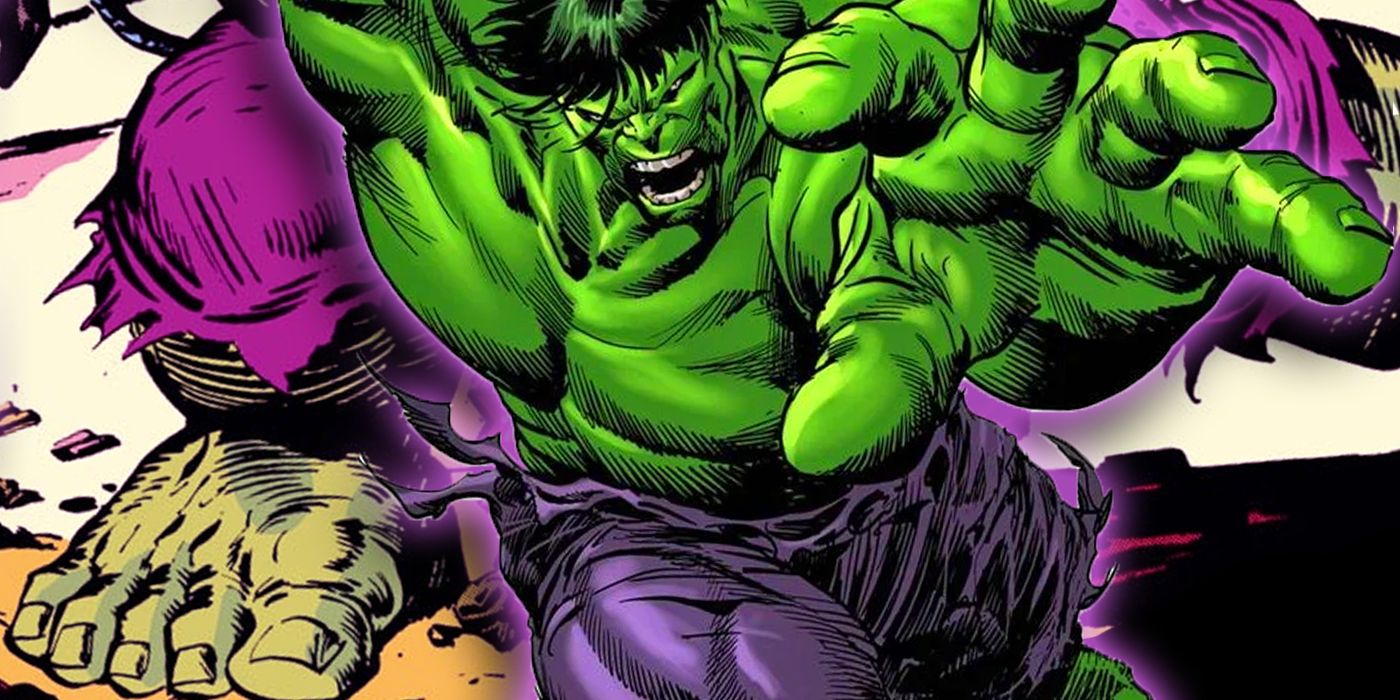
Ever wonder why a guy who turns into a giant green rage-monster somehow always keeps his dignity? It’s the pants. Specifically, the incredible hulk purple pants. They’ve survived tank shells, falls from the stratosphere, and muscle mass increases that should, by all laws of physics, leave Bruce Banner completely naked in a crater.
It’s weirdly consistent.
Whether it's the 1960s comics or the high-budget MCU films, those trousers are the hardest-working garment in fiction. They don't just stay on; they stay purple. But there’s actually a mix of real-world printing history and "comic book science" that explains why this specific fashion choice became the character's literal and figurative safety net.
The Printing Glitch That Changed Everything
Stan Lee and Jack Kirby didn't initially sit down and decide the Hulk needed to be a fashion icon for the color violet. In Incredible Hulk #1 (1962), he was actually grey. The colorist, Stan Goldberg, struggled with the grey ink. Back then, four-color printing (CMYK) was finicky. Grey often came out looking green, or blue, or even a muddy brown depending on the page.
By the second issue, they made him green. It popped. It was easy to keep consistent.
But what do you pair with green? If you look at a color wheel—the kind artists use to create contrast—purple is the direct complementary color to green. If Banner wore blue jeans, they’d blend into the shadows. If he wore khaki, it would look dull. Purple made the character visually "electric." It was a practical solution to a 20th-century printing problem that inadvertently created a legend.
Honestly, it's kind of a miracle we didn't end up with a Hulk in bright orange slacks.
How Do Incredible Hulk Purple Pants Actually Stay On?
This is the question that has kept nerds arguing in comic shops for sixty years. How does a size 32-waist pair of slacks expand to fit a 600-pound behemoth?
Marvel has offered a few "official" explanations over the decades. The most famous one involves Reed Richards. Yes, Mr. Fantastic himself. In several iterations of the lore, it’s suggested that Banner uses "unstable molecules." This is the same stuff the Fantastic Four use so Human Torch doesn't burn his clothes off. Banner, being a genius nuclear physicist, presumably had access to some high-tech fabrics.
But that’s a retcon.
The real reason is the Comics Code Authority. Back in the day, you couldn't have a naked superhero. It just wasn't happening. So, the pants became "indestructible" by editorial decree. They are the strongest material in the Marvel Universe, surpassing Adamantium and Vibranium. They are made of "Plot-Armor-Ite."
The MCU Shift and Real-World Physics
When the Marvel Cinematic Universe kicked off, they had to address the absurdity of the incredible hulk purple pants. In 2008’s The Incredible Hulk, we see Edward Norton’s Bruce Banner specifically buying stretchy, oversized sweatpants from a market. It was a grounded take.
Later, in The Avengers (2012) and Age of Ultron, the pants evolved. If you look closely at the CGI models used by ILM and Digital Domain, the pants have a micro-weave texture. They look like high-end athletic compression gear. They aren't just "purple pants" anymore; they are tactical trousers designed to expand.
Under Armor actually capitalized on this, releasing "Alter Ego" compression gear. It turns out, if you want your pants to survive a Hulk-out, you need a high spandex-to-cotton ratio.
Why Purple Specifically?
- Complementary Colors: As mentioned, green and purple sit opposite each other. It’s why the Joker wears purple. It’s why Lex Luthor’s suit is purple and green. It creates a visual tension that feels "radioactive" or "unnatural."
- Signifier of Royalty and Madness: Historically, purple dye was expensive. In fiction, it often denotes someone who is "apart" from society. For Banner, it marks his exile.
- Brand Recognition: If you see a shredded pair of purple fabric, you don't think of Barney the Dinosaur. You think of a Gamma-irradiated scientist.
What Most People Get Wrong About the Shreds
People often think the Hulk's pants are just magically indestructible. They aren't. In almost every comic run, from Peter David’s iconic 12-year stint to Al Ewing’s Immortal Hulk, the pants are constantly being destroyed. They usually rip at the calf and the thigh.
The "miracle" is always the waistband.
There’s a subtle psychological element here. Stan Lee once joked in an interview that Bruce Banner must just buy his pants at a store that sells "extra-stretchy" materials. But deeper than that, the tattered remains of the incredible hulk purple pants represent Banner’s lingering humanity. As long as he’s wearing a piece of his "human" life, he hasn't fully turned into a monster.
When the Hulk goes completely "Worldbreaker" and the pants start to fail, you know the world is in trouble.
The Evolution of the Shade
Not all purples are created equal. In the 70s TV show starring Lou Ferrigno, the pants were often more of a denim blue-purple. They had to look "real" for a live-action audience. In the Ultimate Marvel line, they shifted him to grey or tan pants to make it feel more like a "government experiment gone wrong" and less like a circus act.
Yet, the purple always comes back.
Fans rejected the tan pants. They felt wrong. There is a specific visual DNA to the Hulk that requires that splash of violet. It's a reminder that comics are, at their heart, a medium of bold colors and impossible physics.
Actionable Takeaways for Fans and Cosplayers
If you're looking to replicate the look or just want to understand the "science" of the garment, here is the breakdown.
1. Fabric Choice Matters
If you’re cosplaying, don't use 100% cotton. It will rip, and not in the way you want. Look for a "Bengaline" fabric or a heavy spandex blend. These have a 4-way stretch that mimics the "unstable molecules" of the comics.
2. The Weathering Technique
To get that "just survived a gamma blast" look, don't use scissors. Scissors leave clean lines that look fake. Use a cheese grater or a wire brush on the edges of the purple fabric. It frays the threads naturally, making it look like the fibers snapped under pressure.
3. Color Matching
The "canonical" purple isn't a pastel. It’s a deep violet or "royal purple." If you’re buying dye, look for Rit Dye in "Purple" or "Violet" and mix in a tiny amount of "Navy Blue" to take the "brightness" off and make it look more like a heavy-duty work pant.
The incredible hulk purple pants are more than just a meme. They are a masterclass in character design. They bridge the gap between a 1960s printing error and a multi-billion dollar movie franchise. They represent the thin line between the man and the beast—a line that is apparently held together by some very, very strong elastic.
To truly appreciate the character, you have to appreciate the wardrobe. Next time you see the Hulk smash a skyscraper, take a second to look at the seams of his trousers. That's the real hero of the story.
Next Steps for Enthusiasts
- Check the Fabric: If buying "Hulk" themed apparel, ensure it is a polyester-elastane blend for the authentic stretch experience.
- Source the Classics: Look for Incredible Hulk #1 (1962) and The Ultimates #1 to see the two extremes of Hulk's fashion evolution.
- DIY Distressing: Use a sandpaper block (80 grit) to distress the hems of purple chinos for an accurate, battle-worn aesthetic.