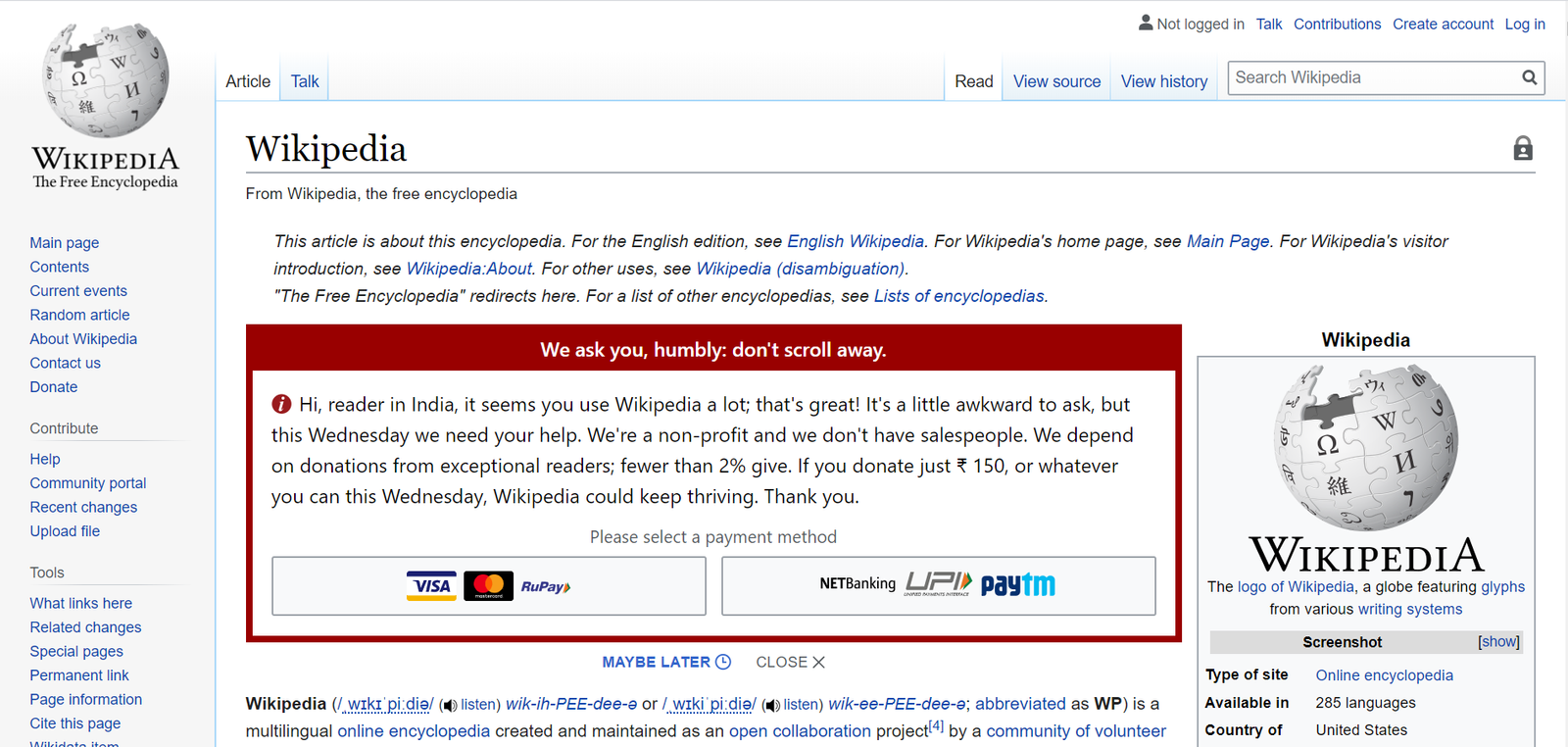
You’ve seen it. That giant, slightly desperate-looking banner at the top of the page. It usually features a photo of Jimmy Wales looking intensely at you, or perhaps a sincere message from a librarian-type figure. The text is usually some variation of "we don't have ads" and "if everyone reading this gave $3, we’d be done in an hour." It feels urgent. It feels like if you don't click that donate button, the world’s collective knowledge might just vanish into a 404 error by Tuesday.
But why is Wikipedia asking for money when it seems like they’re doing just fine?
It’s a fair question. Honestly, it's one that surfaces every single time the fundraising drive kicks off. Wikipedia is the seventh most visited website on the planet. It’s the backbone of Siri, Alexa, and every high school history paper written since 2005. Yet, despite its ubiquity, the organization behind it—the Wikimedia Foundation (WMF)—operates in a way that feels totally alien to the Silicon Valley "move fast and break things" ethos.
The short answer? They want to stay independent. The long answer? It’s complicated, involving massive endowment funds, skyrocketing personnel costs, and a philosophical debate about how much a "free" encyclopedia should actually cost to run.
The "End of the World" Marketing Strategy
One reason people get annoyed is the tone of the appeals. If you read the banners, you might think the servers are about to be repossessed. In reality, Wikipedia is not in any danger of shutting down. Not today. Not next month.
The Wikimedia Foundation has been incredibly successful at fundraising. So successful, in fact, that they have hundreds of millions of dollars in the bank. According to their 2022-2023 financial reports, the WMF held over $250 million in net assets. On top of that, they launched the Wikimedia Endowment, a separate "rainy day" fund managed by Tides Foundation, which hit its $100 million goal years ahead of schedule.
So, why the drama?
It’s basically a marketing tactic. Direct, urgent appeals work. If the banner said, "Hey, we’re doing pretty well, but we’d like to hire a few more developers and maybe upgrade a server in Singapore," nobody would click. By framing it as a grassroots struggle for survival, they tap into the user's sense of "public good." You aren't just paying for a website; you're protecting the "sum of all human knowledge."
Where Does Your $3 Actually Go?
When you drop a few bucks into the virtual tip jar, it doesn’t go to the volunteer editors. Most people don't realize that the people actually writing the articles—the ones arguing over the exact wording of the "Mughal Empire" page or patrolling for vandalism on celebrity bios—are unpaid volunteers. There are thousands of them. They do it for the love of the game.
The money goes to the Wikimedia Foundation, the non-profit that provides the infrastructure.
1. Servers and Engineering
This is the obvious part. Hosting a site that gets billions of hits a month is expensive. They have data centers in Virginia, Texas, the Netherlands, and Singapore. They need to ensure the site stays up under massive load, stays fast in developing nations, and remains secure from DDoS attacks. However, "internet hosting" is actually a relatively small slice of their budget—usually less than 10%.
2. The Growing Staff
This is where the controversy starts. In the early 2000s, the WMF was a tiny team. Today, they have over 700 employees. Salaries and wages are the largest expense by far. They hire software engineers, lawyers to fight "right to be forgotten" requests, and community organizers to help support volunteer groups in places like India or Nigeria.
Critics, including some long-time volunteer editors, argue that the Foundation has become "bloated." They point to the fact that the site's core functionality hasn't changed much in twenty years, yet the payroll has exploded. The Foundation counters that maintaining a top-10 global website in a modern security environment requires professional-grade talent that doesn't come cheap.
3. Global Outreach and Grants
A significant chunk of the money is distributed as grants. They fund "Chapters"—local organizations like Wikimedia Deutschland or Wikimedia UK. These groups run photography contests (like Wiki Loves Monuments), digitize library archives, and host edit-a-thons to bridge gender and diversity gaps in content.
The Ad-Free Mandate
The most obvious way to fund Wikipedia would be to run a few Google ads. If Wikipedia put a single banner ad on their pages, they would be one of the wealthiest media companies on earth overnight. They could stop asking for money forever.
But they won't do it.
The leadership believes—and they're probably right—that ads would compromise their neutrality. If a major pharmaceutical company is a top advertiser, would Wikipedia be as quick to host a scathing "Controversies" section on that company's page? Even the perception of bias would kill the brand. By relying on millions of small donations (the average is around $15), they ensure they aren't beholden to any single corporate master.
The Wikimedia Enterprise Shift
Recently, the "why is Wikipedia asking for money" conversation got a new layer. They launched Wikimedia Enterprise.
This is a commercial product. Big Tech companies like Google, Amazon, and Apple have been "scraping" Wikipedia for years to power their AI and info-boxes. They were essentially getting the labor of Wikipedia for free. Wikimedia Enterprise is a way for these giants to pay for a "high-speed" data feed that is easier for their systems to digest.
It’s a smart move. It moves some of the financial burden off the individual donor and onto the tech titans who benefit most from the data. But even with this new revenue stream, the WMF says they will continue to ask users for donations because they want to remain a "community-supported" project.
The Misconception of "Free"
We’ve been conditioned to think everything online should be free, but the "free" sites we use usually sell our data or melt our brains with ads. Wikipedia is one of the last holdouts of the "Old Internet"—a place that just wants to give you information without trying to sell you a mattress or track your location.
When you ask why they are asking for money, you’re really looking at the cost of independence. It costs money to be unbought. It costs money to have a legal team that can tell a government "no" when they want a page censored. It costs money to make sure a kid in a rural village with a 2G connection can access the same encyclopedia as a Harvard professor.
How to Approach the Donate Banner
Next time you see the banner, don't feel guilty, but don't feel lied to either.
Wikipedia isn't going broke. They aren't going to turn off the lights if you don't give. They have enough in the bank to run the servers for years even if donations stopped tomorrow.
However, if you value the fact that you can look up the history of the "Punic Wars" at 3:00 AM without being tracked by sixteen different ad networks, it’s a service worth a few bucks. Think of it less like a "save the whales" emergency and more like a subscription to a public utility—like a library or a park.
Actionable Takeaways for Users
If you are skeptical but still want to support the mission of free knowledge, here is how to handle the fundraising season:
- Check the Annual Report: The Wikimedia Foundation is a 501(c)(3) non-profit. Their Form 990 filings and annual reports are public. If you’re curious where the millions go, go look at the "Program Services" vs. "Fundraising" breakdown. It’s all there.
- Give Small: You don't need to be a "hero." The Foundation thrives on the sheer volume of $5 and $10 donations.
- Support Local Chapters: If you don't like how the central Foundation spends money, look into your local chapter. These groups often do the "on the ground" work of getting more people to contribute to the actual content of the site.
- Volunteer Instead: The best way to "pay" Wikipedia back isn't with a credit card. It’s by fixing a typo, adding a citation to an unsourced claim, or expanding a stub article about your hometown. That labor is the true currency of the site.
The reality is that Wikipedia's financial model is weird because Wikipedia itself is a weird, beautiful anomaly. In a world of paywalls and algorithmic outrage, it remains a boring, text-heavy, pedantic, and utterly essential oasis. They ask for money because they can, because it works, and because it keeps them from having to become like everyone else.