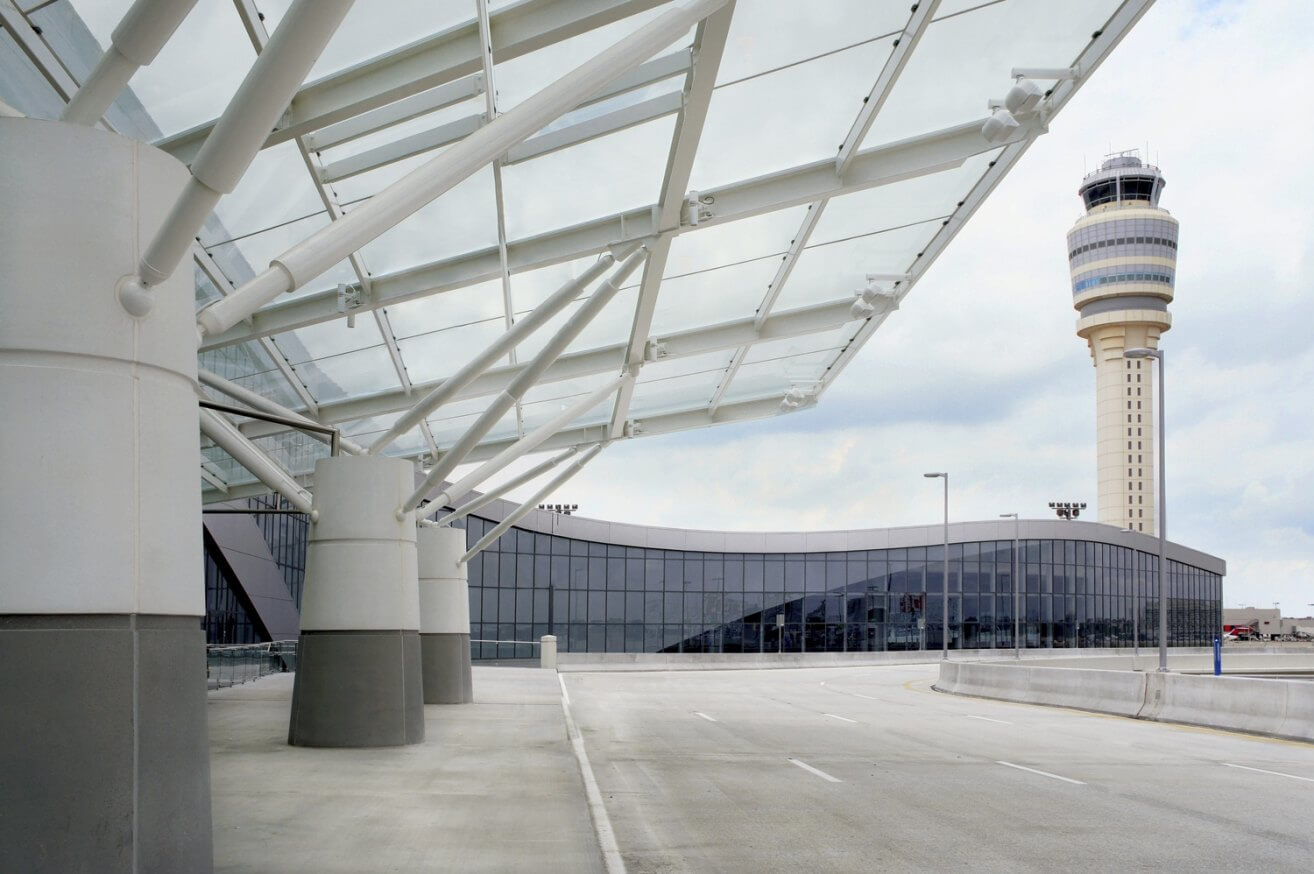
It is huge. 1.2 million square feet, to be exact. If you’ve ever flown through Hartsfield-Jackson Atlanta International Airport, you know the feeling of being a tiny ant in a massive, glass-walled hive. Most people just call it "the international terminal," but the Maynard Jackson Intl Terminal is more than just a place where you show your passport. It’s a logistical beast. Honestly, if you don't know which entrance to use, you might end up in a different zip code than your luggage.
People get lost here. A lot.
The terminal, named after Atlanta’s first African American mayor, opened back in 2012 to solve a massive headache: the old Concourse E was bursting at the seams. Now, we have Concourse F. It’s shiny. It’s got floor-to-ceiling windows. But it also has a completely separate road system from the domestic side of the airport. If you’re coming from I-75 and you follow the wrong sign, you’re basically looking at a 20-minute detour just to get back to where you started.
The Two-Entrance Trap
One thing people always get wrong is the separation between domestic and international. They are miles apart. Literally. If you are flying Delta to Paris, you go to the Maynard Jackson Intl Terminal. If you are flying Delta to Savannah, you go to the Domestic Terminal. Simple, right?
Not really.
What happens if you’re flying to London but your first leg is a connection in JFK? You’re technically on an international itinerary, but you’re departing from a domestic gate. You check in at Domestic. If you show up at Maynard Jackson for a domestic flight because you "saw it on the ticket," you’re going to have a bad time. There is no TSA PreCheck at the international terminal for domestic-only flights, and you cannot check domestic bags there.
Wait. Let me rephrase that.
You can check in at Maynard Jackson if your final destination is international, even if your first stop is domestic. But you can't do it the other way around. It’s one of those weird airport rules that keeps the shuttle drivers busy. The shuttle between the two terminals takes about 15 minutes, and that’s if traffic is behaving. It usually isn't.
Architecture That Actually Works (Mostly)
The design of the Maynard Jackson Intl Terminal was a joint venture between several firms, including Gresham, Smith and Partners. They wanted to get rid of that "basement" feel that many older airports have. It worked. The terminal is flooded with natural light.
You’ve got 12 gates in Concourse F. That sounds small compared to the rest of ATL, but these gates are massive. They are built for the "heavies"—the Airbus A380s and Boeing 747s. When an A380 unloads, you’re talking about 500+ people hitting customs at once.
Customs and the "Atlanta Recheck"
This is where the real stress happens.
If Atlanta is your first point of entry into the U.S., you have to grab your bags. Even if they are tagged to your final destination in Birmingham or Nashville. You pick them up, walk through customs, and then drop them back on a belt. It feels redundant. It feels like a waste of time. But it’s federal law.
The Maynard Jackson Intl Terminal made this slightly less painful by introducing "Arrivals" and "Departures" levels that actually make sense. If you are a local—meaning Atlanta is your final stop—you grab your bags and walk straight out to the curb. You don't have to lug your suitcases through a security re-check or ride the Plane Train. This was a massive upgrade over the old system where everyone was funneled into the same bottleneck.
What's Inside? (Besides Expensive Coffee)
Let's talk food. Airport food is usually a sad affair of soggy sandwiches.
Concourse F is slightly better. You’ve got the Varsity (because, Atlanta), but you also have Ecco. Honestly, if you have a two-hour layover, sitting at the bar at Ecco with a glass of wine and some fried goat cheese is the only way to survive. It doesn't feel like an airport.
There’s also the Delta Sky Club. It has an outdoor "Sky Deck." If you’re an aviation nerd, this is holy ground. You can sit outside, feel the jet fumes (maybe don't breathe too deep), and watch the takeoffs on 27L. It’s one of the few places in a modern U.S. airport where you can actually be outside after passing security.
- The Art Program: There’s a massive installation called "Airfield" by Amy Landesberg. It’s made of hundreds of translucent "flaps" that mimic the movement of birds or planes. It’s cool. It’s also a good landmark if you lose your travel partner.
- The Quiet: Because Concourse F is at the very end of the line, it’s often quieter than Concourses A or B. If you need to sleep, head to the far end of F.
- The Plane Train: It goes all the way there. Just remember, it’s a long ride. From the Domestic terminal to F, it’s about a 10-minute journey underwater.
The Logistics of Parking
Parking at the Maynard Jackson Intl Terminal is its own specific saga.
There is an hourly deck and a "Gold Reserve" lot. It’s expensive. But the convenience is unmatched if you’re just doing a quick international hop. The real trick is the "International Park-Ride." It’s off-site but has a dedicated shuttle.
Don't make the mistake of parking at the Domestic North or South decks if you’re flying out of Maynard Jackson. You will have to take the Plane Train back to get your car, which means you have to go through security again. Or you take the "loop" shuttle, which circles the entire airport perimeter. It takes forever. Seriously.
Why the Tech Matters
Back in 2018, the Maynard Jackson Intl Terminal became the site of the first "biometric terminal" in the United States.
Basically, Delta and CBP (Customs and Border Protection) teamed up to use facial recognition instead of boarding passes. You look at a camera, it matches your face to your passport photo on file, and you walk on the plane. Some people find it creepy. Privacy advocates have plenty to say about it. But from a purely "I want to get home" perspective, it shaved minutes off the boarding process.
The facial recognition tech is now used at most gates in F and for entering the U.S. at customs. If you have Global Entry, it’s even faster. You don't even scan your passport anymore; the kiosk just recognizes your face and spits out a receipt. Or, increasingly, it just tells the officer you’re good to go.
Common Mistakes to Avoid
Most people think they can just "wing it" at ATL. You can't.
- Checking in at the wrong side: Always check your airline’s terminal. Foreign carriers (Lufthansa, British Airways, Air France, Qatar, etc.) always use Maynard Jackson. Delta is the wild card.
- Missing the last Plane Train: It runs 24/7, but during maintenance, it might slow down. If you’re stuck at Concourse F at 3:00 AM, it’s a very long walk back to the domestic baggage claim (about 1.2 miles).
- Forgetting the "Liquid" rule at re-check: If you bought duty-free booze in Frankfurt, you can't carry it through the TSA re-check in Atlanta unless it’s in a specific, sealed, tamper-evident bag (STEB). Even then, TSA might make you put it in your checked luggage.
The Maynard Jackson Intl Terminal is a marvel of engineering, but it's also a lesson in scale. It’s built for the future of travel—high tech, high volume, and high speed. But for the traveler on the ground, it’s just a place where you hope the lines are short and the Wi-Fi is strong.
Actionable Steps for Your Next Trip
Before you head to the airport, verify your terminal on the FlyDelta app or the Hartsfield-Jackson website. If your flight number is four digits and starts with a 3, 4, or 5, you might be on a regional partner—double-check that gate.
If you're driving, use the I-75 exit 239 for the International terminal. Do not use the Main Airport exit from I-85 unless you want to spend your morning on a shuttle bus.
Download the Mobile Passport Control (MPC) app if you don't have Global Entry. It’s a free way to skip the main customs line, and at Maynard Jackson, the MPC line is often shorter than the "regular" line.
Check the wait times for the "International" security checkpoint online before you leave the house. Sometimes it’s faster to go through the domestic side and take the train, but only if you aren't checking any bags.
Pack a portable charger. While Concourse F has plenty of outlets, the "power poles" are often crowded during the evening rush of flights to Europe and South America.