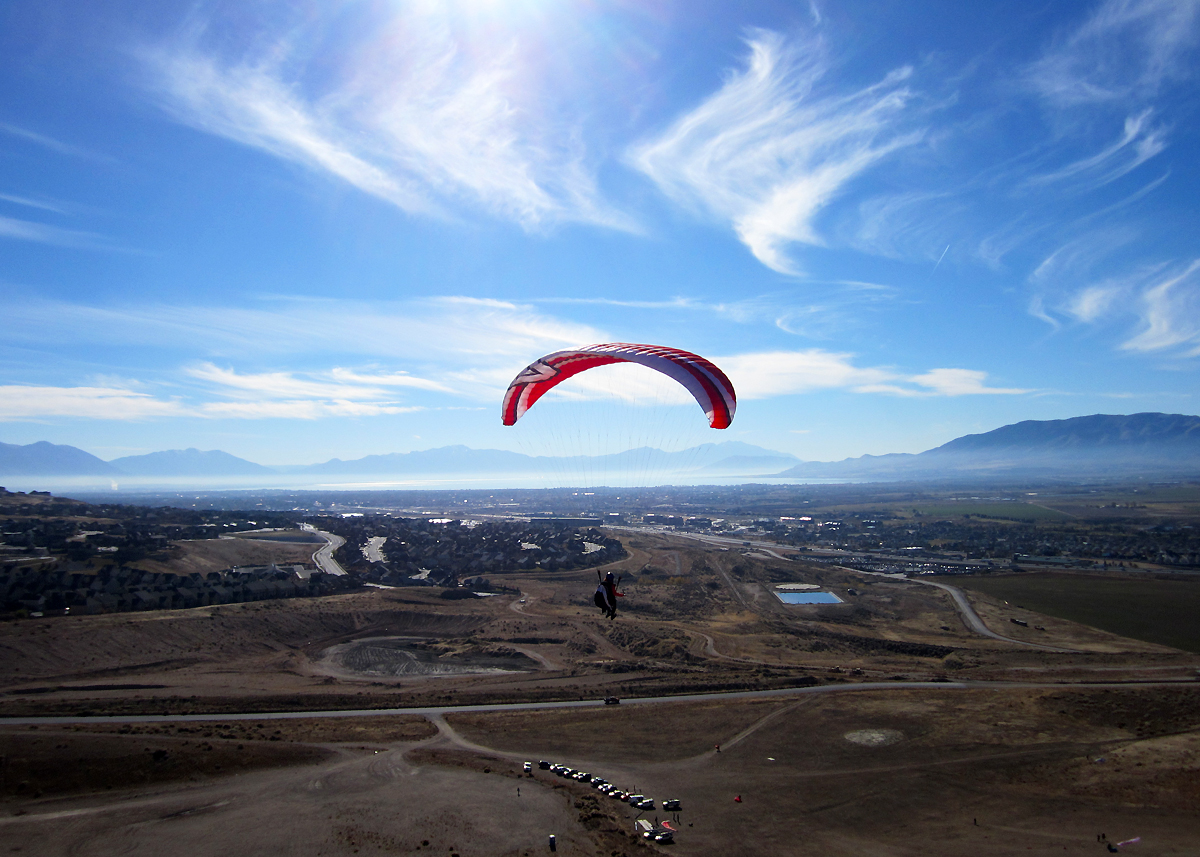
You’re standing on a giant pile of sand and gravel, looking down at a prison on one side and a sprawling suburban tech hub on the other. It doesn’t exactly scream "world-class aviation destination." But then the wind hits your face—smooth, consistent, and oddly predictable—and you realize why paragliding Point of the Mountain is basically the Mecca of foot-launched flight.
It's a geological fluke.
About 15,000 years ago, Lake Bonneville was a massive inland sea. As it drained, it left behind these enormous gravel benches right at the narrowest point between the Salt Lake and Utah Valleys. Because of the way the mountains bottle-neck here, the wind gets squeezed. It creates a laminar airflow that is so steady it feels like an invisible escalator.
If you want to learn to fly, you come here. If you want to test a new wing without dying, you come here. Honestly, if you just want to see fifty colorful kites hanging in the air like stationary ornaments, this is the spot.
The North vs. South Face Drama
Most flying sites give you one direction. You get what you get. But the Point is special because it has two distinct personalities: the North Side and the South Side.
The South Side is where the magic happens in the morning. As the sun heats up the Utah Valley floor, the air begins to rise and pull toward the mountain. Usually, by 7:00 AM or 8:00 AM, the "dawn patrol" is already out. It’s a ridge soaring paradise. You can stay up for hours just by crabbing back and forth along the ridge. It’s mellow. It’s easy. It’s where instructors take students for their first solo mountain flights because the air is usually buttery smooth.
Then everything changes around noon.
As the day heats up, the wind usually "switches." The South Side becomes turbulent and dangerous (rotary air is no joke), and everyone migrates over to the North Side. The North Side is different. It’s steeper. It’s higher. It’s where the high-performance pilots go to catch thermals and disappear into the clouds. On a good day, you can "bench up" from the North Side and fly all the way across the valley to the Wasatch Range.
Why the Geology Actually Matters
You've probably heard people call it a "dump." To be fair, there is a massive gravel pit nearby. But that's actually part of the secret sauce. The lack of heavy vegetation on the South Side means the ground heats up quickly and evenly.
In most mountain ranges, you have to deal with "mechanical turbulence"—wind hitting trees, jagged rocks, and canyons, which creates swirls and "rotors" in the air. At the Point, the shape of the hill is so aerodynamic that the air just follows the curve. It’s like a giant, natural wind tunnel.
There’s also the "lake effect" from the Great Salt Lake to the north and Utah Lake to the south. These massive bodies of water act as thermal regulators. They keep the air from getting too rowdy compared to the high-desert thermals you’d find in places like Arizona or Nevada.
The Logistics of Not Crashing
If you show up at the Flight Park State Recreation Area, you’ll see a bunch of people standing around staring at grass. They aren't bored; they’re "reading" the wind.
Paragliding is 90% waiting and 10% terrifying/sublime action.
You need a permit. Don't be that person who just rolls out a wing and tries to huck themselves off the hill. The Utah Hang Gliding and Paragliding Association (UHGPWA) manages the site, and because it’s a State Park, there are actual rules. You need a USHPA (United States Hang Gliding and Paragliding Association) rating. If you’re a student, you need to be with a certified instructor from one of the local schools like Super Fly or Cloud 9.
The "South Side" is technically the Flight Park State Recreation Area. It’s one of the only parks in the country dedicated specifically to non-motorized flight. It has a paved parking lot, bathrooms, and a wide, groomed launch area. It’s civilized.
The North Side is a bit more rugged. You’re launching off a steep slope near a bunch of high-end houses. If you blow your launch there, you’re hiking back up a very steep, dusty trail. It builds character. Or it just makes you really sweaty.
Common Misconceptions About the Point
People think paragliding is "falling with style." It's not.
At paragliding Point of the Mountain, you are often gaining altitude. I’ve seen pilots get stuck in the "green air" and struggle to come down because the lift was so strong.
Another big myth: "It’s safe because everyone does it."
The Point is actually one of the most crowded sites in the world. On a Saturday morning, there might be 40 wings in the air. Mid-air collisions are a real risk. You have to know the "rules of the road."
- The pilot with their right side to the ridge has the right of way.
- Overtake on the inside.
- Don't be a jerk.
Actually, the "don't be a jerk" rule is the most important one. Local pilots are protective of their site. If they see you doing something sketchy—like launching into a 20-mph gust or failing to clear your turns—they will call you out. It’s not because they’re mean; it’s because if too many people get hurt, the insurance premiums go up and the site gets shut down.
What to Expect if You're a Total Newbie
If you’ve never flown before, you’re likely looking for a tandem flight. You’ll be strapped into a harness in front of a certified instructor. They do all the work; you just have to run.
That’s the part that trips people up. You don't jump off the mountain. If you jump, you fall. You have to run down the slope until the wing lifts you off your feet. It feels like someone is grabbing you by the backpack and hoisting you toward the sky.
Once you’re up, it’s surprisingly quiet. No engine. Just the whistle of the lines and the occasional beep of a variometer (a device that tells pilots if they are going up or down). You can see the entire Salt Lake Valley. You can see the Oquirrh Mountains to the west and the towering peaks of the Wasatch to the east.
The "Micro-Climate" Warning
Salt Lake City weather is weird. Point of the Mountain weather is even weirder.
There’s a phenomenon called the "South Wind." If the wind is coming from the south at more than 15 mph at the airport, it might be 25 mph at the Point. This is called "venturi." Because the mountain narrows the gap, the wind speeds up.
Always check the sensors. There are weather stations right on the North and South faces. Local pilots use apps like Wind-speed or the UHGPWA website to check the live feeds. If the graph looks like a saw blade with huge spikes, stay on the ground. You want a nice, steady line.
Actionable Steps for Your First Visit
If you are serious about checking this out, don't just wing it.
- Check the Wind First: Visit the UHGPWA weather page. Look for winds between 6-12 mph for the South Side. If it's over 15 mph, it's for experts only.
- Visit in the "Golden Hours": For the South Side, be there by 7:30 AM. For the North Side, wait until after 5:00 PM in the summer.
- Bring Water and Dust Gear: It is a desert. The "dirt" at the Point is a fine, silty powder that gets into every crevice of your car and soul.
- Talk to the Locals: Find the "Shady Grove" (the cluster of trees/tents on the South Side). Ask someone who looks like they’ve been there a while about the current conditions. They'll tell you if it’s "crossing" or if a front is moving in.
- Sign the Waiver: Even if you’re just visiting, respect the site. If you plan to fly, get your USHPA membership and site intro sorted before you arrive.
The Point of the Mountain is a world-class resource that Salt Lake locals often take for granted. It’s one of the few places on Earth where the wind, the dirt, and the geography conspired to create a perfect playground for humans who want to pretend they’re birds. Just remember: the mountain always wins, so respect the wind.