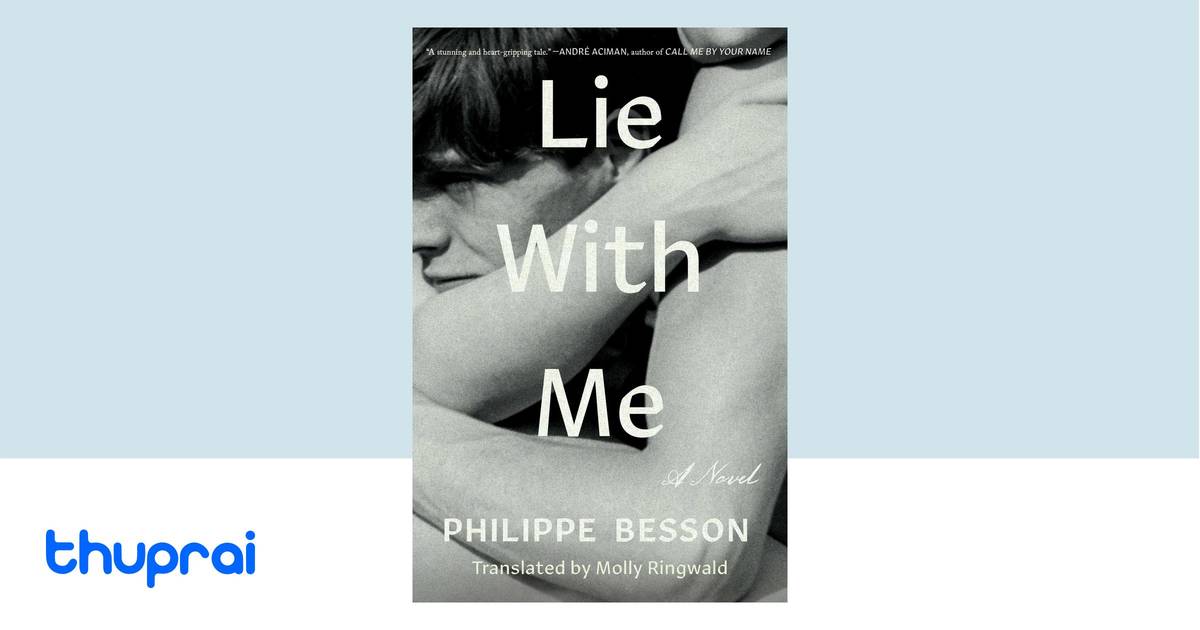
It’s just a slim book. You could probably finish the Lie With Me novel in a single afternoon if you really put your mind to it. But honestly? You probably shouldn't. It’s the kind of story that requires a bit of breathing room because, by the time you hit the final fifty pages, the emotional weight starts to feel like a physical pressure on your chest.
I remember the first time I picked up Philippe Besson’s masterpiece—originally titled Arrête avec tes mensonges in French—and thinking it was just going to be another "coming of age" story. I was wrong. It’s a ghost story, really. Not the kind with rattling chains or flickering lights, but the kind where the ghosts are just the versions of ourselves we had to kill off to survive high school.
The Raw Reality of Philippe Besson’s Memory
The Lie With Me novel isn't just a work of fiction. That’s the thing people often miss when they first dive in. It is deeply, painfully autobiographical. Besson writes as himself, looking back from the vantage point of a successful, middle-aged novelist who happens to see a face in a hotel lobby that looks exactly like his first love.
That first love was Thomas Andrieu.
In 1984, in a small town in rural France, Philippe is the "good" kid. He’s the son of the school principal, bookish, thin, and clearly destined for a life far away from the muddy fields of Barbezieux. Thomas is the opposite. He’s the son of a farmer. He’s quiet, rugged, and carries the heavy silence of generations of men who worked the land and didn't talk about their feelings.
Their affair is conducted in the shadows. It has to be. In a small French town in the eighties, being gay wasn't just a "lifestyle choice" or a "social hurdle"—it was an impossibility. It didn't exist in the public square. So, they met in gym locker rooms, behind the school, and in the quiet spaces where no one was looking.
Why the Translation Matters
If you’re reading this in English, you’re reading the work of Molly Ringwald. Yes, that Molly Ringwald. The 80s icon and Brat Pack member is a fluent French speaker and a massive fan of Besson’s work. She captured the sparse, haunting rhythm of his prose in a way that feels incredibly intimate.
She understood that the Lie With Me novel isn’t about flowery metaphors. It’s about the silence between the words. The way Thomas refuses to acknowledge Philippe in the hallways, then clings to him in private. It's devastating. Ringwald’s translation preserves that "tightness" in the chest that Besson’s French original creates so effortlessly.
Breaking Down the Lie
What is the lie?
It’s not just one thing. Thomas lies to his family. Philippe lies to his peers. But the biggest lie is the one they tell themselves about the future. Philippe knows he is leaving. He knows that his intellect is his ticket out. Thomas, however, is tethered to his lineage. He is the son of a farmer, and he will be a farmer. He cannot imagine a world where he exists outside of that rigid, masculine structure.
This creates a power dynamic that is frankly heartbreaking. Philippe is the one with the "power" of the future, but Thomas is the one who holds Philippe’s heart in the present.
The novel is split into three distinct time periods:
- 1984: The heat of the initial affair.
- 2007: A chance encounter that reopens the wound.
- 2016: The final, crushing realization of what happened to Thomas in the intervening years.
It’s a non-linear gut punch. You see the boy, then you see the shadow of the man, and finally, you see the tragedy of a life lived in a closet that never really opened.
Not Just Another Call Me By Your Name
People love to compare the Lie With Me novel to André Aciman’s Call Me By Your Name. I get it. They both involve young men, a European summer, and a lot of yearning. But they are fundamentally different beasts.
Aciman’s book is lush. It’s sensory. It’s about the luxury of intellectual discovery and the beauty of Elio’s family being, for the most part, incredibly supportive.
Besson’s book is colder. It’s grittier. There is no Italian villa or supportive father giving a moving monologue at the end. There is only the crushing weight of social class and the realization that some people never get to escape their circumstances. Thomas Andrieu didn't have the luxury of being an intellectual in a big city. He was trapped by his own skin and the soil he walked on.
The Cinematic Adaptation
If you’ve seen the 2023 film directed by Olivier Peyon, you know it’s a bit different. The movie ages Philippe up and changes some of the "current day" mechanics to make it work better for the screen. It’s a beautiful film—Guillaume de Tonquédec is incredible—but the book is where the real marrow is.
The book gives you Philippe's internal monologue, which is often self-critical and deeply observant. He doesn't paint himself as a hero. He paints himself as a witness.
The Impact on Modern LGBTQ+ Literature
Why does this book keep trending? Why do people keep posting pictures of its minimalist cover on Instagram and TikTok?
Because it’s honest about the cost of silence.
Most queer stories today—thankfully—focus on pride, coming out, and finding community. But the Lie With Me novel reminds us of the generation that didn't get that. It speaks to the "hidden" history of rural queer life. It’s a reminder that for every person who made it to Paris or New York, there were others who stayed behind and lived lives of quiet, desperate conformity.
It’s a short read, but it lingers. It’s the kind of book that makes you want to call your first love, or maybe just sit in a dark room and think about the person you were at seventeen.
Facts You Might Have Missed
- The Title: The French title Arrête avec tes mensonges literally translates to "Stop with your lies." It was a phrase Philippe’s mother used to say to him because he had such a vivid imagination as a child.
- The Real Thomas: Besson has stated in interviews that he wrote the book after learning the truth about what happened to the real Thomas Andrieu. The ending isn't just a plot point; it's a eulogy.
- Global Success: The book has been translated into over twenty languages, proving that the specific pain of a small-town secret is a universal experience.
Navigating the Emotional Fallout
If you are planning to read the Lie With Me novel for the first time, here is how to actually get through it without a total breakdown.
First, don't rush. The prose is sparse for a reason. Every sentence is doing heavy lifting. When Philippe describes the way Thomas looks at him, he’s not just describing a crush; he’s describing a man looking at a life he knows he can never have.
Second, pay attention to the setting. The dampness of the French countryside, the smell of the harvest, the coldness of the school hallways. Besson uses the environment to mirror the emotional isolation of his characters.
Lastly, accept that there is no "happy ending" in the traditional sense. This isn't a romance novel. It’s a memoir of a haunting. The value isn't in the resolution; it’s in the act of remembering. By writing the book, Besson finally "stops with the lies" and tells the truth about who Thomas was and what they meant to each other.
To get the most out of your reading experience:
- Read the Ringwald translation. It’s the gold standard for English speakers and captures the "breath" of the original French.
- Look up the geography. Seeing the actual layout of the Cognac region helps ground the story in its very specific reality.
- Listen to the audiobook. Hearing the story narrated can emphasize the "confessional" nature of the text.
The Lie With Me novel is a masterclass in brevity. It proves that you don't need five hundred pages to tell an epic story. You just need the truth, no matter how much it hurts to tell it.
After you finish the final page, take a moment to look at the people in your life who grew up in different circumstances than you. The book’s greatest insight is that we are all products of the places that refused to hold us. Philippe escaped, but he spent the rest of his life writing his way back to the one person who couldn't.