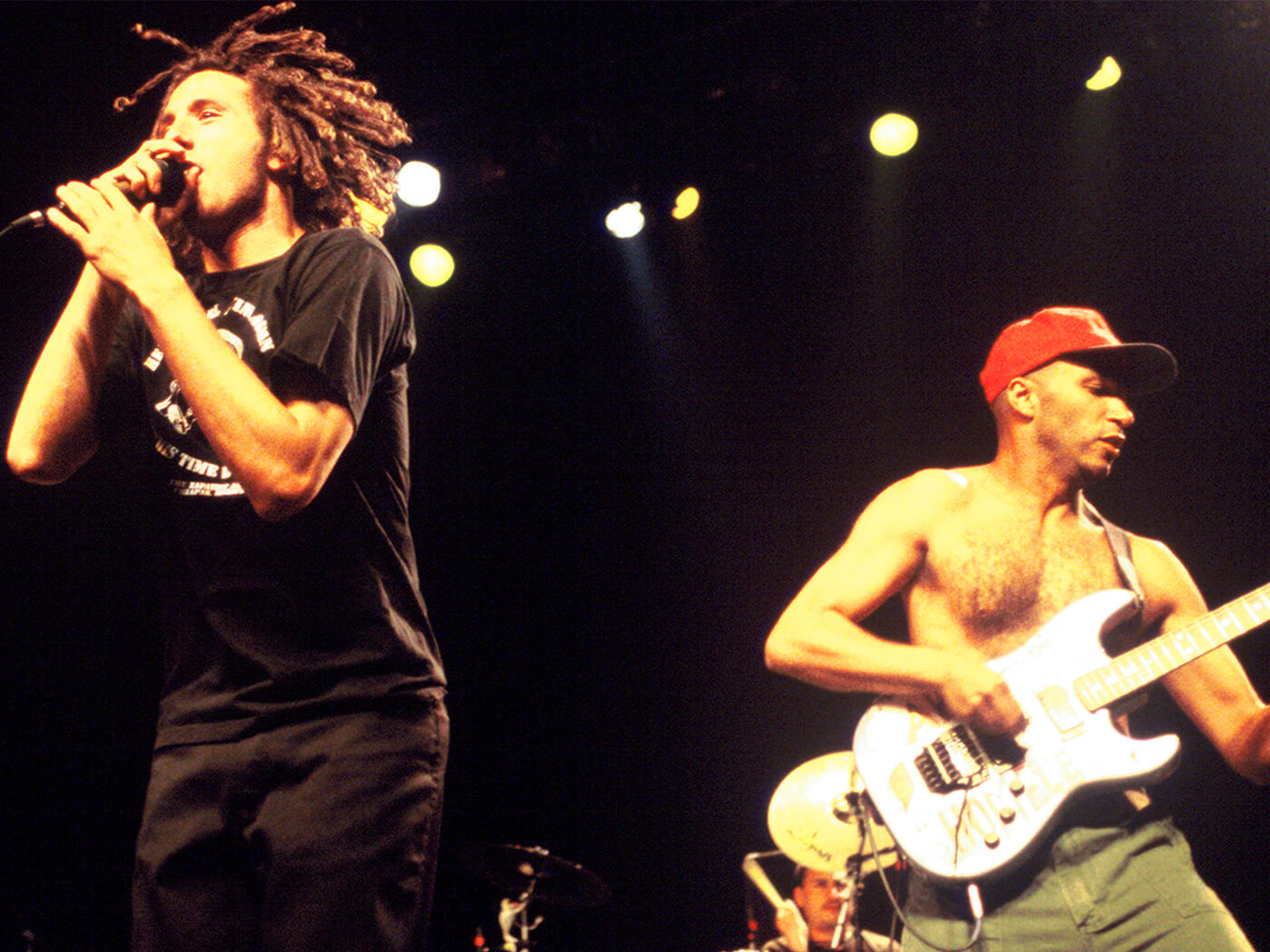
If you’ve ever listened to Bulls on Parade and wondered how a guitar could sound like a DJ scratching a record, you aren’t alone. It’s weird. It’s metallic. It’s definitely loud. For decades, the Rage Against the Machine guitar sound has been a source of obsession for bedroom players and professional gearheads alike. Tom Morello, the man behind the noise, didn’t just play the guitar; he interrogated it. He pushed it until it screamed back in ways that didn't seem possible for a six-string instrument made of wood and wire.
Most people assume there’s a massive rack of high-tech gear involved. Honestly, it’s the opposite.
The Gear Behind the Rage Against the Machine Guitar
The irony of Morello’s revolutionary sound is that it’s built on gear he didn't even like at first. Unlike most rock stars who swap out their rigs every tour, Tom has used basically the same setup for over thirty years. He decided at one point that he was spending too much time trying to find the "perfect" tone and not enough time making music. So, he just stopped. He dialed in a setting on his Marshall JCM800 2205 head, marked it with a pencil, and never looked back.
His main guitar, the "Arm the Homeless" custom build, is a Frankenstein monster. It’s got a Kramer-style body, a performance neck, and EMG pickups. It’s objectively a strange instrument. Yet, it defines the Rage Against the Machine guitar identity. Then there’s "Soul Power," the Fender Stratocaster he used later, but the core of that early 90s revolution was that mismatched, blue-painted beast.
If you want to replicate that tone, don't buy a $5,000 boutique amp. Get a 50-watt Marshall and a standard 4x12 cabinet. It’s about the mid-range. It’s about the grit.
The Pedalboard of a Sonic Architect
People look at his board and expect a spaceship. They're usually disappointed. It's actually pretty sparse. You have the Boss DD-3 Digital Delay, which he uses for those stuttering, rhythmic echoes. Then there's the MXR Phase 90. It adds that subtle swirl to certain riffs, giving them a bit of movement without washing out the heaviness.
But the real MVP? The DigiTech Whammy WH-1.
Without that pedal, there is no Rage Against the Machine guitar legacy. This is what allows for those two-octave jumps that sound like a siren. It’s what makes the solo in Killing in the Name pierce through your skull. He uses it as an expression pedal, shifting pitch in real-time. It’s expressive. It’s chaotic. It’s also incredibly difficult to master because it requires the foot-eye coordination of a professional athlete.
He also uses a Jim Dunlop Cry Baby Wah, but not always for the "wacka-wacka" sound you hear in funk. He often uses it as a fixed filter, leaving it cocked at a certain angle to emphasize specific frequencies. It makes the guitar sound like it’s talking.
It’s Not Just About the Pedals (It’s the Toggle Switch)
You can buy every pedal Tom Morello owns and you still won't sound like him. Why? Because you're probably playing with your fingers and a pick. Tom plays with the electricity of the guitar itself.
One of the most iconic elements of the Rage Against the Machine guitar style is the toggle switch technique. On guitars with two volume knobs—like his "Arm the Homeless" or a standard Gibson Les Paul—you can turn one pickup's volume to ten and the other to zero. By flicking the selector switch back and forth rapidly, you create a kill-switch effect.
This isn't just a gimmick.
It’s how he mimics the "transform" scratch of a hip-hop DJ. When combined with the way he rubs his hand across the strings over the pickups, he creates a percussive, rhythmic noise that shouldn't come from a guitar. He’s treating the instrument like a turntable. This shift in mindset changed everything. He stopped trying to be Jimmy Page and started trying to be Jam Master Jay.
The Importance of the Bridge Pickup
If you’re trying to nail this sound at home, stay on your bridge pickup. Always. Morello’s sound is bright, biting, and incredibly "tight." If you use the neck pickup, it gets too muddy. You need that bridge-position EMG (or any high-output humbucker) to cut through the massive basslines provided by Tim Commerford.
In a band like Rage, the guitar and bass are often playing the exact same riff. If the guitar is too bass-heavy, the whole song turns into a wall of sludge. The Rage Against the Machine guitar tone is specifically engineered to sit on top of the bass, not underneath it.
The Theory of Creative Limitation
Morello has often spoken about how he felt "stuck" as a shredder. He could play fast, sure. But so could everyone else in the late 80s. He realized that the "traditional" vocabulary of the guitar was exhausted.
So he made a rule: no more traditional solos.
He began looking at the guitar as a box of wires and magnets. He started using an Allen wrench to tap the strings. He unplugged the cable from the guitar and touched the tip of it to the bridge to create a rhythmic buzzing. These "noises" became the hooks. When you listen to Sleep Now in the Fire, that feedback at the end isn't an accident; it’s a controlled, melodic use of the guitar’s natural tendency to scream when it’s too close to an amp.
This is what E-E-A-T looks like in the world of music: it’s the expertise to know the rules so well that you know exactly how to break them for maximum impact.
Actionable Steps for Your Own Rig
If you want to capture the essence of the Rage Against the Machine guitar sound without spending a fortune, here is how you should prioritize your setup.
First, get your hands on a kill-switch. If your guitar doesn't have two volume knobs, you can actually buy a "kill-switch" button and install it. It’s a cheap mod that opens up an entire world of rhythmic possibilities.
Second, stop over-complicating your EQ. Set your Bass, Mids, and Treble all to about 6 or 7. Don't scoop the mids. If you scoop the mids, you lose the "vocal" quality of the riffs. Morello’s sound is very "honky" and mid-forward.
Third, practice your timing. The Rage Against the Machine guitar style is 90% about the pocket. If you aren't locked in with the drums, the riffs fall apart. Use a metronome. Play the riff from Bombtrack until you can do it in your sleep. It’s a funk riff played with metal distortion. That’s the secret sauce.
Fourth, experiment with non-musical objects. Grab a slide, an Allen wrench, or even a pen. Run them across the strings while using a delay pedal. See what happens. The goal isn't to play notes; it's to create textures.
Why This Style Persists
Even in 2026, these riffs feel modern. They don't feel like "classic rock" because they don't follow the blues-rock tropes that defined the 70s and 80s. By incorporating hip-hop rhythms and industrial noises, the Rage Against the Machine guitar legacy remains a blueprint for any musician who feels restricted by their instrument.
The gear is secondary. The attitude is everything.
You don't need a signature model guitar. You need a mindset that views the guitar as a tool for disruption. Tom Morello proved that you could be one of the greatest guitarists in the world while barely playing "traditional" guitar at all. That is the real power of the sound.
Start by stripping back your effects. Focus on the raw power of a single, well-placed note. Master the silence between the notes, because in the world of Rage, the "kill-switch" is just as important as the "on" switch. Practice the stutter. Master the feedback. Stop trying to sound like a guitar player and start trying to sound like a riot.