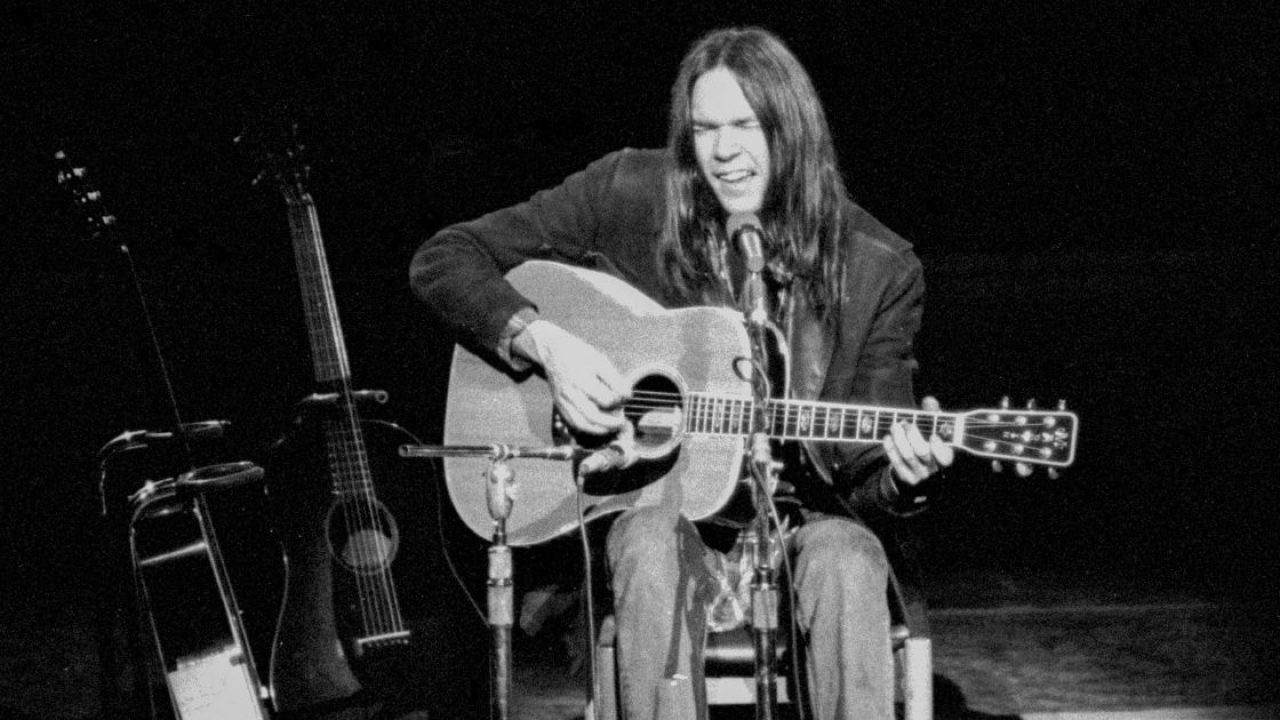
You’ve heard it at a dozen campaign rallies. It’s played at sporting events. It blares from the speakers while flags wave. But if you actually sit down and listen to the lyrics of Rockin in the Free World Neil Young, you realize something pretty fast.
It’s not a celebration. Not even a little bit.
Honestly, it’s one of the most misunderstood songs in the history of rock. Most people hear that massive, distorted guitar riff and that soaring chorus—"Keep on rockin' in the free world"—and they assume it’s a patriotic "USA! USA!" moment. It’s the same trap people fell into with Bruce Springsteen’s Born in the U.S.A. The hook is so catchy it hides the blood and guts underneath.
The Night a Throwaway Line Became Legend
The origin story is kinda wild. It was February 1989. Neil Young was on the road with his band, The Restless. They were supposed to do this cultural exchange tour in Russia, but the whole thing went south. A promoter basically vanished with the cash.
Neil’s guitarist, Frank "Poncho" Sampedro, was looking at the news. He saw footage of the Ayatollah Khomeini’s funeral in Iran where people were burning American flags. Poncho turned to Neil and basically said, "Man, I guess we’re just gonna have to keep on rockin' in the free world."
Neil liked the line. He liked it a lot.
He stayed up that night and wrote the entire song. The very next day, they played it live in Seattle at the Paramount Theatre. No rehearsal. Just raw, jagged energy. By the time it appeared on his album Freedom later that year, it was already becoming a monster.
What the Lyrics Are Actually Saying
Neil Young isn't exactly subtle, but he uses irony like a sledgehammer here. The song is a direct attack on the "New World Order" and the domestic policies of the George H.W. Bush administration.
Remember the "Thousand Points of Light" speech? Bush used it to talk about volunteerism and the American spirit. Neil flipped it on its head. He sings:
"We got a thousand points of light / For the homeless man / We got a kinder, gentler / Machine gun hand."
That’s not a tribute. It’s a snarl.
The verses are bleak. Really bleak. One verse describes a woman in the night with a baby in her hand, putting the kid away just to "get a hit." He talks about the ozone layer, styrofoam boxes, and people sleeping in their shoes. It’s a portrait of an empire that’s rotting from the inside while pretending everything is fine because, hey, we’re the "free world."
It’s about the gap between the rhetoric of freedom and the reality of poverty.
The SNL Performance That Changed Everything
If you want to see the definitive version of Rockin in the Free World Neil Young, you have to watch the 1989 Saturday Night Live footage.
Neil looks like he’s about to explode. He’s wearing an Elvis shirt and a leather vest, his hair is a mess, and he’s playing his "Old Black" Les Paul like he’s trying to rip the strings off. He was 43 at the time, which was considered "old" for rock back then. But he had more fire than any of the hair metal bands topping the charts.
That performance basically signaled the birth of Grunge.
A few years later, Pearl Jam started covering it. They even performed it with Neil at the 1993 MTV Video Music Awards. That’s the moment the torch was passed. To the kids in flannel, Neil wasn't a "classic rock" relic. He was the Godfather of Grunge. He was the one guy from the 60s who hadn't sold out or started making slick, over-produced pop.
A Song Caught in the Crossfire
The weirdest part of this song's life is its political afterlife.
For years, politicians have tried to use it as a walk-out song. Donald Trump used it when he announced his candidacy in 2015. Neil Young, a guy who had been supporting Bernie Sanders and is famously left-leaning, was not happy. He actually sued the Trump campaign in 2020 for copyright infringement.
He eventually dropped the suit, but the point was made.
It’s a bizarre sight: a politician smiling and waving to a song that literally mocks the "machine gun hand" of the government. It shows how the "vibe" of a song can completely overpower its actual meaning. People hear the word "Free" and they stop thinking.
Why It Still Matters in 2026
We’re still talking about this song because the problems Neil wrote about haven't gone away.
The environmental stuff? "Got fuel to burn / Got roads to drive." That’s more relevant now than it was in '89. The drug epidemic? He was talking about crack; now it’s fentanyl, but the story of the woman under the street light is the same.
The song is a reminder that "freedom" isn't just a slogan or a flag. It’s something that has to be lived. If people are starving or dying on the streets, how free is the world, really?
Real-World Takeaways for Your Playlist
If you’re looking to dive deeper into this era of Neil’s work, don't just stop at the radio edit. Here’s what you should actually do:
- Listen to the "Acoustic" version first. It’s the opening track on the Freedom album. It’s quiet, lonely, and makes the lyrics hit way harder.
- Compare it to the "Electric" version. This is the closer on the same album. It’s the one with the feedback. It shows how the same words can feel like a mournful prayer or a riot.
- Watch the 1993 MTV VMAs performance. The chemistry between Neil and Pearl Jam is some of the best live television ever recorded.
- Read the 1988 "Kinder, Gentler Nation" speech. Once you know the source material George H.W. Bush used, Neil’s sarcasm becomes much clearer.
Basically, the song is a Rorschach test. What you hear in it says more about you than it does about Neil. But if you're just using it to feel good about your country, you're missing the point. You're supposed to feel a little bit uncomfortable. That's the whole reason he wrote it.
Check out the Freedom album in its entirety to get the full context of where Neil’s head was at during the end of the Cold War.