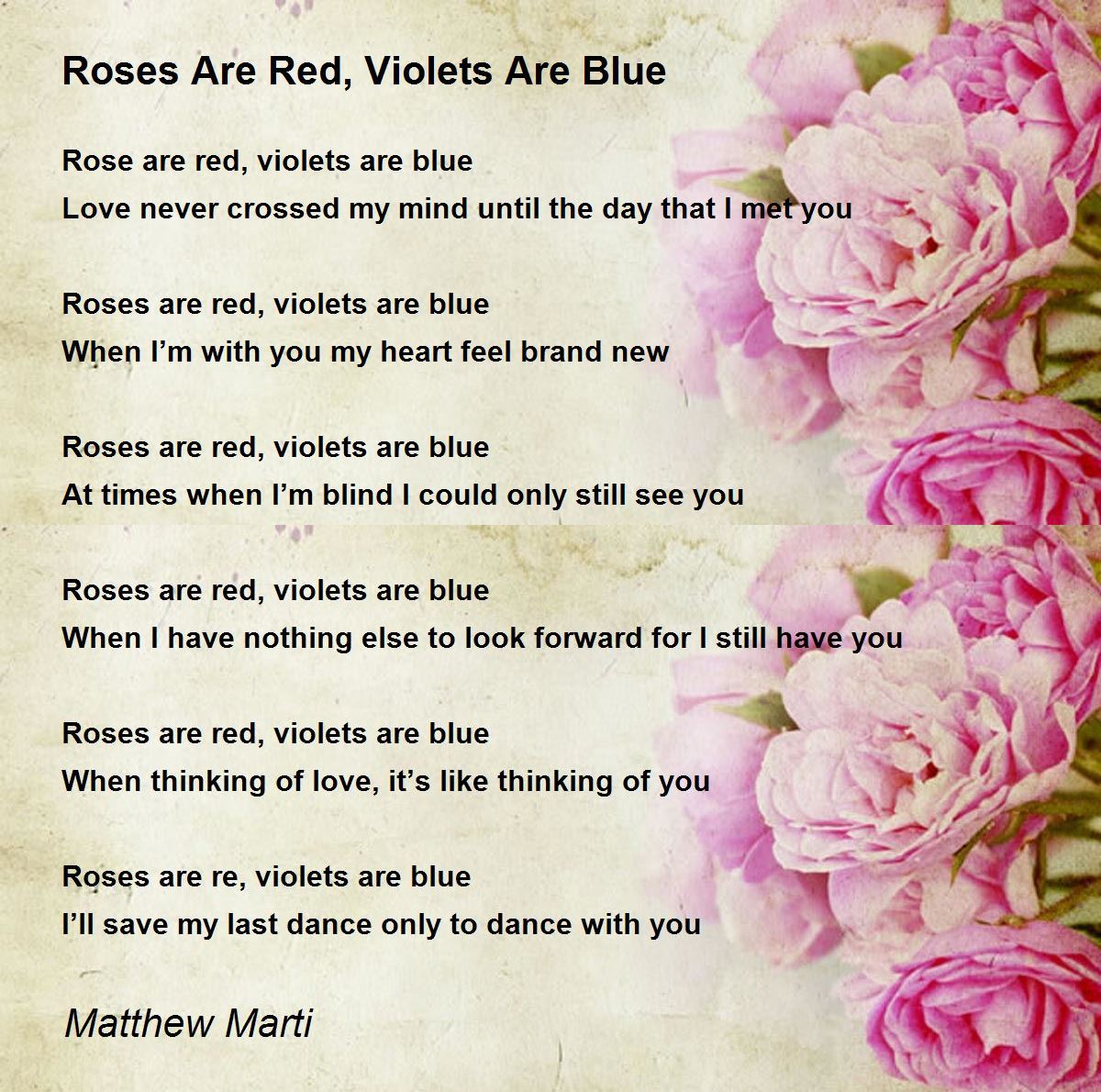
Everyone knows how it starts. It’s ingrained in our collective DNA at this point. You say the first line, and someone else instinctively finishes the rhyme scheme. But while the original 16th-century version was all about chaste romance and courtly love, the modern obsession with roses red violets are blue dirty poems has turned a sweet nursery rhyme into a vehicle for some of the internet's most enduring (and occasionally cringey) adult humor.
Honestly? It’s basically the "Dad Joke" of the bedroom.
We've been doing this for centuries. It isn’t just a TikTok trend or a Reddit sub-thread phenomenon. The shift from "I love you" to "I’m sending this to my ex to be annoying" happened way faster than most literary historians like to admit.
The weirdly long history of a four-line rhyme
You’ve gotta go back to 1590 to find the actual roots of this. Edmund Spenser wrote The Faerie Queene, and he had a line about "She bath'd with roses red, and violets blew." Fast forward to Gammer Gurton's Garland in 1784, and we get the version that looks like what we know today.
The rose is red, the violet's blue,
The honey's sweet, and so are you.
Sweet. Simple. Innocent.
Then humans got involved.
Because the rhyme scheme is a simple ABCB (or sometimes AABB), it is the easiest template in the English language to hijack. You don't need to be Lord Byron to make it work. You just need a word that rhymes with "blue" and a sense of humor that probably peaked in middle school.
Why roses red violets are blue dirty poems keep going viral
The internet loves a low barrier to entry. That’s the secret sauce here.
Most poetry feels gatekept. It’s hard. You have to worry about iambic pentameter or "thematic resonance." But with roses red violets are blue dirty poems, the structure is already a punchline. The moment you hear the first line, your brain prepares for a twist.
If someone sends you a poem that starts with "Roses are red," you know for a fact they aren't about to confess their undying, soul-shattering love. You know a joke is coming. You know it’s probably going to be a little bit "blue" (pun intended).
The anatomy of the subversion
Most of these poems rely on a "hard pivot." You start with the floral imagery to establish the rhythm, then you drop a line that is either sexually suggestive, incredibly cynical, or just plain gross.
Take this common variation:
Roses are red, violets are blue, I’ve got a couch, and a Netflix login for two. That’s the "soft" version. But the internet goes way further. The "dirty" versions usually play on anatomical rhymes or the sheer absurdity of mixing "fine art" (poetry) with "low-brow" (raunchy jokes).
I talked to a few people who run meme accounts. They say these specific rhymes perform better than standard memes because they require the reader to "finish" the beat in their head. It’s interactive. You’re not just looking at a picture; you’re performing a mental limerick.
The psychology of "Naughty" Rhymes
Why do we find this stuff funny? It’s the incongruity theory of humor.
Psychologists often point out that humor arises when there is a gap between what we expect and what we get. When you use a format associated with 18th-century romance to talk about... well, whatever people talk about on Tinder... that gap is massive.
Also, it's relatable.
Modern dating is a mess. Relationships are complicated. Standard romantic poetry feels fake to most people under 40. But a roses red violets are blue dirty poem? That feels honest. It acknowledges that while we might like flowers, we’re also humans with biological drives and a weird sense of humor.
Does it actually work in dating?
Look, if you’re using these as a first message on a dating app, you’re playing a dangerous game. It’s high-risk, high-reward.
- The Risk: You look like a creep who can’t hold a real conversation.
- The Reward: You find someone with the exact same warped sense of humor as you.
I’ve seen screenshots where these poems lead to marriage and others where they lead to an immediate block. It's all about context. If the vibe is already playful, a clever, slightly "dirty" rhyme can be a great pattern interrupt. If you’re talking to someone who wants a serious connection, maybe stick to the 1784 version. Or just don't send a poem at all.
Common tropes in the "Dirty" genre
Most of these poems fall into three buckets:
- The "Lover" Trope: These are the ones that are actually meant to be suggestive. They usually rhyme "blue" with "you" or "do" and imply some sort of late-night activity.
- The "Cynical" Trope: These are for the jilted lovers. Roses are red, violets are blue, I’m doing great, but how about you? (usually implied with a middle finger).
- The "Absurdist" Trope: These don't even try to be dirty in a sexual way; they’re just "dirty" in terms of being messy or weird.
Actually, the absurdist ones are probably the most popular right now. We’re in an era of post-irony. People want rhymes that make zero sense.
Roses are red, violets are blue, I’m a toaster, hoot hoot. Wait, that doesn't even rhyme. And that’s why people love it.
How to write your own (Without being a total weirdo)
If you’re determined to craft your own roses red violets are blue dirty poems, you need to understand the constraints.
First, keep the first two lines standard. Don't mess with the "Roses are red, violets are blue" setup. It’s the hook. It sets the tempo.
Second, the third line needs to build tension. This is where you introduce the "new" subject matter.
Third, the fourth line is the payoff. It has to rhyme with "blue."
Words that rhyme with blue for your "Dirty" endeavors:
- Do
- You
- Through
- Shoe (harder to make dirty, but good for a challenge)
- Review
- Shampoo
- Brew
- Stew
Actually, "stew" is a weirdly funny word to end a dirty poem on. Please don't do that.
The impact of social media on the rhyme
Twitter (X) and TikTok changed everything. Before the internet, these were whispered in school hallways or written on bathroom stalls. Now, they are "templates."
We see "Roses are red" threads that get 50,000 likes. It’s a format. It’s no different than the "Distracted Boyfriend" meme or the "Woman Yelling at a Cat."
But there’s a shelf life.
The reason roses red violets are blue dirty poems have lasted longer than most memes is because they aren't tied to a specific image. They are linguistic. They adapt to whatever the current slang is. In the 90s, they were about pagers. In the 2000s, they were about MySpace. Today, they’re about ghosting and "situationships."
Why we can't stop
Ultimately, we like things that are familiar. Life is chaotic. Everything is changing. But the fact that we can still make a dirty joke using a 500-year-old rhyme structure is oddly comforting.
It reminds us that despite all our technology and our fancy AI and our complex social structures, we’re still basically the same people who laughed at crude jokes in the 1500s. We just have better ways to share them now.
If you're going to use one of these, just read the room. A well-placed rhyme is a work of art. A poorly placed one is a trip to the HR office or a "this person is no longer available on Messenger" screen.
Actionable insights for the "Poetically Inclined"
If you’re looking to dive into this world, here is how to do it without losing your dignity:
- Check the vibe. If you haven't even met the person, maybe don't lead with a poem about what you want to do to them.
- Focus on wit over filth. The "dirty" poems that actually land are the ones that are clever. If it's just a string of swear words, it's not a poem; it's a tantrum.
- Use them for "internal" jokes. These work best between couples who already have an established shorthand. It’s a "bit."
- Keep it short. The four-line structure is perfect. Don't try to write a "Roses are red" epic. Nobody has the attention span for a 12-line version of a dirty joke.
The next time you see a "Roses are red" post, take a second to appreciate the sheer endurance of the form. It’s survived wars, revolutions, and the invention of the internet. It’ll probably survive us, too.
Go ahead and try to write one. Just make sure you know who you’re sending it to before you hit "send." You’ve been warned.
To keep your digital reputation intact, start by testing your humor on close friends in low-stakes group chats before moving to more "sensitive" audiences. Analyze which rhymes get the best "laugh" reactions versus which ones get silence. Use that data to refine your "set."