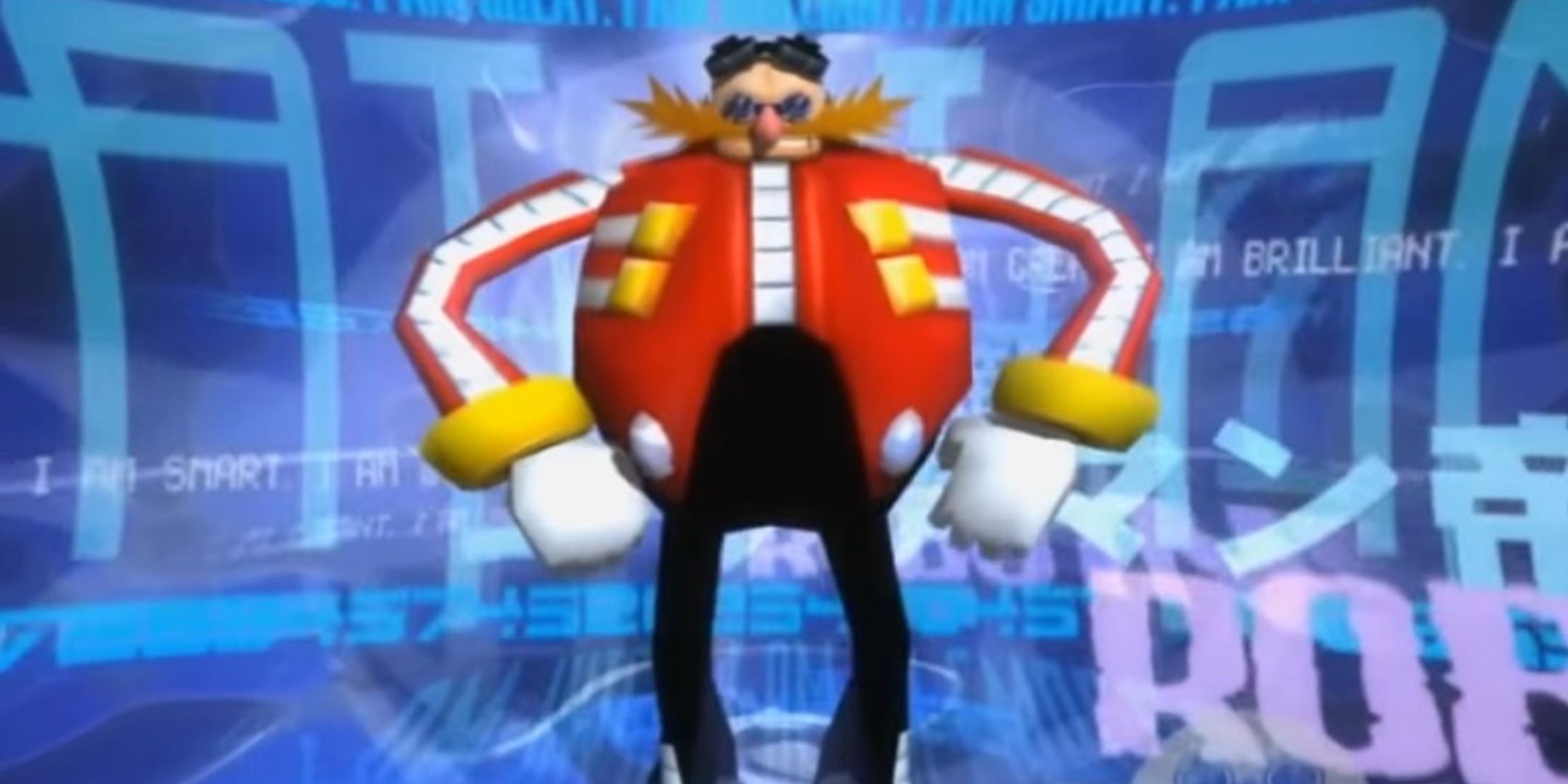
He blew up the moon. Honestly, if you grew up in the early 2000s, that’s the first thing that pops into your head when you think about Sonic Adventure 2 Eggman. It wasn't just some vague threat or a cartoonish "I'll get you next time" moment. He actually did it. He fired the Eclipse Cannon, shaved off a massive chunk of the lunar surface, and broadcasted his face to every screen on Earth while laughing his head off.
It was a vibe shift.
Before this game, Dr. Ivo "Eggman" Robotnik was mostly a round, silent sprite chasing a hedgehog in a 2D plane. Then Sonic Adventure (1998) gave him a voice, but he still felt like a secondary threat to Chaos. In the sequel, things got real. We saw a side of him that was brilliant, genuinely dangerous, and weirdly... human? By the time the credits roll on the Dreamcast classic, you realize you aren't just looking at a villain anymore. You're looking at a protagonist.
The Playable Villain: A Design Masterstroke
Making Sonic Adventure 2 Eggman a playable character was a massive risk for Sonic Team back in 2001. Imagine taking the big bad of a franchise and putting him behind the controls for 50% of the game. It worked because the gameplay reinforced his personality. While Sonic and Shadow are out there doing parkour at Mach 1, Eggman is sitting in a literal walking tank.
The Big Foot and Hornet mechs felt heavy. Clunky. Powerful.
Playing as Eggman wasn't about speed; it was about calculated destruction. You’d lock onto fifteen different targets at once—GUN robots, crates, literal pieces of the environment—and let loose a volley of missiles. It felt like playing a different game entirely, which is exactly how a genius inventor should feel compared to a bunch of fast animals. He’s the guy who brings a gun to a sword fight. Or in this case, a laser-guided missile battery to a footrace.
The "Dark Story" campaign starts with him, too. We follow his journey into the heart of Prison Island to wake up Project Shadow. This wasn't some random scheme. It was a targeted, surgical strike based on his grandfather’s research. We finally got to see how his brain works. He’s not just "evil." He’s obsessed with his family legacy, specifically the shadow of Gerald Robotnik.
That Voice Acting: Deem Bristow’s Magnum Opus
We have to talk about Deem Bristow. For many fans, he is the definitive voice of the doctor. While Mike Pollock did an incredible job in later years (especially in the Sonic Boom era), Bristow brought a specific edge to Sonic Adventure 2 Eggman that hasn't really been captured since.
He sounded authoritative. Threatening.
There’s a specific scene where he threatens to execute Amy Rose. He’s holding a gun to her head—or well, a laser pointer from his mech—and he counts down from three. He sounds like he’s actually going to do it. There’s no wink to the camera. No joke. Just a cold, calculated demand for the Chaos Emerald. It’s easily the highest stakes the series ever reached because the villain wasn't playing around.
The chemistry between Eggman and the rest of the cast, particularly Rouge and Shadow, was top-tier. He wasn't just the boss; he was the leader of a shaky, high-ego coalition. You could hear the frustration in his voice when Shadow went rogue, and the smugness when he thought he’d outsmarted Tails. It was a performance that grounded the wacky "blue hedgehog" premise into something that felt like a high-stakes sci-fi thriller.
The Moment He Saved the World
Most villains stay villains. They lose, they retreat, they try again with a bigger robot. But Sonic Adventure 2 Eggman had to do something unthinkable: he had to help.
When the Biohazard began its descent toward Earth, and Gerald Robotnik’s true plan for revenge was revealed, the Doctor didn't just tuck tail and run. He realized that if the planet died, there’d be nothing left for him to rule. It’s a classic "enemy of my enemy" trope, but it felt earned.
Seeing Eggman work alongside Tails—his intellectual rival—to disable the Eclipse Cannon was a core memory for an entire generation of gamers. He stopped being the "bad guy" and became the "smartest guy in the room." He used his technical prowess to save the very world he had spent the last twenty years trying to conquer.
That nuance is what’s missing from a lot of modern Sonic games. Lately, Eggman has drifted back into being a bit of a buffoon. He’s funny, sure, but he’s rarely scary. In Sonic Adventure 2, he was both. He could be ridiculous (have you seen his "egg-walker" idle animation?), but he was also a man who could command a space station and hold the world hostage with a giant laser.
Why the Fans Still Obsess Over This Version
Go to any forum or subreddit today, and you'll see people begging Sega to bring back the "SA2-style" Eggman. Why? Because he had dignity.
Even his theme song, "E.G.G.M.A.N." by Paul Shortino, goes harder than it has any right to. It’s a heavy rock anthem that declares him the "greatest scientific genius in the world." It doesn't mock him. It celebrates his ambition.
There's a specific complexity to his relationship with his grandfather, Gerald. Eggman grew up idolizing this man, only to find out that Gerald had been driven to madness by the government. Finding those old journals on the ARK changed Eggman. You can see the shift in his eyes during the final cutscenes. He’s a man who realized his hero was a monster, yet he chose to be better—in his own twisted, world-conquering way.
It’s also worth noting how well his levels were designed. Places like Iron Gate and Weapons Bed aren't just hallways; they are industrial playgrounds. They tell a story of a man who is literally building his empire out of cold steel and circuitry. The contrast between his mechanical fortress and the natural beauty of levels like Green Forest is visual storytelling at its best.
Real Talk: The Challenges of Playing Him
Let's be honest for a second. If you’re going back to play the HD port on PC or Xbox, the Eggman levels can be frustrating. The lock-on sound effect? It’s a constant beep-beep-beep-beep that will haunt your nightmares.
The controls are also a bit floaty. Since it’s a 2001 game, the camera sometimes decides it wants to look at a wall instead of the enemy shooting at you. But even with those "retro" janks, the power trip is real. There is a specific satisfaction in getting an A-Rank on Cosmic Wall by timing your hover perfectly and chain-locking thirty enemies in a single burst. It’s about precision.
Eggman’s levels required a different kind of "flow" than Sonic’s. You had to learn the rhythm of the lock-on. If you tapped the button too fast, you’d miss the multiplier. If you held it too long, you’d take damage. It was a thinking man's action game, which fits the character perfectly.
The Legacy of the Eclipse Cannon
The moon in the Sonic universe still has a hole in it. Or, well, it’s supposed to. Future games have been inconsistent about whether the damage to the moon stayed, but for fans, the image of the half-moon is the ultimate symbol of Sonic Adventure 2 Eggman.
It represents the peak of his power.
It was the one time he actually won—at least partially. He proved he could do it. He proved his technology was superior to anything the human military (GUN) could throw at him. That victory, however brief, gave the character a level of credibility that has carried him through decades of less-than-stellar games.
Even in Sonic Frontiers, we see shades of this deeper Eggman returning. His interactions with Sage feel like a spiritual successor to the family-driven motivations we saw on the ARK. It took over twenty years, but Sega seems to be finally remembering that Eggman is at his best when he’s treated as a complex person with a drive that goes beyond "I hate that hedgehog."
How to Experience This Version Today
If you want to see what the hype is about, you don't need a dusty Dreamcast. The game is readily available on Steam.
- Get the PC Version: It’s the easiest way to play and supports modern resolutions.
- Install SA2 Mod Loader: This is crucial. The community has spent years fixing the lighting and sound issues that the official ports introduced.
- Download the "Retranslated" Mod: If you want the deepest lore, there are mods that fix the English script to be more faithful to the original Japanese dialogue, which adds even more depth to Eggman’s motivations regarding his grandfather.
- Play the Dark Story First: While the game lets you choose, starting with the Dark side makes the eventual team-up feel much more impactful.
Watching the evolution of Sonic Adventure 2 Eggman from a conqueror to a reluctant savior is one of the best arcs in platforming history. He isn't just a villain. He’s the guy who built a legacy in the stars, even if he had to blow up a few things to get there.
Next time you’re playing, pay attention to the small stuff. The way he adjusts his glasses. The way he looks at the photo of his grandfather. It’s all there. He’s the most consistent, well-written character in the franchise, and SA2 was his finest hour. Go back and play the Cosmic Wall level. Listen to the music. Watch the moon break. You'll see exactly why we're still talking about this version of the doctor twenty-five years later.
To really get the most out of your run, try focusing on the "hidden" emblems in the Eggman stages—they require some of the most creative uses of the hover mechanic in the entire game. Once you've mastered the lock-on timing, the game transforms from a clunky shooter into a high-speed rhythmic destruction sim. It's a blast. All hail the empire.