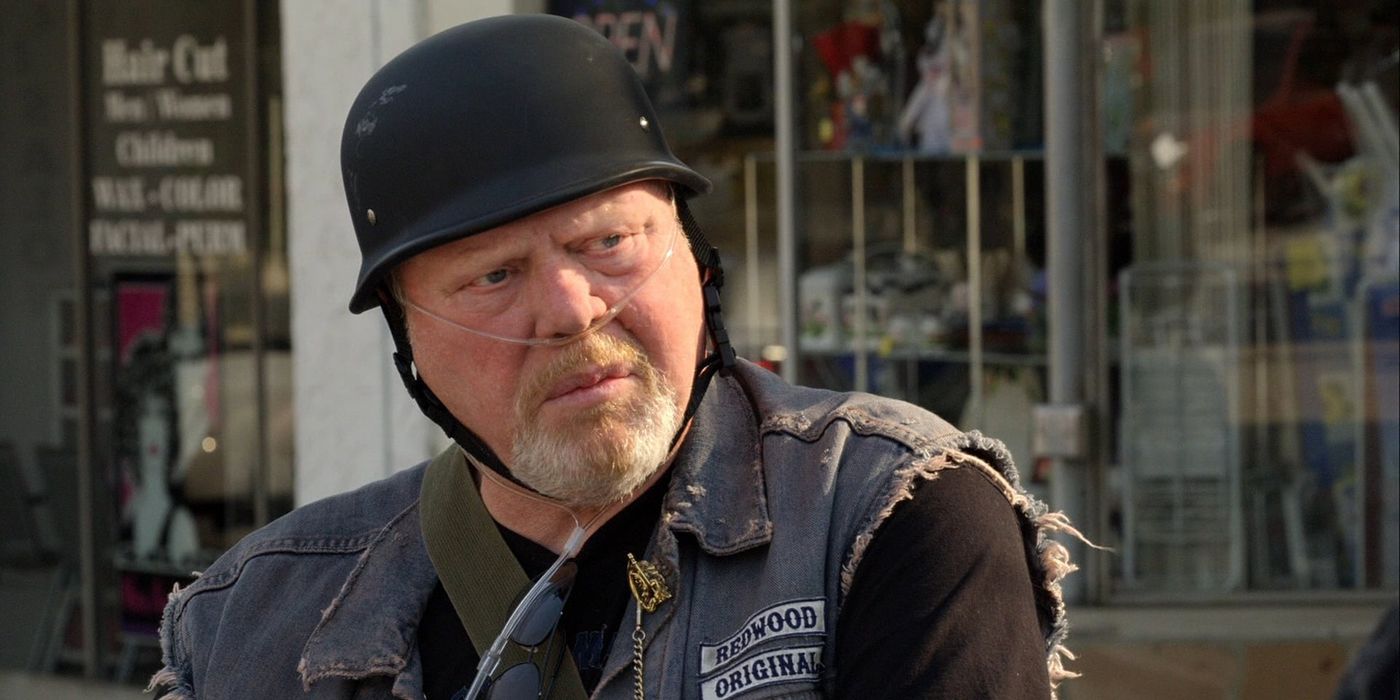
He was the oldest member. The denim vest he wore—his "cut"—was faded nearly to white, a stark contrast to the jet-black leather of the younger generation. Piney Winston wasn't just a side character in Sons of Anarchy; he was the walking, breathing conscience of a club that had long ago lost its way. When you look at the trajectory of the series, Sons of Anarchy Piney stands out because he represents the "First 9," the original founders who envisioned a social rebellion, not a drug-running syndicate.
Kurt Sutter, the show's creator, used Piney as a mirror. Every time Jax Teller looked at Piney, he saw what his father, John Teller, might have become if he hadn't died on that highway. Piney was grumpy. He was perpetually attached to an oxygen tank. He carried a shotgun like it was an extension of his arm. But beneath the gruff exterior and the constant coughing fits brought on by severe emphysema, he was the only one brave enough to tell Clay Morrow the truth.
The Gritty Reality of Piney’s Early Days
You have to understand where Piney came from to get why he was so bitter. He served in Vietnam as a paratrooper. When he came home to a country that didn't want him, he and JT (John Teller) started the Sons of Anarchy Motorcycle Club Redwood Original (SAMCRO). It was supposed to be about brotherhood and the open road. It wasn't supposed to be about burying kids.
Honestly, the tragedy of Piney is tied directly to his son, Opie. Watching Piney watch Opie get dragged back into the life after doing five years in Chino is some of the most gut-wrenching television you'll ever see. Piney knew the club was a meat grinder. He’d seen it chew up his best friend, and he spent seven seasons watching it chew up his family. He stayed because he had nowhere else to go. The club was his life, even when it was killing him.
Why Clay Morrow and Piney Could Never Coexist
The tension between Clay and Piney wasn't just about business; it was philosophical. Clay was a shark. He wanted growth, power, and money. Piney wanted the "Letters." He was obsessed with John Teller’s manuscript because it proved he wasn't crazy for thinking the club had drifted off course.
When Piney discovered the truth about JT’s death—that it wasn't an accident—he became a dead man walking. He knew it. Clay knew it. The dynamic between William Lucking (who played Piney) and Ron Perlman was masterfully executed. Lucking played Piney with this weary, "I’m too old for this" energy that made his eventual stand feel incredibly heroic.
Most people forget that Piney was the one who pushed Jax to lead. He didn't do it because he thought Jax was perfect. He did it because Jax was the only hope left for SAMCRO's soul. Piney's cabin in the woods became a sanctuary for the truth, which is exactly why it eventually became a crime scene.
That Fateful Night in the Cabin
Let's talk about Season 4, Episode 8. "Ricochet."
Clay shows up at Piney’s cabin. He wants the letters John Teller wrote. Piney, ever the stubborn veteran, refuses to give them up. He’s sitting there in his chair, oxygen tank nearby, completely unafraid of the man who had become a monster. Clay shoots him in the chest with a shotgun. It was a cold, calculated move to protect a lie.
The death of Sons of Anarchy Piney changed everything. It was the moment SAMCRO officially broke. You can’t kill a founder and expect the foundation to hold. It sent Opie into a spiral of depression and rage that led to his own sacrifice later in the series. Without Piney’s death, Jax might never have fully committed to taking Clay down. It was the catalyst for the endgame.
The Actor Behind the Denim: William Lucking
William Lucking brought something authentic to the role. He didn't look like a Hollywood actor playing a biker; he looked like a guy you'd actually see at a roadside bar in Northern California. Lucking, who sadly passed away in 2021, had a career spanning decades, but Piney Winston was his most iconic work. He understood the "broken warrior" archetype better than anyone.
People often ask if Piney was "weak" because of his illness. That’s a total misunderstanding of the character. Staying in a violent outlaw club while carrying an O2 tank takes a specific kind of toughness. He was the only member who could call Clay a "coward" to his face and not get immediately killed—until he pushed too far.
What Most Fans Get Wrong About Piney's Legacy
A lot of viewers think Piney was just a miserable old man. They see him as a drag on the club’s operations. That’s a surface-level take. In reality, Piney was the only one who actually followed the rules of the club. He believed in the bylaws. He believed in the "Men of Mayhem" patch.
- He never sought power for himself.
- He prioritizes the club's history over its profit margins.
- He was a father figure to every member, even when he was yelling at them.
When Piney died, the history of the club died with him. No one else left at the table remembered the original vision. They were all just reacting to the chaos Clay had created.
Key Details You Might Have Missed
If you rewatch the series, pay attention to Piney’s vest. The "First 9" patch is the most prestigious thing a member can wear. There were only nine of them, and by the time the show starts, only a few are left. Piney’s presence at the table was a constant reminder of the club’s debt to the past.
Also, look at his relationship with Gemma. It was complicated. They had decades of history together. Gemma respected Piney because she knew he was one of the few people who knew who she really was before she became the "Queen" of SAMCRO. Even she couldn't protect him once he went after Clay.
The Symbolism of the Oxygen Tank
It’s not just a prop. The emphysema was a physical manifestation of the club's environment. The smoke, the exhaust, the stress—it was literally suffocating him. Piney was dying from the life he chose, yet he couldn't leave it. It’s a metaphor for the entire show. Everyone in Sons of Anarchy is breathing in "poison," and most of them don't realize it until they can't breathe anymore.
Moving Forward: How to Honor the Piney Archetype
If you're a writer or a fan of character-driven drama, Piney Winston is a masterclass in the "Mentor who Failed" trope. He didn't save the club, but his death gave the protagonist the tools to try.
To truly appreciate the depth of this character, you should:
- Watch the "First 9" flashbacks and lore videos. Understanding the 1960s origins of the club makes Piney’s disappointment in the modern era much more poignant.
- Analyze the dialogue in the cabin scenes. Note how Piney never begs for his life. He’s accepted his fate long before Clay pulls the trigger.
- Read the official "Sons of Anarchy" comic books. They dive deeper into the early days of the First 9 and show a younger, healthier Piney who was a force to be reckoned with.
- Observe the parallels between Piney and Bobby Elvis. Both served as the club's moral compass at different times, and both paid the ultimate price for it.
Piney Winston was the last of a dying breed. He wasn't a hero in the traditional sense—he was an outlaw, after all—but he was a man of principle in a world that had abandoned them. His legacy is the realization that you can't build a brotherhood on a foundation of secrets and blood. Eventually, the weight of the past will crush the present.