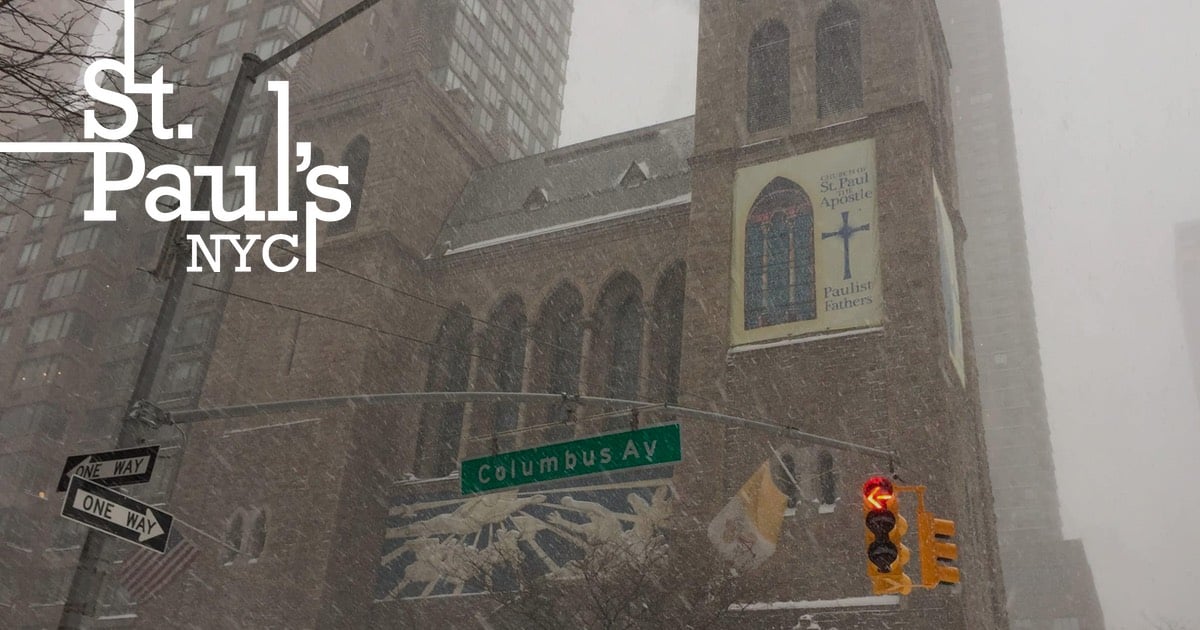
If you’re walking down 60th Street toward Columbus Avenue, you’ll probably miss it at first. The Church of St. Paul the Apostle NYC doesn't scream for attention like the glass towers of Hudson Yards or the neon blur of Times Square nearby. It sits there, a massive, brooding pile of gray granite that looks like it was plucked out of a medieval European village and dropped into the middle of Manhattan’s chaos. Honestly, most people just walk right past the heavy doors without realizing they’re missing one of the most artistically significant interiors in the United States.
It’s big. Really big. We’re talking about a space that rivals some of the great cathedrals of the world, yet it’s technically just a parish church. But the scale isn't even the point. The point is that this building is a living museum of the American Renaissance. While other churches in the late 1800s were busy copying Gothic styles from England, the Paulist Fathers—the guys who built this place—decided to do something totally different. They wanted an "American" church. They hired the biggest names of the day, guys like John LaFarge, Augustus Saint-Gaudens, and Stanford White. You’ve probably seen their work in the Met or the mansions of Newport, but here, it’s all under one roof, tucked away in Hell's Kitchen.
The Weird, Wonderful History of the Paulist Fathers
To understand the building, you have to understand the Paulists. They weren't your typical 19th-century priests. Founded by Isaac Hecker, a convert who was basically a Transcendentalist before he was a Catholic, the Paulists were—and still are—intellectuals and artists. They were the first religious community of men founded in the U.S. Hecker was friends with people like Ralph Waldo Emerson and Henry David Thoreau. He wanted a Catholicism that felt at home in a democracy, something modern and open.
When they started building St. Paul the Apostle NYC in 1876, they didn't want a cookie-cutter design. They wanted something that felt ancient but acted new. The architect, Jeremiah O’Rourke, went with a Byzantine-meets-Romanesque vibe. It’s heavy. It’s solid. It feels like a fortress of faith in a city that’s constantly shifting. They used "Manhattan Schist"—the very rock the island is built on—for the exterior. That’s why it looks so grounded; it’s literally made of New York.
The construction wasn't a quick job. It took decades. They opened the doors for service in 1885, but the inside? That was a work in progress for ages. This wasn't because they were lazy. It was because they were picky. They brought in the best of the American art world. John LaFarge, who was basically the rival to Louis Comfort Tiffany, did a massive amount of the stained glass and murals. If you look at the windows, you'll see colors that don't exist in other churches. LaFarge invented opalescent glass right here in the city, and St. Paul's was his playground.
Art That Breaks All the Rules
Most people expect church art to be kind of... stiff. But the art in St. Paul the Apostle NYC is alive. Take the "Angel of the Moon" and "Angel of the Sun" mosaics. They are stunning. They don't look like traditional Catholic icons; they look like something out of a dream or a high-end Victorian art gallery.
The sanctuary is dominated by a massive altar designed by Stanford White. Yes, that Stanford White—the celebrity architect who was later murdered in one of the city's most famous scandals. He wasn't even Catholic, but the Paulists didn't care. They wanted the best. The baldacchino (that's the big canopy over the altar) is inspired by the one in St. Peter’s Basilica in Rome, but it has this distinct New York edge. It’s made of yellow Numidian marble and gilt bronze. When the light hits it through the clerestory windows, the whole place glows.
And then there's the ceiling. It’s a deep, midnight blue, speckled with gold stars. It’s meant to represent the heavens, obviously, but there’s a local legend that the stars are positioned exactly as they were on the night the church was dedicated. It’s that kind of attention to detail that makes the place feel special. You aren't just in a room; you’re in a curated cosmos.
The Stained Glass Rivalry
You can't talk about this church without mentioning the glass. Everyone knows Tiffany, but John LaFarge was arguably the more sophisticated artist. He and Tiffany actually got into a legal battle over who invented opalescent glass. While Tiffany went on to be a commercial giant, LaFarge’s work at St. Paul’s is considered some of his finest.
- The "Adoration of the Magi" window is a masterpiece of layering.
- Unlike traditional flat glass, this stuff has texture. It’s thick.
- If you stand close to it, you can see the ripples and folds in the glass that mimic fabric.
Why It Matters Today (And It Really Does)
In a city where everything is being torn down to build ultra-luxury condos, St. Paul the Apostle NYC stands as a stubborn reminder of what New York used to be. It’s a bridge between the old "Gangs of New York" era and the modern Upper West Side.
But it’s not just a museum. It’s a very active parish. The Paulists are known for being one of the more progressive arms of the Church. They’ve been involved in social justice, film, and media for a century. They even had their own radio station back in the day (WLWL). Today, you’ll see a incredibly diverse crowd there—actors from the nearby Lincoln Center, students from Fordham, and families who have lived in the neighborhood for four generations.
There's also the music. The acoustics in a stone building this size are terrifyingly good. They have a massive organ—a Möller that was later rebuilt—and hearing a choir in that space is an experience that stays with you. It doesn't matter if you're religious or not. The vibration of the low pipes in a space that large hits you in the chest. It's visceral.
Things You’ll Probably Miss If You’re Not Looking
Seriously, look at the side altars. Each one is dedicated to a different saint, but they were designed by different artists, so the styles clash in this wonderful, eclectic way. The St. Patrick’s altar is pure Celtic revival. The St. Joseph’s altar feels more Italianate. It’s like a tour of 19th-century design trends.
Also, check out the baptistery. It’s often tucked away or gated off, but the metalwork is incredible. It was designed by William Laurel Harris. He spent years working on the interior decorations, trying to create a cohesive "American" aesthetic that blended various global traditions. He basically lived in the church for a while. That's dedication.
What Most People Get Wrong About the Church
People often assume a church this big must be a cathedral. It isn't. St. Patrick’s on 5th Avenue is the Cathedral. St. Paul’s is just... a big church. But honestly? It feels more intimate. Because it’s not on the main tourist drag, you can actually sit in a pew and have a moment of silence without a thousand people with selfie sticks walking past you.
Another misconception is that it’s "old fashioned." While the building is historic, the Paulist community has always been about "firsts." They were pioneers in using the press to spread their message. They were early adopters of radio. They’ve always been about meeting people where they are. In NYC, that means being a place of refuge in a city that never stops moving.
A Quick Reality Check
Look, it's an old building. Maintaining a massive granite structure in the middle of a polluted city is a nightmare. You might see some scaffolding. You might see some areas where the paint is peeling or the mosaics need a cleaning. Don't let that put you off. It’s part of the charm. It’s a building that is used, not just looked at. It’s "lived-in" in a way that the pristine, museum-like churches in Europe sometimes aren't.
How to Actually See It
If you want to visit, don't just stand on the sidewalk. Go inside. The best time is mid-afternoon on a sunny day. The way the light filters through the LaFarge windows is something you can't capture on a phone camera.
- Location: 405 West 59th Street (right at 9th Avenue/Columbus).
- Hours: Usually open during the day, but check their schedule for Mass times. If you go during a service, obviously be respectful.
- Photography: Usually okay if there isn't a service going on, but be cool about it. No tripods without permission.
- Pro Tip: Look for the small details in the wood carvings. The craftsmanship is insane.
The Actionable Stuff: Your Visit Plan
Don't just wander in aimlessly. Do this:
- Start Outside: Look at the massive towers. They were never finished with the spires O’Rourke originally planned, which gives it that heavy, almost military look.
- The Main Nave: Walk halfway down and just look up. Let your eyes adjust to the darkness. The scale is meant to make you feel small—embrace it.
- The Side Chapels: Walk the perimeter. Specifically, find the St. Agnes chapel. The mosaic work there is some of the most intricate in the building.
- The Altar: Get as close as the railings allow. Look at the marble work on the baldacchino. It’s a masterclass in textures.
- Check the Schedule: If they have a concert or a high mass with the full choir, go. The music is the "soul" of the architecture.
St. Paul the Apostle NYC isn't just a place for Sunday morning. It’s a piece of New York history that’s still breathing. It’s a testament to a time when people thought art and soul were more important than square footage and ROI. Whether you're there for the history, the art, or just a quiet place to escape the Midtown noise, it’s one of those rare spots that actually delivers.
Next time you’re near Columbus Circle, skip the mall for twenty minutes. Cross the street, pull open those heavy doors, and step into the 1880s. You won't regret it.