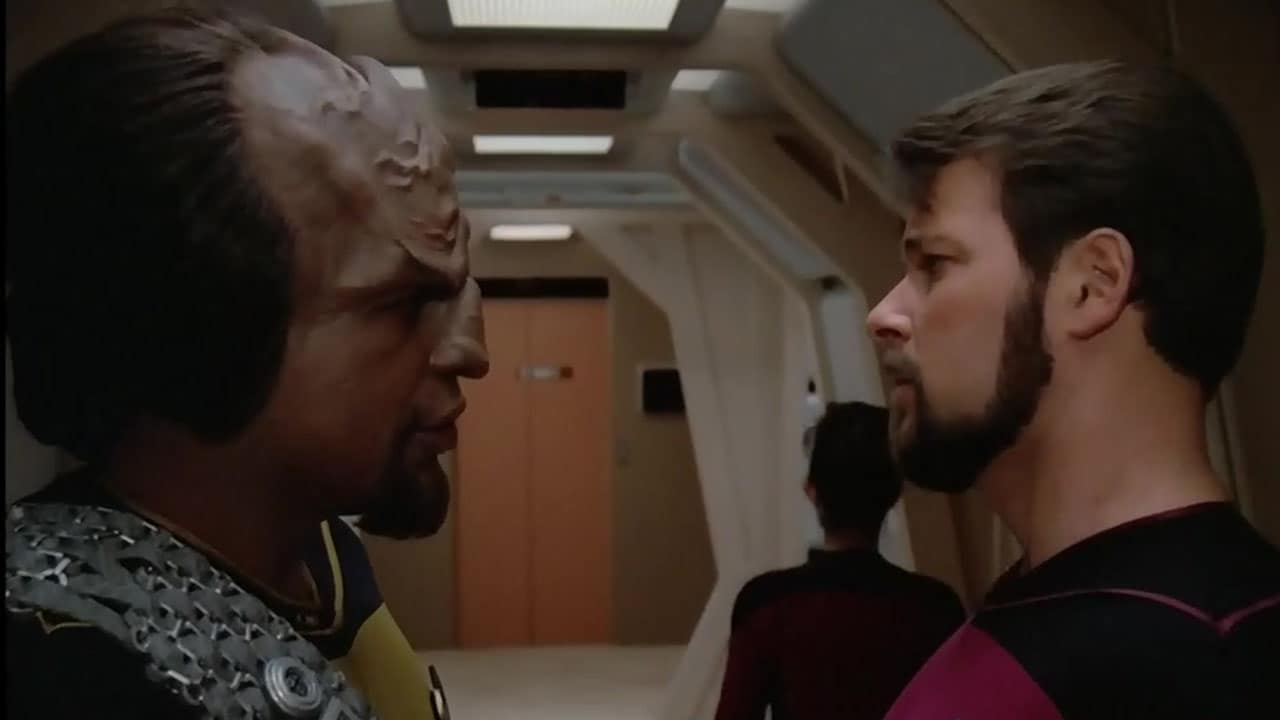
Star Trek: The Next Generation had a rough start. Most fans admit that. Season one was a mess of recycled scripts and awkward pacing, and the early bits of season two weren't much better. But then we got Star Trek: The Next Generation A Matter of Honor. It changed things. This episode, the eighth of the second season, finally gave us a glimpse of what the show could actually be when it stopped trying to be the Original Series and started being its own thing.
It’s the one where Riker goes to a Klingon ship.
Simple premise.
Basically, Starfleet starts an Officer Exchange Program. Commander Riker, always looking for a way to prove he’s the toughest guy in the room, volunteers to serve on the Klingon bird-of-prey, the Paglh. It’s a classic fish-out-of-water story, but it’s handled with a level of grit and cultural nuance that the show desperately needed at the time. Honestly, if you look at the DNA of how Klingons are portrayed in Deep Space Nine or even later seasons of TNG, it all starts right here.
The Cultural Deep End of Star Trek: The Next Generation A Matter of Honor
Before this episode, Klingons were mostly just "the bad guys" from the 1960s who now happened to have a guy on the bridge of the Enterprise. We didn't really know them. Star Trek: The Next Generation A Matter of Honor fixed that by forcing Riker—and the audience—to live by their rules.
The food scene is legendary. You’ve probably seen the memes. Riker sits down at the mess hall table and is presented with gagh (serpents that are best served live), pipius claw, and heart of targ. Most Starfleet officers would have turned their noses up or made some speech about "advanced Federation sensibilities." Not Riker. He digs in. He eats the worms. It’s a small moment, but it’s huge for his character development. It shows he’s not just a stiff in a uniform; he’s a guy who respects the culture he’s in, even if that culture involves eating things that are still wiggling.
The tension on the Paglh is palpable. Captain Kargan, played with a fantastic, gruff suspicion by Christopher Collins (who also voiced Starscream and Cobra Commander, fun fact), doesn't trust Riker. Why would he? Riker is a Federation "spy" as far as he's concerned. The episode does a great job of showing that Klingon honor isn't just about fighting; it’s about a very rigid, almost paranoid sense of hierarchy and duty.
Why the B-Plot with Mendon Actually Matters
While Riker is busy trying not to get stabbed on a Klingon ship, the Enterprise takes on a Benzite officer named Mendon. This is the part of Star Trek: The Next Generation A Matter of Honor that people often forget, but it’s just as important for the "Exchange Program" theme. Mendon is brilliant but annoying. He’s a Benzite, so he has that breathing apparatus and a culture that prizes being right above being polite.
He finds a space-born bacteria eating the Enterprise’s hull. Instead of reporting it immediately, he waits until he has a full analysis because, in his culture, you don't bring a problem to your superior until you have the solution.
It almost gets them killed.
This creates a beautiful parallel. Riker is over on the Klingon ship learning how to be more aggressive and direct to fit in, while Mendon is on the Enterprise learning that the "perfect" Federation way actually requires more communication and less individual ego. It’s a smart bit of writing by Burton Armus. It highlights that the Federation isn't just a "human" club—it’s a messy collection of species trying to figure out how to work together without blowing each other up.
The Turning Point: The Hull Bacteria Conflict
The real drama kicks off when the Paglh also discovers the bacteria on their hull. Because they are Klingons, they assume the Enterprise put it there. Captain Kargan goes into full war mode. This is where the title Star Trek: The Next Generation A Matter of Honor really earns its keep. Riker is stuck. He’s a Starfleet officer, but he’s sworn an oath to the Klingon captain.
What does he do? He uses the Klingon system against itself.
Riker knows Kargan will attack the Enterprise. He also knows that as First Officer, he has the right to challenge his Captain if the Captain is being an idiot (or "dishonorable"). Riker steals the Enterprise’s tactical sensor range data, uses it to "prove" he can help the Klingons, and then, when the time is right, he relieves Kargan of command. He doesn't do it because he wants to be a hero; he does it because it's the only way to save both ships while remaining "Klingon" enough to be respected.
Technical Nuance and Behind the Scenes
The episode looks different than the ones around it. The lighting on the Paglh is dim, red, and smoky. It feels claustrophobic. Rob Bowman, the director, really leaned into the "submarine" feel of the Klingon ship. This was a massive departure from the bright, carpeted, hotel-lobby aesthetic of the Enterprise-D.
It’s also worth noting the makeup. This was early in the tenure of Michael Westmore, the makeup legend. The Benzite makeup for Mendon was a carry-over from the species first seen in "Coming of Age," but the Klingon looks were being refined here. They were moving away from the "brown face paint and a bumpy forehead" look of the early 80s movies and toward the more distinct, individualistic looks we see later in the series.
The dialogue is also surprisingly sharp. When Riker tells the Klingon crew, "I am your Second Officer. My life is yours," it doesn't sound like a cheesy TV line. Jonathan Frakes sells it with this simmering intensity. It’s one of the first times we see Riker as a commander who could actually lead his own ship. Before this, he was often just the "action guy" who went on away missions so Picard could stay safe. Here, he’s a diplomat, a warrior, and a strategist all at once.
Common Misconceptions About This Episode
Some people think this is the episode where Riker and Worf become best friends. Not really. Worf is actually pretty hands-off here, though he does give Riker the "emergency transponder" (which Riker hides in his sleeve) and warns him that he'll basically be a target the whole time. The real relationship building is between Riker and the Klingon crew as a collective.
Another misconception is that the bacteria subplot is "filler." If you remove the bacteria, there’s no tension. The bacteria provides the "inciting incident" that forces the two cultures into a standoff. Without it, Riker is just hanging out on a ship for a week and then coming home. The stakes have to be life and death for the "Honor" part of the title to mean anything.
The Legacy of the Paglh
The ship itself, the Paglh, became a template for how we view Klingon life. We see the gambling, the roughhousing, the way they eat, and the way they mock their enemies. It humanized—or, well, "Klingon-ized"—the species. It moved them from being caricatures of Soviets to being a complex, honor-bound society with their own internal logic.
If you're looking for the roots of the Klingon Civil War arc that dominates seasons four and five, or the deep lore of Star Trek: Deep Space Nine, you have to start with Star Trek: The Next Generation A Matter of Honor. It’s the foundation.
Real-World Takeaways for the Trek Fan
- Watch the body language: Notice how Frakes changes his posture when he's on the Klingon bridge versus the Enterprise bridge. He stands wider. He takes up more space. It’s a masterclass in subtle acting.
- Look at the Benzite: If you watch closely, Mendon’s breathing apparatus actually cycles. The attention to detail for a "one-off" alien was high for 1989.
- Check the credits: This episode was written by Burton Armus, who was a veteran of cop shows like Kojak. You can feel that "tough guy" energy in the script. It lacks the flowery, philosophical waxing that often bogged down early TNG.
Actionable Next Steps for Viewing
If you want to get the most out of Star Trek: The Next Generation A Matter of Honor, try this "Mini-Marathon" to see the evolution of the themes:
- Watch "Heart of Glory" (Season 1, Episode 20): This sets up the initial tension of Klingons in a post-war Federation world.
- Watch "A Matter of Honor": Focus on Riker’s adaptability and the introduction of the Officer Exchange Program.
- Watch "Sins of the Father" (Season 3, Episode 17): See how the cultural details established in "A Matter of Honor" are expanded into a full-blown political thriller.
- Watch "The Emissary" (Season 2, Episode 20): This introduces K'Ehleyr and shows another side of Klingon/Federation relations.
By looking at these episodes in sequence, you see that Star Trek: The Next Generation A Matter of Honor wasn't just a random adventure. It was the moment the writers realized they could tell stories about cultural friction without making one side "right" and the other "wrong." It’s about finding the middle ground where you can eat the gagh and still keep your commission. It’s arguably the most "Trek" episode of the second season.
Go back and re-watch the scene where Riker punches the Klingon officer who challenges him. It’s not just a fight. It’s Riker speaking their language. Once you see it through that lens, the whole episode clicks. It’s not about a mission; it’s about the transformation of a character who finally understands that "honor" isn't a Federation word—it's a universal one.