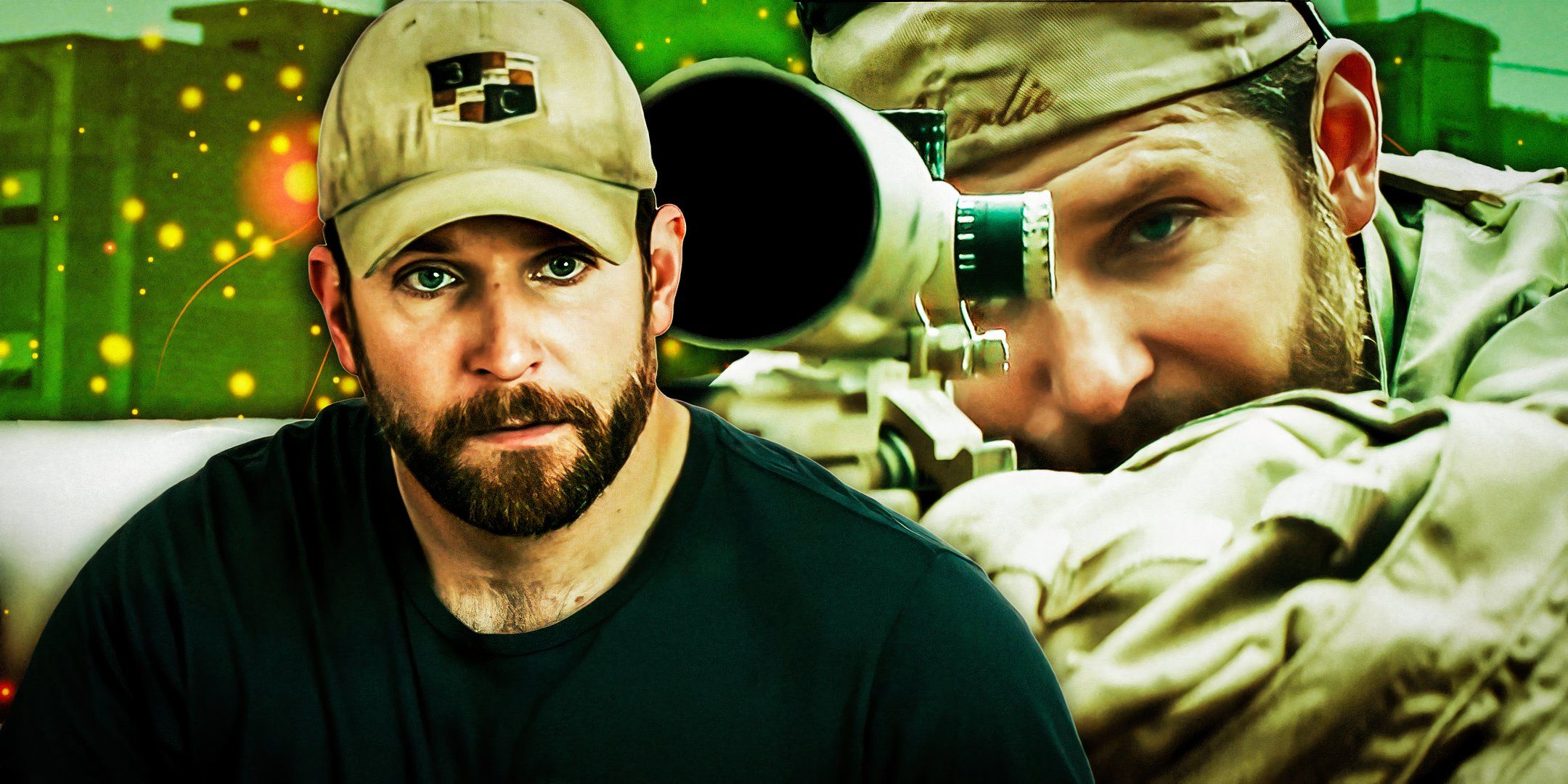
It's been years. Yet, if you mention the American Sniper movie ending in a crowded room, the energy shifts. People remember the silence. That eerie, total lack of music as the credits rolled over real-life footage of Chris Kyle’s funeral procession. It wasn't just a creative choice by Clint Eastwood; it was a necessity. When a film builds up a man as an untouchable legend—the "Legend" of the SEAL teams—and then he dies not in a hail of gunfire in Sadr City, but at a quiet shooting range in Texas, how else do you handle that?
Most war movies end with a bang. Or a heroic sacrifice on the battlefield. This one didn't.
Chris Kyle, played with a sort of weary intensity by Bradley Cooper, survives four brutal tours in Iraq. He survives the "Butcher." He survives Mustapha, the olympic-level sniper who seemed like his dark mirror image. He finally comes home and starts to actually find himself again. He’s playing with his kids. He’s reconnecting with Taya. Then, a single screen of text changes everything.
The Reality Behind the Final Scene
The way the movie handles the death of Chris Kyle is actually pretty restrained. We see Kyle leaving his house. He’s got that slight, knowing smile. He’s going to help a veteran. Taya, played by Sienna Miller, watches him go, and there’s this brief, lingering look between them. It feels like foreshadowing because, well, it is. But the film chooses not to show the actual incident at Rough Creek Lodge.
Honestly, that was the right call.
Showing the murders of Chris Kyle and Chad Littlefield by Eddie Ray Routh would have turned the movie into a different kind of film—something more like a true crime thriller. Eastwood kept the focus on the tragedy of the homecoming. The American Sniper movie ending is specifically designed to highlight the irony of a man who survived the most dangerous places on earth only to be killed by someone he was trying to help back on American soil.
Routh was a 25-year-old Marine veteran. He was struggling with what was later diagnosed as schizophrenia and PTSD. On February 2, 2013, Kyle and Littlefield took him to the shooting range because that’s what Kyle did—he used the familiar environment of the range to bond with veterans and help them open up. Instead, Routh opened fire.
What People Often Get Wrong About the Ending
There is a common misconception that the movie ignores the "why" of the ending. Some critics at the time argued that by skipping the trial or the shooter’s perspective, the film became propaganda. But looking at it now, the narrative isn't about the shooter. It’s about the cost of service.
Kyle’s death happened just as he was finally "coming back" from the war mentally. Throughout the film, we see him physically present in Texas but mentally still over the scope. He’s hearing the sounds of drills that remind him of gunfire. He’s nearly choking a dog at a backyard BBQ because his nervous system is still wired for combat.
The tragedy of the American Sniper movie ending is that he had finally found a way to bridge his two lives. He was using his skills as a sniper and a soldier to heal other soldiers. He had found a new mission.
- He wasn't looking for a fight that day.
- He was unarmed in the traditional sense of being "on duty."
- He was killed by a fellow veteran, which adds a layer of betrayal that the film leans into through Taya’s eyes.
The Role of "The Legend"
The film spends two hours building Kyle into a myth. We see him making the 2,100-yard shot. We see the bounty placed on his head. He becomes a symbol of American military might and the "protector" archetype.
But the ending strips that away.
In those final shots of the real-life funeral, we see the thousands of people lining the highway. We see the SEALs hammering their Tridents into his casket. It’s a transition from the fictionalized version of the man back to the reality of the person. You’ve got to wonder if Eastwood was trying to tell us that no matter how much of a "Legend" someone becomes, they are still fundamentally fragile.
There’s a specific detail in the book—the autobiography also titled American Sniper—that the movie touches on but can't quite capture. Kyle often said he wasn't bothered by the people he killed; he was haunted by the people he couldn't save. The ending is the ultimate expression of that. He was trying to save one more person, and it was the one person he couldn't protect himself from.
The Significance of the Silent Credits
If you saw this in a theater in 2014, you probably remember the walk to the parking lot. Nobody talked.
The decision to use no music during the credits was suggested by the film’s editor, Joel Cox. Originally, there was supposed to be a score, but they realized that any music would dictate how the audience should feel—patriotic, sad, angry. By leaving it silent, the American Sniper movie ending forces the viewer to sit with the weight of the story. It’s a rare moment of cinematic minimalism that makes the impact of Kyle's death feel much more immediate.
Expert Perspective: PTSD and the Veteran Experience
Psychologically, the movie ending addresses a very real and dangerous gap in veteran care. Veterans often speak about the "second war" that starts when they get home.
Dr. Jonathan Shay, a clinical psychiatrist known for his work with Vietnam veterans, often talks about "moral injury." This is different from PTSD; it’s the damage done to a person’s soul when they see or do things that violate their deeply held moral beliefs. While the movie portrays Kyle as very certain of his actions, the ending suggests a man who was desperately trying to make sense of his life post-combat by serving others.
The irony that his killer was also a victim of the same "second war" is the most complex part of the whole story. The movie doesn't demonize Eddie Ray Routh, but it doesn't explain him either. It leaves him as this chaotic force of nature that interrupts a healing process.
Why the Movie Remains Controversial
Even years later, people argue about the ending's portrayal of war.
- Some say it glorifies a killer.
- Others say it’s a heartbreaking tribute to a hero.
- A third group feels it ignores the complexities of the Iraq War's politics.
But movies are rarely about politics when they're directed by Clint Eastwood. They’re about men and their codes. The American Sniper movie ending is the conclusion of a story about a man who lived by a code of protection, only to find that the world doesn't always respect that code.
The real-life Chris Kyle was a complicated figure. His book contains claims that were later disputed in court (specifically the incident involving Jesse Ventura). The movie brushes past some of these rougher edges to focus on the psychological toll of being a sniper. By the time we reach the end, we aren't looking at a political figure; we’re looking at a father who finally put down his rifle, only to be taken down in the one place he felt safe.
Actionable Takeaways for Movie Fans and Researchers
If you want to understand the full context of the American Sniper movie ending, don't just stop at the credits. There are several ways to get the full picture of what happened and the impact it had.
First, read the original book by Chris Kyle. It’s much more blunt and less "polished" than the movie. It gives you a better sense of his internal voice. You'll see that the movie actually softened some of his perspectives to make him a more "relatable" protagonist for a general audience.
Second, look into the trial of Eddie Ray Routh. The court documents provide a chilling look at his mental state during the time of the shooting. It adds a layer of tragedy to the film's ending because it shows how many "red flags" were present before Kyle and Littlefield ever picked him up that morning.
Third, watch the documentary The Life and Legend of Chris Kyle. It features interviews with his teammates and family, providing the non-Hollywood version of the funeral scenes shown at the end of the film.
Finally, consider the broader context of veteran support. The ending of the movie isn't just a plot point; it’s a reflection of the ongoing struggle to integrate combat veterans back into society. Supporting organizations that focus on veteran mental health is a practical way to honor the intent Kyle had in his final days.
The American Sniper movie ending isn't meant to be "satisfying" in the traditional sense. It’s meant to be jarring. It reminds us that for the people who fight these wars, there is no clean "The End." There is only the attempt to find peace, which, for Chris Kyle, was cut tragically short.