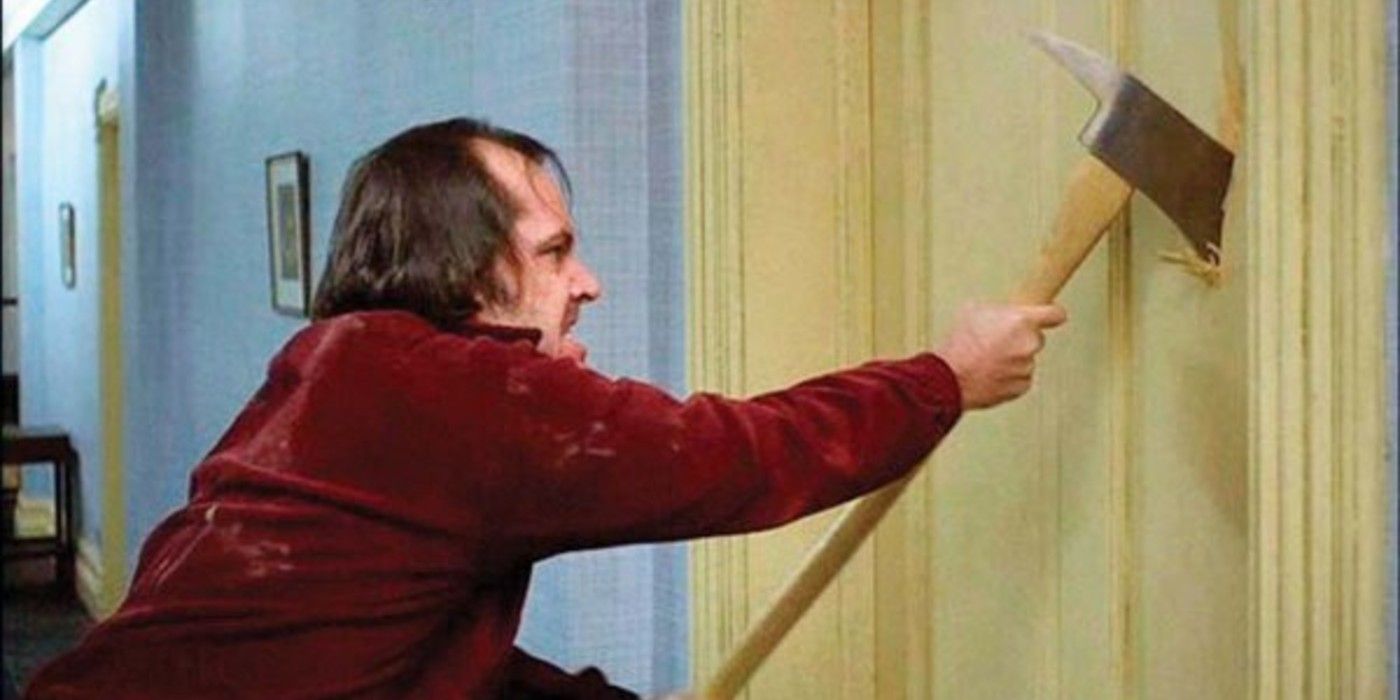
Jack Torrance is huffing. He’s leaning against a bathroom door, clutching a heavy fire axe, and he looks absolutely exhausted. That’s the thing people forget about the axe scene in The Shining. It isn’t just about the jump scare or the "Here’s Johnny" line. It’s about the sheer, grueling physical labor of a man trying to murder his family.
Stanley Kubrick was a perfectionist. Everyone knows that. But for this specific sequence, his obsession bordered on the sadistic. He didn't just want a scary scene; he wanted a breakdown.
Shelley Duvall was actually terrified. Jack Nicholson was actually swinging a real axe. The wood was real. The splinters were flying. When you watch Danny’s face or Wendy’s trembling hands, you aren't just seeing great acting. You’re seeing the result of three days and 60 destroyed doors.
The Physicality of the Axe Scene in The Shining
Most modern horror movies use CGI or flimsy "breakaway" props. Kubrick hated that. He wanted the audience to feel the weight of the steel.
Originally, the production team built a door that was designed to break easily. It didn't work. Why? Because Jack Nicholson had been a volunteer firefighter. He was too good at chopping. He tore through the prop door like it was wet tissue paper in seconds. To get the slow, agonizing crawl of the axe scene in The Shining, the crew had to replace the prop with a heavy, industrial-strength timber door.
Nicholson had to actually work for it.
The sound design plays a massive role here too. Listen closely next time. It isn’t just a "thwack." It’s a rhythmic, wet thud. It sounds like a butcher. Between the swings, you hear Jack’s heavy breathing—that "Little pig, little pig" monologue wasn't just scripted dialogue; it was a taunt delivered by a man who was genuinely out of breath from the exertion of 100+ takes.
Why "Here’s Johnny" Wasn't Even in the Script
It’s the most famous line in horror history. Yet, it was a complete fluke.
Jack Nicholson ad-libbed the line on a whim. He was referencing The Tonight Show Starring Johnny Carson, a cultural staple at the time. Kubrick, who had been living in England for years, supposedly didn't even get the reference. He almost cut it. He thought it was weird.
Honestly, it’s lucky he didn't.
That line provides the only moment of dark "humor" in an otherwise suffocating sequence. It highlights Jack’s complete descent into madness. He isn't just a killer; he’s a performer. He’s enjoying the show. This meta-commentary is what separates the axe scene in The Shining from a standard slasher flick. It’s theatrical. It’s cruel. It turns a domestic homicide into a televised nightmare.
The Psychological Toll on Shelley Duvall
We have to talk about Wendy Torrance. For years, critics panned Shelley Duvall’s performance as "over the top." They were wrong.
Kubrick’s method for filming the axe scene in The Shining involved keeping Duvall in a state of perpetual hysteria. He reportedly told the crew not to sympathize with her. He kept her isolated. By the time they got to the bathroom sequence, she was losing her hair from stress. She was dehydrated from crying.
When she’s swinging that kitchen knife and screaming in that high-pitched, ragged tone, that is the sound of a woman who has been pushed to her absolute limit.
The Composition of the Shot
Look at the framing. Kubrick uses a "one-point perspective" that makes the Overlook Hotel feel like it’s swallowing the characters. In the bathroom, the space is tiny. It’s claustrophobic.
- The camera stays at Wendy’s eye level.
- We see the blade bite through the wood from her perspective first.
- The contrast between the white bathroom tiles and the dark wood of the door makes every crack look like a wound.
There is no music during the actual chopping. Just the sound of the axe. The silence makes the violence feel intimate. It’s not a "movie" moment; it’s a home invasion.
Common Misconceptions About the Axe
People often ask: Why didn't Wendy just jump out the window?
She tried. The window in the bathroom was too small for her to fit through comfortably while panicked, and it was a long drop into the snow. The axe scene in The Shining works because it removes all exits. It’s a "bottle" scene within a "bottle" movie.
Another myth is that the scene took 127 takes. While the "staircase scene" with the baseball bat famously holds a Guinness World Record for takes, the axe-through-the-door sequence took about three days and used dozens of doors, but the 127 number is often a conflation of different scenes. Still, 60 doors is an insane amount of woodwork for a one-minute clip.
The Legacy of the Blade
The axe scene in The Shining changed how we view "the monster." Before this, monsters were often external—vampires, ghosts, creatures from the black lagoon. Here, the monster is the father. The weapon isn't a magical sword; it’s a tool used for keeping a fire going.
It’s the perversion of the domestic. The father, the protector, uses a household tool to dismantle the house itself.
Even the color palette—Jack’s red jacket against the beige and brown of the hallway—was chosen to make him look like a literal bloodstain moving through the hotel. It’s visual storytelling at its most aggressive.
How to Analyze the Scene Like a Pro
If you want to truly appreciate the technical mastery here, try this: watch the scene on mute.
Without the screaming and the "Here's Johnny," you can see the sheer precision of the editing. Ray Lovejoy, the editor, cuts between Wendy’s shaking hands and Jack’s grinning face with a heartbeat-like rhythm. You realize that the terror isn't in the blood—there actually isn't much blood in this specific scene—it's in the anticipation of the next swing.
Practical Next Steps for Film Buffs:
- Watch the Documentary: Check out Filmworker (2017) or Making 'The Shining' (directed by Vivian Kubrick). They show raw footage of Nicholson prepping for the axe swings, jumping around and psyching himself up.
- Compare the Book: Read Stephen King’s original novel. In the book, Jack uses a roque mallet, not an axe. Kubrick changed it to an axe because he felt the visual of the wood splintering was more visceral. He was right.
- Visit the Props: The actual hero axe used in the film sold at auction for over $200,000. Various replicas exist in film museums globally; seeing the scale of a fire axe in person helps you realize how heavy that weapon actually is.
The axe scene in The Shining remains the gold standard for tension. It proves that you don't need a high body count to create a masterpiece. You just need a door, a man with a tool, and a director who won't yell "cut" until everyone on set is genuinely losing their minds.