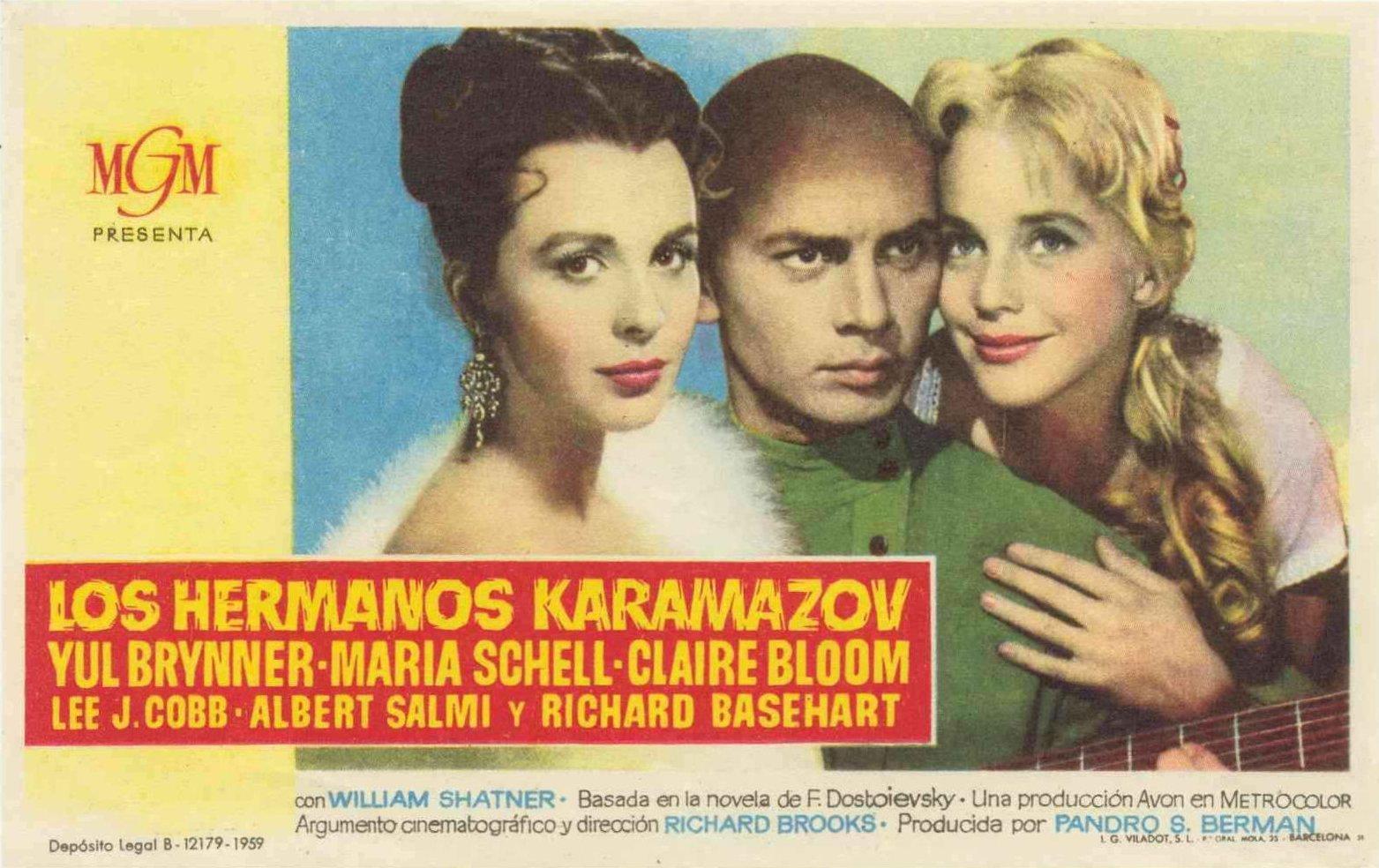
Honestly, trying to cram Fyodor Dostoevsky’s 800-page philosophical behemoth into a two-and-a-half-hour Hollywood movie is a bit like trying to fit a gallon of vodka into a shot glass. It’s messy. It’s ambitious. Most people will tell you it shouldn't even work. Yet, The Brothers Karamazov 1958 film remains this fascinating, neon-drenched artifact of Metro-Goldwyn-Mayer’s late-fifties ambition.
It was directed by Richard Brooks. He’s the same guy who did Cat on a Hot Tin Roof, so you know he wasn't afraid of high-octane family drama. But Russia isn't Mississippi. The film stars Yul Brynner, Maria Schell, and a very young William Shatner—yes, Captain Kirk himself—in his film debut as the saintly Alyosha.
The High-Stakes Casting of The Brothers Karamazov 1958 film
When you look back at the production, the casting alone is a wild ride. Marilyn Monroe famously wanted to play Grushenka. She was obsessed with the role. She reportedly studied it with Lee Strasberg at the Actors Studio, desperate to prove she was more than just a blonde bombshell. She didn't get it. Instead, the role went to Maria Schell. Schell brings this manic, giggling energy to the screen that is genuinely unsettling and brilliant.
Yul Brynner plays Dmitri. He's all brawn and desperation. If you've read the book, you know Dmitri is a man of "broad" Russian character, capable of both immense cruelty and sudden, weeping generosity. Brynner plays it at an 11 the entire time. It’s loud. It’s sweaty. It’s very much a product of 1950s acting styles where every emotion had to reach the back of the theater.
Then there’s Lee J. Cobb as the father, Fyodor Karamazov. He is disgusting. Truly. He plays the patriarch as a leering, bloated clown who enjoys his own vileness. It’s arguably the best performance in the movie because he leans so hard into the grotesque nature of the character.
A Technicolor Russia That Never Existed
One of the first things you notice about The Brothers Karamazov 1958 film is the color. MGM used Metrocolor, and they used it aggressively. This isn't the bleak, grey, snow-covered Russia of our collective imagination. It’s a world of deep purples, harsh reds, and sickly greens.
Cinematographer John Alton, a legend of film noir, brought a weird, expressionistic vibe to the set. He used lighting to show the internal rot of the characters. When a character is feeling guilty or tormented, the light shifts into these unnatural hues. It’s not realistic. Not even close. But it captures the psychological fever dream of Dostoevsky’s writing in a way that a more grounded, "accurate" film might miss.
The sets are massive. They feel like soundstages because they are soundstages. There is a sense of theatricality that permeates every scene.
Shatner as the Moral Compass
Let's talk about William Shatner. Before he was a space commander or a lawyer, he was Alyosha Karamazov. It’s a restrained performance. He’s the novice monk trying to navigate his brothers' sins and his father's madness.
It’s actually quite jarring to see him so quiet. He doesn't have the "Shatner-pause" yet. He’s the anchor. Without his stillness, the movie would just be a series of people screaming at each other in colorful rooms. Richard Basehart plays Ivan, the intellectual, and his descent into madness is handled with a fair amount of nuance, though the film skips over the "Grand Inquisitor" chapter almost entirely.
That’s the biggest gripe for literary purists.
The "Grand Inquisitor" is the heart of the book. It’s a massive philosophical poem about the burden of free will. In the 1958 film, it’s basically a footnote. You can't really blame Brooks, though. How do you film a twenty-page monologue about Christ returning during the Spanish Inquisition in a mid-century Hollywood drama? You don't. You focus on the murder mystery instead.
Why the Critics Were Split
The movie was nominated for an Oscar—Lee J. Cobb for Best Supporting Actor—but it didn't sweep the awards. Critics in 1958 were kind of confused by it. Some loved the spectacle. Others thought it was a "Reader's Digest" version of a masterpiece.
They weren't wrong.
It is a simplified version. The deep dives into Russian Orthodoxy, the nature of suffering, and the social structures of the 19th century are stripped away to make room for a love triangle and a "whodunnit" plot. But if you view it as its own entity—a gothic, mid-century melodrama—it’s actually pretty stellar.
- The music score by Bronislau Kaper is sweeping and dramatic.
- The costume design is lush, even if it feels more like "Hollywood-meets-Moscow."
- The pacing is surprisingly fast for a film of its length.
The 1958 version was the first time many Americans were even introduced to the story. It brought Dostoevsky to the masses, even if it had to put him in a tuxedo and a bit of makeup first.
Comparing the 1958 Film to Other Adaptations
There have been plenty of other attempts to capture this story. The USSR made a three-part epic in 1969 that is much more "accurate" and grim. It feels more like the book. It’s longer, it’s more somber, and it takes the theology seriously.
But there’s something about the The Brothers Karamazov 1958 film that feels more daring in its artifice. It’s not trying to be a documentary of 19th-century Russia. It’s trying to be a psychological opera.
When you watch the 1958 version, you’re watching the end of an era. The studio system was starting to crack. Big-budget literary adaptations were the "prestige" move for studios trying to fight off the rising popularity of television. They poured money into these films, hoping that scale and star power would keep people in seats.
The Murder, the Trial, and the Drama
The second half of the film moves into the trial of Dmitri Karamazov. This is where Brooks really shines as a director. He loves a courtroom. He loves the tension of a man’s life hanging in the balance based on circumstantial evidence.
The trial in the movie is streamlined. In the book, the lawyers give these endless, sprawling speeches that analyze the "Russian soul." In the film, it’s much more about the evidence. Did he kill his father for the 3,000 rubles?
The ending of the film also takes some liberties. Without spoiling too much for those who haven't read the book or seen the movie, it leans a bit more toward a Hollywood resolution than the ambiguous, lingering sadness of the novel. It’s a bit cleaner. A bit more "finished."
Was it a Failure?
Financially, it did okay. It wasn't Ben-Hur, but it wasn't a flop. It’s one of those movies that lived on through late-night television broadcasts in the 70s and 80s, which is where a lot of modern Dostoevsky fans first caught a glimpse of it.
It’s a flawed movie. Definitely. But its flaws are what make it interesting. It’s a collision of high art and commercial necessity. It’s Yul Brynner chewing the scenery while Maria Schell laughs like a maniac in a purple room. It’s a piece of cinema history that refuses to be boring.
How to Watch It Today
If you’re looking to dive into The Brothers Karamazov 1958 film, don't expect a literal translation of the book. Go into it for the performances. Look at it as a masterclass in 1950s production design.
- Watch for the use of colored lights during Ivan's scenes. It’s early psychological lighting at its best.
- Pay attention to Lee J. Cobb. He’s the magnetic center of the film's first half.
- Enjoy the spectacle. It’s a big, loud, messy movie, just like the family it portrays.
You can usually find it on digital rental platforms like Amazon or Apple, and it occasionally pops up on TCM. If you’re a fan of classic Hollywood trying to tackle impossible subjects, it’s a must-watch.
The film serves as a bridge. It bridges the gap between the rigid studio films of the 40s and the more experimental, director-driven films of the 60s. Richard Brooks was a writer-director, a rarity at the time, and his voice comes through even under the weight of an MGM production.
The 1958 adaptation might not be the "best" version of the story ever told, but it is certainly the most vivid. It’s a reminder that sometimes, in the pursuit of greatness, the "almost-successes" are more interesting than the perfect hits. It’s a wild, colorful, Russian fever dream filtered through a California lens.
To get the most out of the experience, try reading the first hundred pages of the novel first. Then watch how the movie translates that internal monologue into external action. You’ll see exactly where Hollywood had to make cuts and where they decided to add a little extra flair. It makes the viewing experience a lot more rewarding.
Then, check out the 1969 Russian version for a total tonal 180. Comparing the two is the best way to understand how culture shapes storytelling. One is a scream; the other is a prayer. Both have their place.