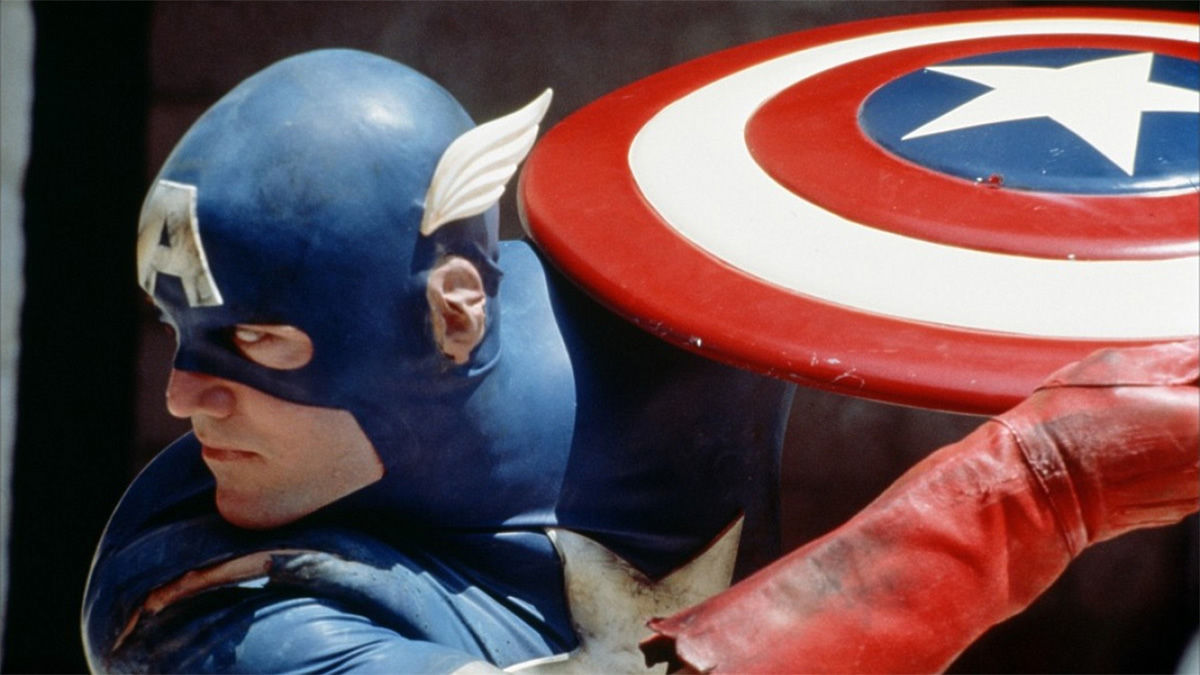
Before the multi-billion dollar Disney machine turned Steve Rogers into a global icon, there was Albert Pyun’s version. It’s a trip. If you only know Chris Evans and the polished aesthetic of the MCU, watching the Captain America 1990 film feels like stepping into an alternate dimension where the budget was thin, the ears were rubber, and the logic was... optional. Honestly, it’s easy to dunk on this movie. Most people do. But if you look past the campy 90s veneer, there’s a strange, earnest heart beating underneath all that spandex.
Matt Salinger—son of the legendary Catcher in the Rye author J.D. Salinger—is our Steve Rogers. He’s tall, lanky, and possesses a sort of wide-eyed sincerity that actually fits the "kid from Brooklyn" vibe, even if he doesn't look like he’s spent a single day in a gym.
The movie starts where you’d expect: World War II. We see the origin of the Red Skull, who, in a bizarre departure from the comics, is an Italian boy kidnapped by fascists rather than a German protégé of Hitler. He's played by Scott Paulin with a heavy accent and a prosthetic face that looks like a sun-dried tomato. Then we get Steve. He’s a polio survivor here, not just a "90-pound weakling." He gets the super-soldier serum, he gets the shield, and within about ten minutes of screen time, he’s frozen in ice after a disastrous first mission.
He wakes up in the 90s. This is where the movie gets truly weird.
The Captain America 1990 film was a victim of its own ambition
Making a superhero movie in 1990 wasn't like it is now. There was no blueprint. Tim Burton’s Batman had just come out a year prior, but that was a dark, gothic anomaly. Director Albert Pyun was working with 21st Century Film Corporation, a studio that was constantly teetering on the edge of bankruptcy. You can see the struggle on screen.
The production was a mess. They filmed in Yugoslavia to save money. Every time the production ran out of cash, they’d just stop. This led to some of the most infamous "shortcuts" in cinema history. Remember Cap’s ears? In the comics, the mask has wings or painted ears. In this movie, Matt Salinger has visible, rubber ears sewn into the cowl because the mask looked too "alien" without them. It’s a small detail that screams "low budget," but it also gives the film this weird, tactile charm that CGI-heavy modern films lack.
One of the funniest, most human things Steve Rogers does in this movie is steal cars. Frequently.
He doesn't have a motorcycle or a Quinjet. He’s a man out of time who is perpetually lost. So, he fakes being sick to trick people into pulling over, then he just... takes their cars. It’s hilarious. It’s also probably the most realistic thing a confused WWII vet would do if he were dropped into 1990s Alaska without a credit card.
Why does the Red Skull look like a normal guy for 80% of the movie?
This is the big sticking point for fans. After the initial 1940s sequence, the Red Skull undergoes plastic surgery. For the rest of the film, he just looks like a wealthy, older Italian businessman. No red face. No skull. Just Scott Paulin in a nice suit.
It was a budget move, obviously. Keeping a lead actor in heavy prosthetics for a whole shoot is expensive and time-consuming. But from a narrative standpoint, it turns the Captain America 1990 film into a bizarre political thriller. The Red Skull is basically running a shadow government with his daughter, played by Francesca Neri. They’re kidnapping the President (Ronny Cox), and Cap has to team up with his old flame’s daughter (Kim Gillingham) to save the day.
The stakes feel small. The action is crunchy. When Cap throws the shield, it doesn't look like a physics-defying weapon; it looks like a heavy frisbee that someone might actually get hurt by.
A cast that was way better than the script
Look at the credits and you’ll be shocked. Ned Beatty is in this. Ronny Cox, the legendary villain from RoboCop and Total Recall, plays the President of the United States. Bill Mumy is the young Dr. Vaselli. These are serious actors.
Ronny Cox, in particular, gives a performance that is way more dignified than this movie deserves. His President Tom Prescott is an environmentalist who wants to pass "The Environmental Act," which is why the Red Skull wants him gone. It’s very "Captain Planet" era politics.
Matt Salinger gets a lot of flak for his performance, but he captures the melancholy of the character. When he returns to his childhood home and finds it turned into a museum, there’s a genuine sense of loss. He’s not a quipping action hero. He’s a guy who lost his life and is trying to find a reason to keep fighting.
The legacy of a "lost" Marvel movie
For years, you couldn't even find this movie. It had a brief theatrical release in the UK and some other territories, but in the US, it went straight to VHS and cable in 1992. It became a legend of the "bootleg" circuit at comic book conventions.
It’s easy to call it "bad." By modern standards, it is. The editing is choppy, the pacing is all over the place, and the final fight in a castle in Italy is shockingly brief. But there’s a DNA here that eventually found its way into the MCU. The idea of Steve Rogers being a symbol that people need to believe in, even when the man himself is struggling, is present here.
We should also talk about the shield. They used a few different versions for filming—some were heavy metal for close-ups, others were fiberglass. Watching Salinger try to run while holding a giant, un-aerodynamic disc is a reminder of how much work goes into making these characters look "cool."
What you should actually do if you want to watch it
If you’re going to dive into the Captain America 1990 film, don't go in expecting The Winter Soldier. Go in expecting a weird, B-movie hybrid of a spy thriller and a comic book origin story.
- Find the Director’s Cut: Albert Pyun eventually released a "Cyberpunk Edition" or director's cut that restores some footage and fixes some of the soundtrack issues. It's much more coherent.
- Watch the background: The Yugoslavian locations are actually quite beautiful. The crumbling castles and coastal towns give the movie a European vibe that sets it apart from the usual New York City backdrops.
- Appreciate the stunts: There’s a scene where Cap hangs off the side of a rocket. It’s a practical stunt. It looks dangerous because it probably was.
- Compare the "fish out of water" tropes: See how this film handles Steve’s adjustment to the modern world compared to the 2011 version. In 1990, it's mostly about him being confused by cassettes and environmentalism.
The movie isn't a masterpiece. It's barely a "good" movie. But it’s a fascinating piece of history. It represents a time when Marvel was struggling to get anything on screen, selling off rights to whoever had a checkbook. It’s the cousin to the unreleased Roger Corman Fantastic Four movie and the David Hasselhoff Nick Fury flick.
The best way to experience it is with friends and a very open mind. It’s a snapshot of a pre-CGI world where a guy in a blue suit and rubber ears was the best we could get. And honestly? There’s something kind of heroic about that.
To truly understand how far superhero cinema has come, you have to look at where it started. Tracking down a high-quality version of the 1990 film—specifically the 2013 Blu-ray release from Shout! Factory—is the best way to see the practical effects in their (admittedly dated) glory. Once you've seen Matt Salinger fake a car sickness-induced heist to get a ride to Ohio, you'll never look at the First Avenger the same way again.
Check the secondary market or specialty collectors' sites for the Shout! Factory "Collector’s Edition." It contains the most stable transfer of the film available and includes interviews that explain just how chaotic the production really was behind the scenes. Seeing the struggle of the creators makes the flaws feel a lot more like battle scars than mistakes.