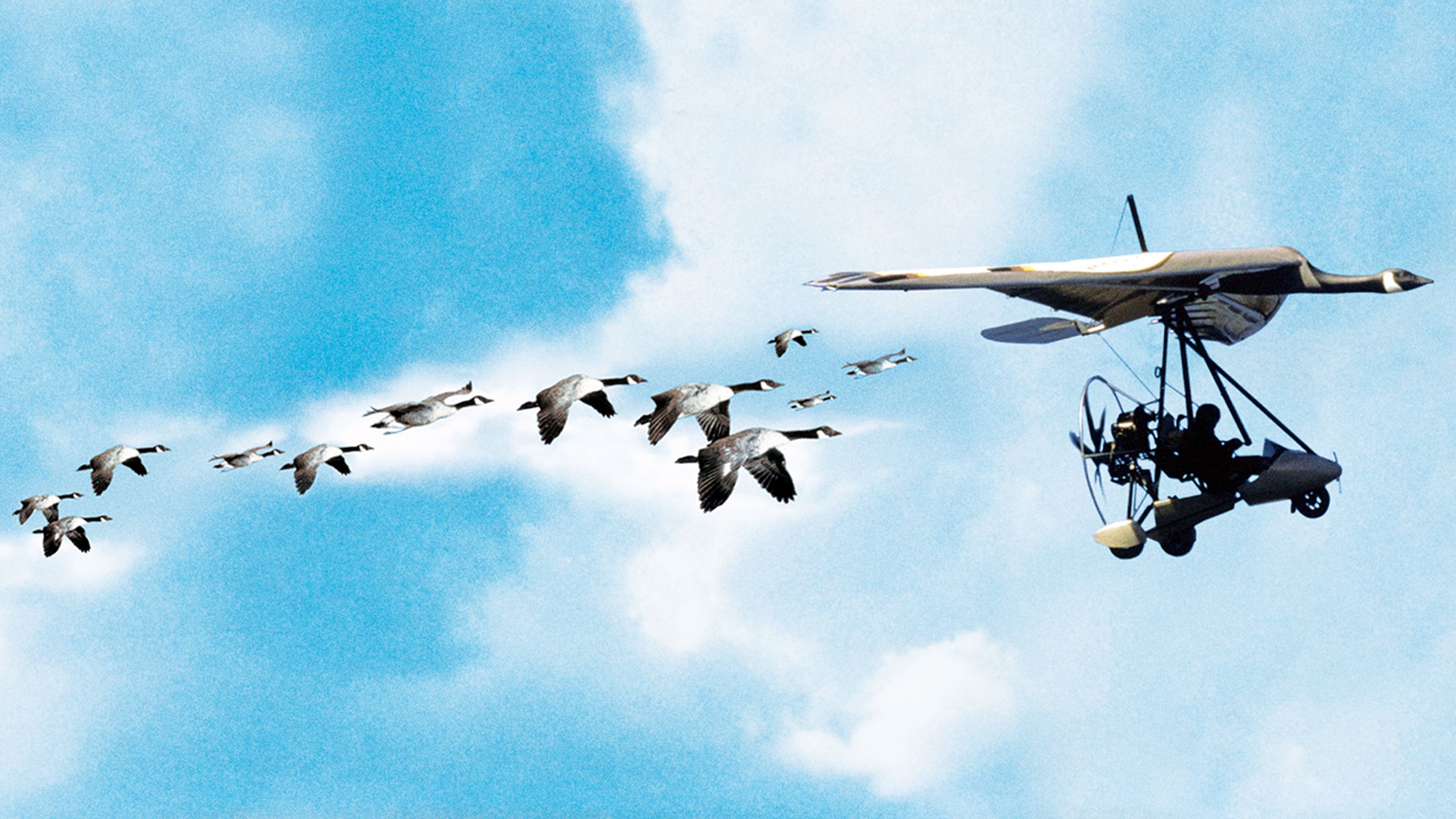
You remember the geese. Everyone remembers the geese. There is this specific, hazy gold light that filters through the 1996 film Flying Away Home that makes you feel like you’re breathing in crisp Ontario morning air. It’s a movie that, on the surface, looks like a standard "family rescues animals" flick. But honestly? It’s much weirder and more beautiful than that. If you revisit the Flying Away Home movie today, you realize it’s actually a pretty heavy meditation on grief, engineering, and the sheer audacity of trying to be a parent when you don't have a clue what you're doing.
Amy Alden, played by a young Anna Paquin right after her Oscar win for The Piano, is a kid who has just lost her mother in a car accident. She moves from New Zealand to Canada to live with her estranged, eccentric inventor father, Thomas (Jeff Daniels). It’s an awkward setup. The house is a mess. The vibe is tense. Then, developers bulldoze a nearby woods, and Amy finds a nest of abandoned Canada Goose eggs. She rescues them. They hatch. And because geese are imprinting creatures, they decide this sullen pre-teen is their mother.
The Real Story Behind the Wings
Most people don't realize that this wasn't just some Hollywood screenwriter's fever dream. The Flying Away Home movie is actually based on the real-life experiments of Bill Lishman. He was a Canadian inventor and artist who really did train geese to follow his ultralight aircraft. Lishman, who passed away in 2017, was a pioneer in what we now call "interspecies migration." He figured out that if geese don't have parents to show them the way south, they just won't go. They’ll stay put and freeze.
Lishman’s book, Father Goose, served as the primary inspiration. In the film, they swapped his real-life sons for a daughter to heighten the emotional stakes of the "mother goose" metaphor, but the technical stuff? That was largely real. They didn't have sophisticated CGI in 1996 to handle flocks of birds in flight. What you’re seeing on screen are real birds and real ultralight planes. The production actually had to hatch and raise several groups of geese so they would be imprinted on the actors and the aircraft. It was a logistical nightmare that resulted in some of the most stunning practical cinematography of the 90s.
Why the Cinematography Matters
Caleb Deschanel was the cinematographer. If that name sounds familiar, it’s because he’s a legend (and father to Zooey and Emily). He treats the Canadian landscape like a cathedral. There is a specific scene where the ultralight, painted to look like a giant goose, takes off for the first time with the flock. It’s low-tech. It’s scrappy. It’s basically a lawnmower engine with wings. Yet, when those birds lift off, it feels like a religious experience.
Movies today are too clean. They're polished until they lose their texture. Flying Away Home is tactile. You can almost feel the mud on Amy’s boots and the wind whipping through those flimsy cockpit wires. The film captures a very specific 90s aesthetic of "the eccentric inventor in the woods" that feels almost extinct now.
Grief as a Silent Character
Let's talk about the grief. It's the engine of the movie. Amy isn't just saving geese; she’s trying to find a way to navigate a world that feels fundamentally broken. Thomas Alden isn't a perfect dad. He’s distracted, a bit selfish with his art, and totally unprepared for a grieving daughter. The geese become a bridge. It’s a classic "show, don't tell" scenario. They don't sit down and have long, tearful chats about the car accident. Instead, they build a plane.
It’s about mechanical healing.
The Environmental Subplot
There’s a developer vs. nature subplot that feels a bit "90s villain," but it serves a purpose. It grounds the story in the reality of habitat loss. Even in 1996, the film was sounding the alarm on how urban sprawl was messing with migratory patterns. When the birds finally land in the North Carolina bird sanctuary at the end, it’s a victory for the land as much as it is for the family.
Interestingly, the film's success actually helped raise awareness for Operation Migration, the non-profit co-founded by Lishman. They spent years using ultralights to lead endangered Whooping Cranes along safe migration routes. The Flying Away Home movie isn't just a piece of entertainment; it’s a popularized version of a massive conservation breakthrough.
Addressing the "Slow" Criticism
Is the movie slow? By modern standards, yeah, maybe. It takes its time. It lets you watch birds eat mash. It lets you watch a man struggle with a welding torch. But that slowness is a feature, not a bug. It builds the bond between the audience and the flock. If the migration started at the 30-minute mark, you wouldn't care if the birds made it to the coast. You care because you watched them hatch in a dresser drawer.
Things You Might Have Missed
- The Music: Mark Isham’s score is incredible. It uses Celtic-inspired themes that tie back to Amy’s life in New Zealand while soaring during the flight sequences. "10,000 Miles," the song by Mary Chapin Carpenter, became synonymous with the film. It captures that bittersweet feeling of leaving home perfectly.
- The Legal Stakes: There’s a scene where a local wildlife officer wants to "clip" the birds' wings so they can't fly, essentially turning them into pets. This is a crucial turning point. It moves the geese from "cute animals" to "symbols of freedom."
- The Design: Thomas Alden’s house is a masterpiece of production design. It’s built into a silo and filled with kinetic sculptures. It reflects his character—disorganized but brilliant.
How to Revisit the Film Today
If you’re planning to watch the Flying Away Home movie again, or showing it to a new generation, keep a few things in mind. First, explain that the birds are real. Kids used to Pixar might assume it’s all digital. Knowing those geese were actually following that plane changes the way you watch the final act.
Second, look at the relationship between Thomas and his brother David (Terry Kinney). It’s a very realistic portrayal of adult siblings—one who stayed grounded and one who stayed a dreamer. They bicker, they stress over money, and they eventually come together for the kid.
The Lasting Impact
The movie holds an 88% on Rotten Tomatoes for a reason. It doesn't pander. It treats Amy’s anger as valid. It treats the science of migration with respect. It’s one of the few "family" films from that era that doesn't feel dated by pop culture references or bad jokes.
It’s just a story about a girl, her dad, and a bunch of birds.
Actionable Takeaways for Movie Buffs
- Watch the Documentary: If you can find it, look for C'mon Geese. It’s the original documentary about Bill Lishman’s work. It shows the real footage that inspired the film.
- Check the Filming Locations: Most of the movie was shot in Ontario, specifically around the Sandbanks Provincial Park. It’s a beautiful area to visit if you’re a fan of the film’s "look."
- Support Conservation: The legacy of the film lives on in organizations like the International Crane Foundation. They still use some of the principles developed by Lishman to help endangered birds.
- Practical Effects Study: If you’re a film student or hobbyist, study the flight sequences. Notice how they use different camera angles to hide the safety rigs and how they manage the lighting to keep the birds from looking like silhouettes.
The Flying Away Home movie isn't just nostalgia bait. It’s a well-crafted piece of cinema that reminds us that sometimes, to find your way home, you have to follow something small and fragile until you're both safe. It’s a quiet masterpiece of the mid-90s that deserves its spot in the "they don't make 'em like this anymore" Hall of Fame.