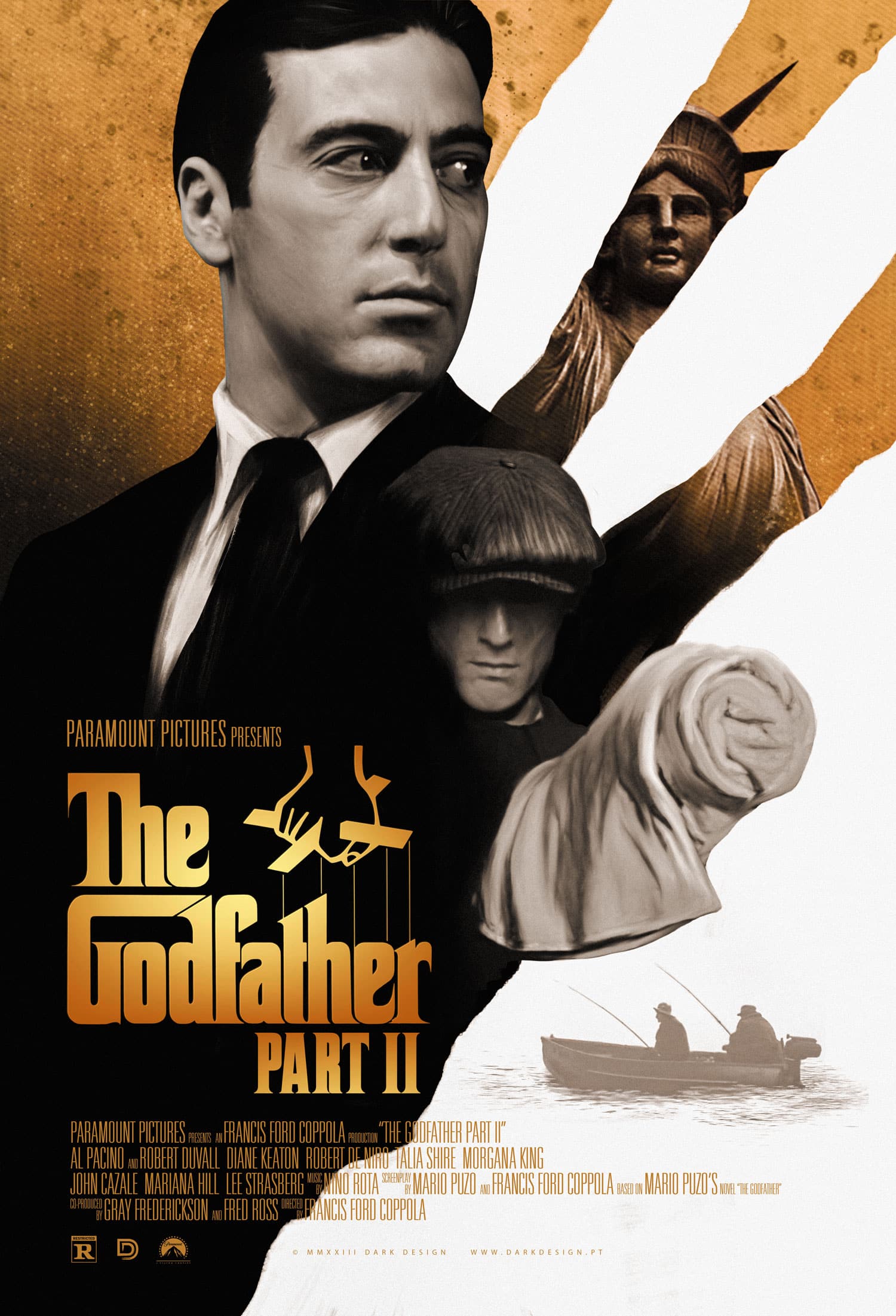
People argue about this all the time. It’s the ultimate cinematic debate, right? You’re at a bar, or maybe just scrolling through some forum, and someone brings up the Corleones. They usually say the original is the perfect movie. They’re wrong. Honestly, The Godfather Part II is the superior achievement, not just because it’s "bigger," but because it’s braver. It’s a sequel that functions as a surgical deconstruction of the American Dream, and it does it while jumping back and forth through time like a fever dream.
Francis Ford Coppola didn't even want to do it at first. He wanted Martin Scorsese to direct it. Can you imagine that version? Paramount basically threw money at Coppola and told him he could do whatever he wanted, including that crazy "Part II" title which, believe it or not, was a huge deal back then. Studios hated numbering sequels. They thought it sounded boring.
The Dual Narrative Nobody Thought Would Work
The structure is what makes The Godfather Part II so dense and, frankly, kind of exhausting in the best way possible. You’ve got Michael Corleone in 1958, slowly losing his soul in Lake Tahoe, and then you’ve got Vito Corleone in the early 1900s, finding his footing in Hell’s Kitchen. It’s a mirror.
Vito, played by Robert De Niro in a performance that basically defined his career, builds a family to protect his community. He kills Don Fanucci because he has to. It’s business, yeah, but it’s also survival. Then you look at Michael. Al Pacino plays him with this terrifying, icy stillness. Michael isn't building; he’s protecting a crumbling empire by destroying everyone he loves.
If you watch closely, the lighting changes between these eras. Gordon Willis, the cinematographer they called "The Prince of Darkness," used these warm, sepia tones for the young Vito scenes. It feels nostalgic. It feels like a memory. Then he switches to the 1950s, and everything is cold, blue, and sterile. Michael’s world is literally losing its warmth.
What Most People Get Wrong About Fredo
We have to talk about Fredo. "I’m your older brother, Mike, and I was stepped over!" It’s the most heartbreaking line in the whole movie. Most people think Fredo was just a traitor or "the dumb one." That’s too simple. John Cazale—who, by the way, appeared in five movies before he died and every single one was nominated for Best Picture—played Fredo with such profound insecurity.
Fredo didn't want Michael dead. He just wanted a seat at the table. He wanted respect. The tragedy of The Godfather Part II isn't just that Michael kills his brother; it’s that Michael knows he doesn't have to, but his own rigid code of "loyalty" has become a cage. He’s become the very thing he fought to avoid in the first movie. He’s a monster.
The Hyman Roth Connection
Lee Strasberg as Hyman Roth is a masterclass in "less is more." He’s based on Meyer Lansky, the real-life mob accountant. There’s a scene where he’s sitting in his undershirt, eating a tuna sandwich and watching a football game. He looks like a retired grandpa in Florida. That’s the point. The real power isn't in a tuxedo at a wedding; it's in the guy who can order a hit while complaining about his health.
The whole Cuba sequence is where the movie gets political. It shows the intersection of the Mafia and American corporate interests. When Michael sees the rebel blow himself up with a grenade rather than be captured, he realizes they can’t win. "The soldiers fight for money, the rebels fight for a cause." Michael is the soldier. He’s got all the money, but he’s lost the cause.
Why the Prequel Elements Matter
Watching De Niro's Vito is fascinating because of how much he studied Marlon Brando. He went to Sicily to learn the dialect. He practiced that specific, raspy whisper. But he’s more athletic, more vibrant. When he’s jumping across the rooftops to assassinate Fanucci during the San Rocco festival, it’s arguably the most "action" the franchise ever gets, yet it feels grounded.
It provides the context Michael lacks. Vito came from nothing. He saw his mother murdered by Don Ciccio. His violence was a reaction to a world that gave him no choices. Michael, conversely, had all the choices in the world. He was a war hero. He could have been a Senator, just like his father wanted. He chose the dark, and that’s why the ending of the film—that long, lonely shot of Michael sitting by the lake—is so haunting.
The Production Was A Nightmare
It wasn't easy to make. Coppola was miserable. Pacino got sick during filming in Santo Domingo. The script was being rewritten constantly. There’s this famous story that the actors didn't know how the movie would end while they were halfway through it.
And yet, it became the first sequel to win the Academy Award for Best Picture. It’s a miracle of editing. The way it cuts from Vito holding a baby Michael on a train to Michael sitting alone in his office... it’s visual poetry. It tells you everything you need to know about the cost of power without saying a word.
Misconceptions and Forgotten Details
- The Brando Cameo: People always wonder why Marlon Brando isn't in the flashback at the end. He was supposed to be. He just didn't show up for the day of filming because of a dispute with Paramount. Coppola had to rewrite the scene on the spot. Honestly? It’s better without him. Having the family talk to an empty chair makes his presence feel more like a ghost.
- The Senator: G.D. Spradlin’s Senator Pat Geary is one of the most disgusting characters in cinema. The way he talks to Michael, insulting his "oily hair" and his family, only to end up in Michael’s pocket after a setup involving a dead girl... it shows that the "legitimate" world is just as filthy as the Mafia.
- The Kiss: The "Kiss of Death" in Havana wasn't just a dramatic moment. It’s a ritual. It’s the moment Michael publicly marks Fredo. It’s chilling because it’s the last time they are truly brothers before they become "The Don" and "The Traitor."
How to Truly Appreciate It Today
If you’re going to watch The Godfather Part II, don't do it on your phone. Don't do it while folding laundry. You have to commit to the three-hour-plus runtime. Look at the background of the shots. Look at the way Kay (Diane Keaton) is slowly being pushed out of the frame in every scene she shares with Michael.
She represents the audience’s conscience. When she tells Michael about the "unholy" thing she did, she’s basically trying to burn the house down because she can’t live in the cold anymore. It’s the final break. The family is dead long before Fredo gets in that boat.
Actionable Insights for Cinephiles
- Watch for the "Door" Motif: Just like the first movie ends with a door closing on Kay, the second movie is full of thresholds. Notice who is allowed in a room and who is left in the hallway.
- Compare the Oranges: In this universe, oranges usually signal a death or a near-death experience. Look for them in the background of the Florida scenes or on the tables in the boardroom.
- Study the Sound Design: Listen to the trains in the Vito sequences. The screeching metal adds a layer of industrial tension that reflects the harshness of immigrant life in 1917 New York.
- Analyze the Ending: The final flashback isn't just a gimmick. It’s Michael’s last moment of innocence. He’s at the table with his brothers, and he announces he’s joined the Marines. They all yell at him. He’s left alone at the table while they go to greet their father. That’s his whole life: he’s the one who stayed behind to "protect" the family, but he ended up being the one who destroyed it.
The brilliance of this film lies in its refusal to give you a happy ending. It’s a tragedy in the classic sense. You don't root for Michael by the end; you're terrified of him. That’s why it’s a masterpiece. It doesn't care if you like the protagonist. It only cares that you understand the weight of his crown.
Go back and watch the scenes in Sicily where Vito returns to kill Don Ciccio. Compare that to Michael’s cold, calculated hits. One is a settling of scores; the other is a soul being extinguished. Once you see that contrast, you’ll never look at the first movie the same way again.