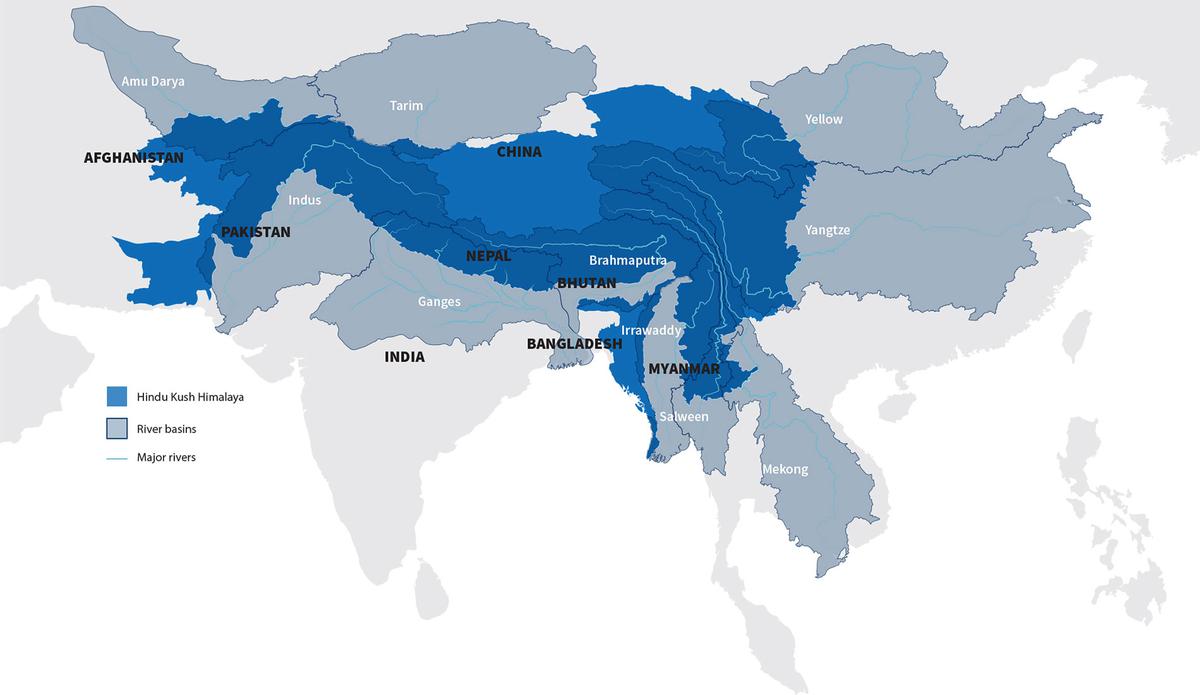
You’ve seen the maps. Huge brown ridges cutting across Asia like a jagged scar. Most people just look at that massive wall of rock and think, "Yeah, the Himalayas." But honestly? That’s kinda like calling every skyscraper in New York the Empire State Building.
If you’re standing in the high-altitude deserts of northern Pakistan or looking up from the lush valleys of Nepal, the difference between the Himalaya and Hindu Kush mountains is visceral. It’s geological. It’s cultural. It’s the difference between life and death for the people living in their shadows. One is a soaring, moisture-trapping monster of a range that defines the monsoon; the other is a rugged, arid, and politically volatile fortress that has swallowed empires whole.
They meet at a single, incredibly violent point of tectonic pressure: the Pamir Knot. This is the "Roof of the World." It’s where the earth basically crumpled like a piece of paper in a giant's fist.
The Tectonic Mess: How They Actually Formed
Geology is messy. We’re taught in school that India smashed into Asia and—poof—mountains. It was way more violent than that. The Himalaya and Hindu Kush mountains are both results of the Indian Plate’s relentless northward sprint, but they responded differently to the impact.
The Himalayas are the "young" superstars. They’re still growing. Because the Indian plate is still shoving itself under the Eurasian plate, Everest gets a tiny bit taller nearly every year. It’s a literal work in progress.
The Hindu Kush? That’s a different beast. It stretches about 800 kilometers, mostly through Afghanistan and parts of Pakistan. While the Himalayas are generally considered to start at the Indus River, the Hindu Kush pushes westward. It’s a "trans-Himalayan" range in some contexts, but it has its own distinct personality. The rock here is often older, more fractured, and incredibly steep.
Think about Tirich Mir. It’s the highest point of the Hindu Kush at 7,708 meters. It’s not an "eight-thousander" like Everest or K2, but don't let that fool you. The vertical rise from the valleys below is staggering. It’s a wall of ice and granite that makes even experienced climbers feel small.
Climate, Rain, and the Death of Clouds
The Himalayas are the ultimate bouncer. When the summer monsoon sweeps up from the Indian Ocean, it hits the Himalayan wall and just stops. This is why the southern slopes—places like Bhutan and the Indian state of Sikkim—are vibrantly green, dripping with moisture, and home to dense rhododendron forests.
The Hindu Kush doesn't get that invite.
By the time air reaches the Hindu Kush, it’s often dry. This creates a rain-shadow effect that defines the entire region’s look. Instead of misty forests, you get high-altitude deserts. It’s beautiful, but it's harsh. It’s a landscape of browns, ochres, and purples, punctuated by the brilliant blue of glacial meltwater.
- Himalayan flora: Lush, tropical at the base, moving to alpine meadows.
- The Hindu Kush landscape is mostly scrubland, hardy junipers, and vast, rocky scree slopes.
- Water sources: Both are the "Third Pole," holding massive amounts of ice, but the Hindu Kush glaciers are shrinking at a rate that honestly scares researchers because the region lacks the consistent monsoon replenishment that parts of the eastern Himalayas enjoy.
The Cultural Divide: Monks vs. Warriors
History has treated these two ranges very differently. The Himalayas have often been seen as a spiritual sanctuary. You think of monasteries tucked into the cliffs of Ladakh or the sacred peaks of Nanda Devi. There’s a sense of "upward" energy—pilgrimages to the source of the Ganges, the search for Shambhala, and the quiet isolation of the high valleys.
The Hindu Kush has a different vibe. The name itself is a point of contention. Some say it means "Hindu Killer," a grim reference to the days when enslaved people from the Indian subcontinent perished in the freezing passes while being transported to Central Asia. Others, like the legendary traveler Ibn Battuta, corroborated this dark origin in his 14th-century writings.
This range is a fortress. It’s the gatekeeper between Central Asia and South Asia. Alexander the Great hauled his army over these passes. The Silk Road snaked through its valleys. Because it’s so rugged, it has allowed distinct cultures to survive in total isolation for centuries.
Take the Kalash people in Pakistan’s Chitral valley. They live in the Hindu Kush and have maintained a unique polytheistic religion and culture that looks nothing like the Islamic or Buddhist traditions surrounding them. They’ve survived because the mountains are so difficult to traverse that the outside world just… forgot about them for a while.
Why Travelers Get the Two Mixed Up
If you’re trekking in northern Pakistan, you’re often standing at the crossroads. In the Gilgit-Baltistan region, you can actually see where the Himalayas, the Karakoram, and the Hindu Kush all collide. It’s the only place on Earth where you can stand in one spot and see three of the world’s highest mountain ranges.
Most people use "Himalayas" as a catch-all term for any big mountain in Asia. It’s lazy. If you tell someone from Kabul that they live in the Himalayas, they’ll look at you like you’re crazy. The Hindu Kush is their identity. It’s the backbone of Afghanistan.
The Reality of Climbing and Risk
Climbing in the Himalayas is a massive industry. Everest is a literal traffic jam during the spring window. There are fixed ropes, Sherpa support, and a well-oiled machine (though still deadly).
The Hindu Kush is the Wild West.
There are hundreds of peaks in the Hindu Kush that haven't even been named, let alone climbed. The infrastructure isn't there. The political situation in Afghanistan makes the bulk of the range inaccessible to Western mountaineers. Even on the Pakistani side, in the valleys of Swat or Chitral, you’re looking at true exploration. You aren't following a trail of discarded oxygen bottles; you're following goat paths and ancient trade routes.
The Environmental Crisis Nobody Talks About
We talk a lot about the "Third Pole" and the melting of the Himalayan glaciers. It’s a catastrophe for the billions of people downstream who rely on the Indus, Ganges, and Brahmaputra rivers.
But the Hindu Kush is even more vulnerable.
ICIMOD (the International Centre for Integrated Mountain Development) has released reports showing that the Hindu Kush-Himalaya region is warming significantly faster than the global average. In the Hindu Kush, where there’s less rainfall to begin with, the loss of permafrost is causing massive landslides. Entire villages are being wiped out not by floods, but by the mountain itself literally falling apart because the "ice glue" holding the rocks together is melting.
What You Should Actually Do Next
If you’re planning to visit or study these ranges, don't just lump them together. They require different prep.
First, check the geopolitical climate. The Himalayas in Nepal and India are generally stable for travel. The Hindu Kush is a moving target. If you’re heading to the Pakistani side, you need specific permits (NOCs) for many areas.
Second, respect the altitude. People underestimate the Hindu Kush because the peaks are "shorter" than the 8,000-meter giants of the Himalayas. That's a mistake. The base elevations are high, and the air is just as thin.
Third, look at the maps from the Geological Survey of India or the Pakistan Meteorological Department. They show the distinct fault lines that separate these giants. Understanding those lines helps you see the world differently. You realize that a mountain isn't just a pile of dirt—it’s a living, moving, and very dangerous part of the planet's crust.
Dig into the history of the Khyber Pass if you want to understand the Hindu Kush's role in global politics. Then look at the history of the Tibetan plateau to understand the Himalayas. You'll see two completely different stories of how humans try to survive in places we probably shouldn't be.
Stop calling everything the Himalayas. It’s a disservice to the rugged, lonely, and fascinatingly complex world of the Hindu Kush.