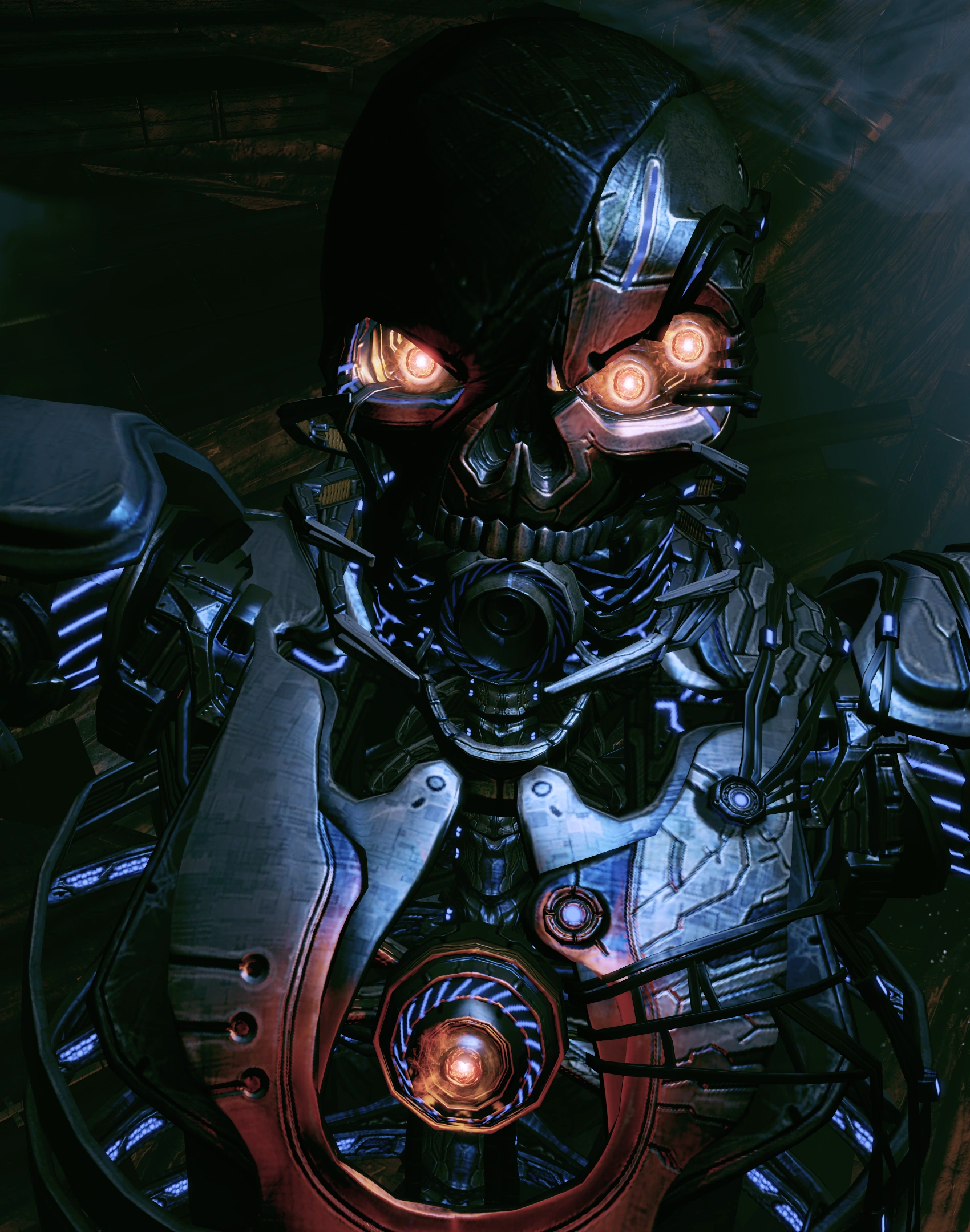
It’s been over a decade since Commander Shepard took that final leap into the heart of the Collector Base, yet people are still arguing about the Mass Effect human reaper. Most players remember the shock. You expect a giant, Lovecraftian spaceship. Instead, you get a skeletal, glowing-eyed infant made of liquefied colonists. It was weird. It was polarizing. Honestly, it was one of the balliest moves BioWare ever made in the trilogy.
The thing about the Human-Reaper Larva—its official name if we’re being technical—is that it represents the most horrifying aspect of the Reaper harvest. We’re not just talking about extinction. We’re talking about "genetic preservation" through a blender.
The Biology of a Nightmare: How They Actually Built It
The Collectors weren’t just kidnapping people for fun. They were looking for the right "genetic paste." In the lore, most species didn't make the cut. The Protheans failed. The Drell, the Hanar, the Elcor? Not enough genetic diversity or whatever metric the Reapers use to judge worthiness. But humans? We were the "special" ones.
Basically, the process involves taking millions of living humans, dissolving them into a raw genetic slurry, and injecting that goo into a synthetic framework. If you look closely at the boss fight in Mass Effect 2, you can see the tubes feeding the "meat" into the machine. It’s disgusting. It’s also a bit of a plot hole for some. Why a human shape? EDI explains it later in Mass Effect 3: the core of every Reaper reflects the species it was made from, but the outer shell is always that standard cuttlefish design we know and love.
The human reaper we fought was just the inner core. If it had finished, it would have been encased in a 2-kilometer-long sovereign-class hull.
Why the Design Caused a Fan Uproar
Not everyone loved the "Terminator" look. Some fans felt it was too "Saturday morning cartoon" compared to the cosmic horror of the first game. In the original Mass Effect, Sovereign was an invincible god-machine. It didn't need a face. It didn't need arms. It was just an inevitable force of nature.
Then comes the sequel. Suddenly, the big bad is a giant skeleton that screams.
But there’s a deeper thematic layer here. The Reapers are obsessed with us. By making the Mass Effect human reaper the centerpiece of the second game, BioWare signaled that humanity had moved from being a galactic footnote to being the Reapers' primary interest. It turned the cosmic horror into something deeply personal. You weren't just saving the galaxy; you were stopping your species from being turned into a giant, immortal battery.
Technical Mechanics: Beating the Larva on Insanity
If you’re replaying the Legendary Edition, the fight can be a massive pain, especially on the harder difficulties. The Larva has two main phases. First, you’re shooting out the orange tubes—the "feeding lines." Then, it’s a straight-up slugfest against its weak points.
- Weapon Choice: If you aren't bringing the M-920 Cain, you’re making life hard for yourself. One shot from the Cain can skip a huge chunk of the final phase.
- Weak Points: Aim for the eyes and the chest core.
- Adrenaline Rush: If you're a Soldier, this is your best friend. The time-dilation effect makes hitting those glowing orange bits much easier while the platforms are moving.
The most dangerous part isn't even the Reaper itself; it's the Collectors flanking you. Harbinger will constantly possess minions. If you ignore the adds, they’ll pin you down with biotic orbs while the Reaper charges its main beam. Stay mobile. Don't stay in one cover spot for more than five seconds.
The Connection to the Protheans and the Cycle
We have to talk about the Collector connection. The Collectors were essentially "mutated" Protheans, hollowed out and turned into drones. They were a failed Reaper. Because the Reapers couldn't make a "Prothean Reaper," they just used the leftovers as a slave race.
This puts the Mass Effect human reaper in a different light. It was the Reapers' second attempt at a "Mammalian" cycle masterpiece. Had Shepard failed, the remains of Earth would have been the foundation for a new god. It’s a dark thought. Every time you see a Reaper in Mass Effect 3, you have to wonder what species is currently "fueling" that ship.
What the Developers Said
Art director Derek Watts has mentioned in various interviews and the "Art of the Mass Effect Universe" book that the design was meant to be jarring. They wanted to show the "embryonic" stage. It’s supposed to look incomplete. It’s supposed to look vulnerable yet terrifying. The transition from organic to synthetic isn't supposed to be pretty.
Legacy of the Larva
Years later, the community is still split. Was it a bit cheesy? Maybe. But it gave the trilogy one of its most visceral moments. It moved the Reapers from "scary ships in deep space" to "monsters that want to eat our souls."
The Mass Effect human reaper remains a symbol of the series' peak experimentation. It was a moment where the stakes became physical. You could see the eyes. You could see the ribcage. It wasn't just metal anymore.
If you’re looking to dive back into this lore, the best way is to pay close attention to EDI’s dialogue during the "Priority: Cerberus Base" mission in the third game. She provides the context that many players missed back in 2010. She explains the "why" behind the shape, confirming that the Reapers are essentially a museum of the civilizations they’ve destroyed.
Actionable Insights for Your Next Playthrough:
- Scan Everything: To get the full narrative weight of the Reaper construction, you need to find the logs in the Collector Base. They detail the "genetic viability" tests.
- Save the Crew: Remember, the size and "health" of the Reaper in the cutscenes actually correlates to how many of your crew members died in the pods. If you wait too long after the IFF mission, you’re basically watching your friends get turned into that giant skeleton.
- Check the Art Books: If you can find a copy of The Art of the Mass Effect Trilogy, look at the early sketches. There were versions that were even more "humanoid" and arguably even more disturbing than what made it into the final game.
The Reaper threat was always about the loss of identity. Nothing illustrates that better than seeing a giant, metallic version of ourselves staring back through the darkness of the Omega-4 Relay.