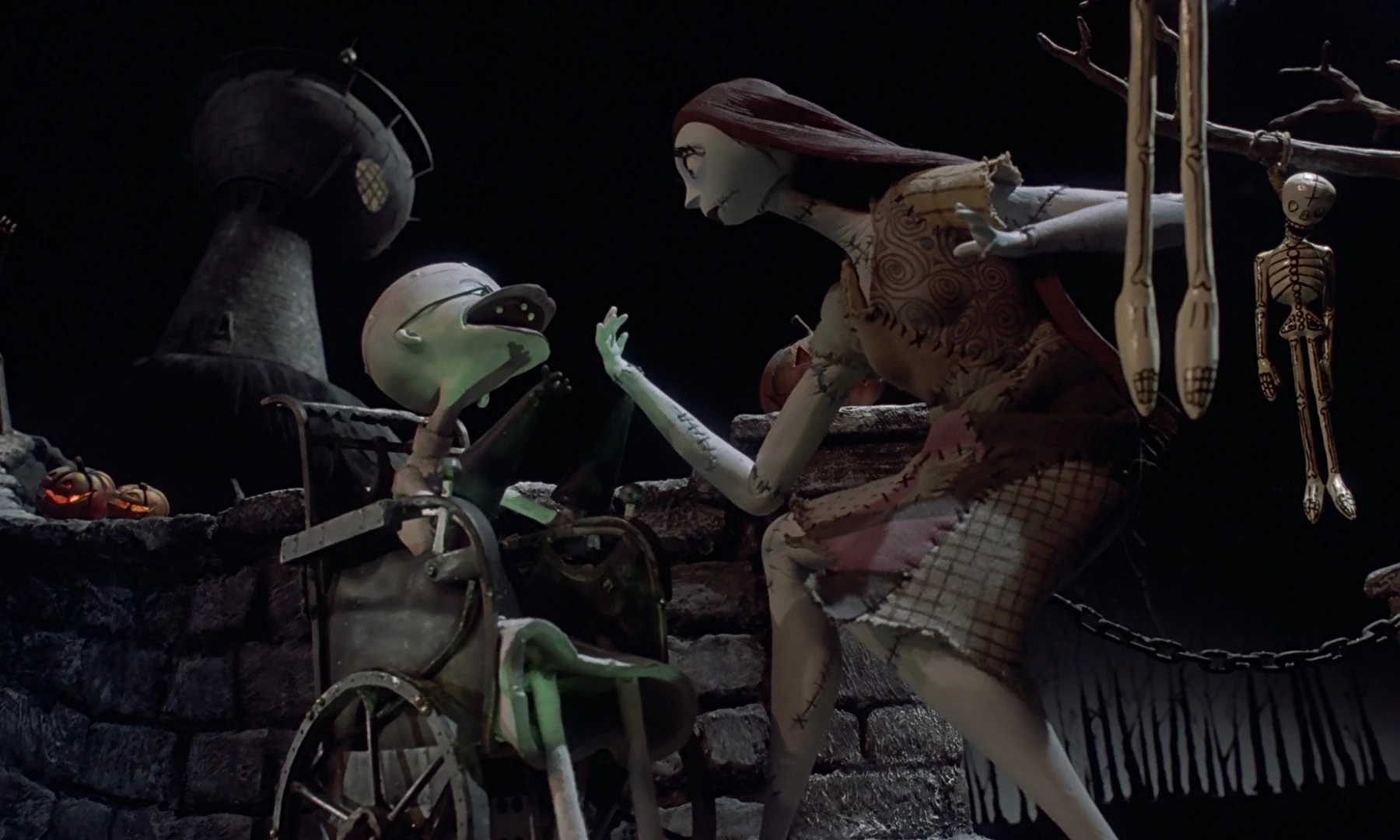
Honestly, whenever people talk about Tim Burton’s holiday masterpiece, they immediately jump to Jack Skellington’s existential crisis or Oogie Boogie’s gambling addiction. But if we’re being real, the absolute weirdest, most unsettling energy in the whole movie comes from the laboratory. I’m talking about The Nightmare Before Christmas Dr Finklestein. He’s not just a generic "mad scientist" trope. He is a literal brain-exposing, soup-sipping curmudgeon who represents a very specific kind of domestic horror that kids (and adults) usually find way more disturbing than a skeleton in a suit.
He’s cranky. He’s possessive. He literally scoops out his own gray matter to think better.
Henry Selick and the team at Skellington Productions didn't just want a guy in a lab coat. They wanted a character who felt like he was falling apart. That motorized wheelchair? It’s not just for mobility; it’s a steampunk throne of control. Voiced by the legendary William Hickey—who brought that raspy, breathless quality to the character—Finklestein is the gatekeeper of Sally’s freedom. That’s where the tension lives.
The Anatomy of a Madman
Let's look at the design. It's iconic. The hinged skull is a stroke of genius because it makes the internal external. When he flips his head open to scratch his brain, it’s a visceral reminder of his "intellectual" nature, but it also feels incredibly fragile. It’s gross. It’s perfect.
Unlike the other citizens of Halloween Town who are monsters by birth or curse, The Nightmare Before Christmas Dr Finklestein feels like a product of his own obsession. He’s a creator. He built Sally. He later builds a wife for himself because he can’t stand the idea of being alone or, more accurately, being without someone he can micromanage.
There’s a subtle bit of lore often missed by casual viewers: the Doctor’s design was partially inspired by classic horror icons, but his movements are purely mechanical. He clicks. He whirrs. He’s essentially a cyborg in a world of ghosts and goblins. This creates a fascinating visual contrast. While Jack is fluid and expressive, Finklestein is rigid. He’s stuck in his ways, literally and figuratively.
Why the Deadly Nightshade Scenes Matter
You remember the soup. Everybody remembers the soup. Sally trying to poison him with Deadly Nightshade so she can sneak out and watch Jack. It’s played for laughs, sure, but it’s actually a pretty dark cycle of domestic rebellion.
- Sally uses "Frog’s Breath" to hide the smell of the poison.
- Finklestein makes her taste it first because he’s paranoid.
- She uses a slotted spoon—a classic trick—to avoid the liquid.
It’s a battle of wits between a creator and his creation. This dynamic is what makes The Nightmare Before Christmas Dr Finklestein such a compelling antagonist. He isn't "evil" in the way Oogie Boogie is evil. He’s just a control freak who thinks he owns the people he makes. He views Sally as an extension of his laboratory equipment. When she leaves, he doesn't miss her company; he misses his "property."
That’s a heavy concept for a "kids' movie."
The Scientific Method in Halloween Town
What exactly is he studying? In the "Jack’s Obsession" montage, we see Finklestein helping Jack try to debunk the "magic" of Christmas through scientific inquiry. He provides the equipment. He’s the one who helps Jack attempt to "measure" joy or "dissect" a candy cane.
It fails, obviously.
This highlights a major theme in the film: the friction between logic and wonder. Finklestein is the embodiment of cold, hard logic. He can’t understand Christmas because you can't put a soul under a microscope. He can build a body, but he can't build a spirit. Even when he creates his second companion at the end of the film—the one who looks like a female version of himself—it’s implied he’s just repeating the same mistakes. He wants a mirror, not a person.
Interestingly, some fans have pointed out that Finklestein might be a reference to Frankenstein, but he’s actually closer to the character of Dr. Arrogant from older European puppet plays. He’s the "Old Man" archetype who refuses to let the "Young Heroine" grow up.
Behind the Voice: William Hickey’s Legacy
You can't talk about this character without talking about William Hickey. He was an Oscar-nominated actor (Prizzi's Honor) who specialized in playing characters that sounded like they were on their last breath. He recorded his lines for The Nightmare Before Christmas Dr Finklestein shortly before he passed away in 1997.
The wheeze is real.
That rattling breath wasn't just a voice acting choice; it was part of Hickey’s physical reality at the time. It adds a layer of mortality to the Doctor. He sounds like he’s decaying. It makes the character feel ancient, like he’s been sitting in that lab since the dawn of Halloween itself.
Misconceptions about the Doctor
A lot of people think he’s the "villain" of the Sally subplot. That’s a bit too simple. He’s a guardian, albeit an abusive and overbearing one. If you look at the original poem by Tim Burton, the character wasn't even there. He was added during the development of the film to give Sally an obstacle.
Without Finklestein, Sally has no reason to be clever.
Her ability to sew herself back together, her knowledge of herbs, her tactical thinking—all of that was developed as a survival mechanism against the Doctor’s confinement. He is the "grit" in the oyster that creates the pearl of Sally’s character.
Some trivia for the die-hards:
In the video game sequel Oogie's Revenge, we see a bit more of his laboratory, and it's clear he has a weirdly high standing in the town. The Mayor actually listens to him. Why? Because in a town of chaos, the man with the blueprints is king. He provides the infrastructure for their scares.
The Evolution of the "Mad Scientist"
We’ve seen a million mad scientists in cinema. Dr. Frankenstein, Dr. Jekyll, Dr. Strangelove. But Finklestein is unique because he’s so... domestic. He’s not trying to take over the world. He just wants his dinner on time and his experiments to stay in their rooms.
He’s a small-scale tyrant.
This makes him more relatable and, in a way, more frustrating. We’ve all dealt with a Finklestein—someone who thinks they know what’s best for us and tries to limit our world to the size of a courtyard.
How to Appreciate the Doctor on Your Next Rewatch
Next time you put on the movie, stop looking at Jack for a second. Look at the background of the lab. Look at the way Finklestein’s chair moves on those tracks. Notice the specific sounds of his skull clicking open.
- Observe how he reacts when Jack asks for the equipment. He’s genuinely proud to be needed by the Pumpkin King.
- Watch the way he treats his second creation at the end. Is he kinder? Probably not.
- Check out the "making of" footage if you can find it. The puppet for Finklestein was one of the most complex because of the hinged head and the motorized chair.
Actionable Steps for Fans and Collectors
If you're looking to dive deeper into the world of The Nightmare Before Christmas Dr Finklestein, there are a few specific things you should do to round out your knowledge or collection.
- Seek out the NECA action figures. While many brands make Finklestein, the older NECA releases captured the "hinged brain" gimmick with way more detail than the modern, stylized Funko Pops. If you want the "real" feel of the character, that's the one.
- Read the Manga sequel. The Nightmare Before Christmas: Zero's Journey and the Sally-centric novel Long Live the Pumpkin Queen by Shea Ernshaw provide much more context on the Doctor’s life before the movie and how Sally eventually reconciles her "birth" from his lab.
- Analyze the "Worm's Wort" and "Frog's Breath" labels. If you're a cosplayer or a prop maker, the exact jars used in the movie are masterpieces of graphic design. They tell a story about the Doctor's organized, yet chaotic, mind.
- Watch "The Cabinet of Dr. Caligari." To truly understand the German Expressionist roots that birthed Finklestein’s aesthetic, this silent film is required reading. You'll see the sharp angles and the "creepy doctor" archetype in its purest form.
The Doctor isn't just a side character. He’s the intellectual backbone of Halloween Town, the accidental father of its most sensible resident, and a reminder that even in a world of magic, someone still has to do the math. Just... maybe don't eat the soup he offers you.