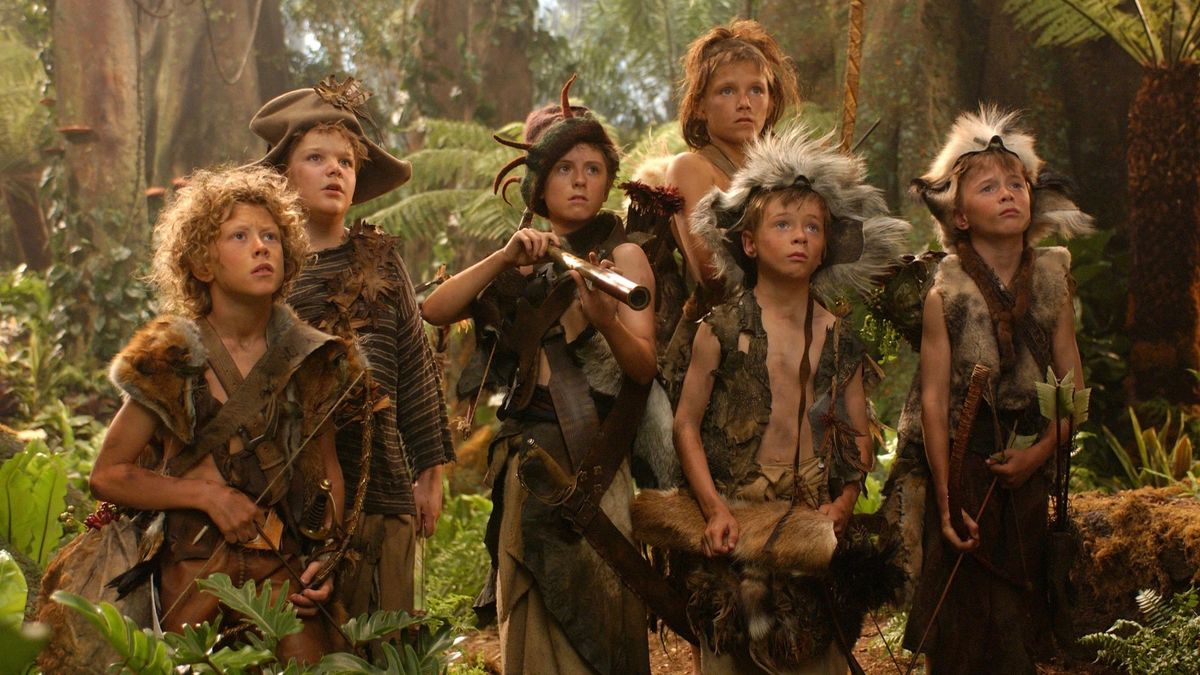
Honestly, it is kind of wild that we are still talking about a movie from over twenty years ago as the gold standard for J.M. Barrie’s story. You’d think with all the Disney remakes and big-budget re-imaginings, someone would have topped it by now. They haven't. The film Peter Pan 2003, directed by P.J. Hogan, remains this weirdly perfect lightning-in-a-bottle moment where the casting, the score, and the slightly dangerous "boy who wouldn't grow up" vibe finally aligned.
Most people grew up with the 1953 Disney cartoon. It’s a classic, sure, but it’s sanitized. It’s safe. The 2003 live-action version took a massive risk by actually treating the source material like the dark, romantic, and hauntingly sad fairy tale it was meant to be. It wasn't just a kids' movie; it was a film about the terrifying prospect of puberty and the bittersweet reality of leaving childhood behind.
The Peter Pan 2003 Film and the "Casting Miracle"
Casting Peter Pan is a nightmare for a director. Historically, the role was played by adult women on stage—think Mary Martin or Sandy Duncan—because of child labor laws and the need for a specific vocal range. But P.J. Hogan wanted a real boy. He found Jeremy Sumpter.
Sumpter was about 13 or 14 during filming. He was growing so fast that the production crew reportedly had to rebuild the window of the Darling nursery several times because he kept getting taller. This physical reality added a layer of unintended brilliance to the movie. You can actually see him outgrowing the role of a child as the story progresses. Then you have Rachel Hurd-Wood as Wendy. She wasn't some polished Hollywood child star; she had this grounded, soulful presence that made the "romance" (if you can call the confusing pre-teen feelings that) feel authentic rather than cringey.
And Jason Isaacs. Man.
Isaacs pulled double duty as Mr. Darling and Captain Hook, which is a traditional theater trope, but he played them with such distinct energy. His Hook wasn't a bumbling buffoon like the cartoon version. He was a tragic, aging aristocrat who was genuinely afraid of time. When he talks about "the tick, tick, tick of the clock," you don't just hear a villain being scared of a crocodile; you hear a man terrified of his own mortality. It's heavy stuff for a PG movie.
Why This Version Hits Different Than Hook or Pan
We’ve had Hook (1991), which is a nostalgic fever dream but basically a Spielberg movie about being a workaholic dad. We had Pan (2015), which... well, let’s just say Hugh Jackman in a pirate ship singing Nirvana was a choice. But the film Peter Pan 2003 stuck to the book's bones.
It captured the "terrible" part of Peter Pan. Barrie famously described Peter as "gay and innocent and heartless." That last word is key. Peter is heartless because he forgets. He forgets the Lost Boys who leave. He forgets the adventures he had yesterday. Sumpter plays this perfectly—one minute he’s your best friend, and the next, he has this cold, alien look in his eyes because he’s already moved on to the next shiny thing.
The visual effects were also ahead of their time. They used a mix of practical sets and CGI that actually holds up. The flight to Neverland doesn't look like actors in front of a green screen; it feels like a literal rip through the fabric of reality into a dreamscape. They spent $100 million on this, which was a massive gamble for Universal and Columbia at the time, and you can see every cent on the screen.
The Subtle Darkness of Neverland
Neverland isn't just a playground here. It’s a reflection of the children's minds. When Wendy is happy, the island blooms. When Hook is winning, it’s a frozen wasteland. This psychological connection to the setting is something later adaptations completely missed.
Also, can we talk about James Newton Howard’s score? If you haven't listened to the track "I Do Believe in Fairies" lately, go do it. It’s soaring and triumphant, but it has this underlying minor key that feels like a goodbye. That’s the whole theme of the film Peter Pan 2003: saying goodbye.
There is a specific scene where Peter visits the Darling nursery years later and sees Wendy has grown up. It’s devastating. Most versions skip the "grown-up Wendy" epilogue or rush through it, but Hogan leaned into the tragedy of it. Peter is stuck in a loop of eternal childhood, while everyone he loves eventually leaves him behind to face the real world. It’s a lonely existence disguised as a party.
Real Talk: The Box Office Failure
If this movie was so good, why did it flop?
It made about $122 million against a $100 million budget. Once you factor in marketing, it lost money. A big part of that was the release date. It came out in December 2003. Do you know what else came out then? The Lord of the Rings: The Return of the King.
You can't compete with the Return of the King. Nobody could.
The movie also suffered from being "too faithful." It wasn't a bright, colorful comedy. It had stakes. It had blood. It had a Hook who was legitimately trying to kill children. Parents in 2003 were used to the Disney version, and some found this one a bit too intense. But that’s exactly why it has a cult following now. The kids who grew up watching this on DVD are now adults who realize it was the only version that actually respected their intelligence.
Technical Nuance: The Cinematography
Donald McAlpine, the cinematographer, used a very specific color palette. The "real world" London is cold, blue, and cramped. Neverland is hyper-saturated—pinks, deep greens, and glowing golds.
This contrast is vital for the narrative. It’s not just about "magic." It’s about the vibrancy of imagination versus the dullness of Victorian expectations. When the kids fly out of the window, the camera movement changes from static and rigid to fluid and sweeping. It’s a masterclass in visual storytelling that most modern CGI-heavy films ignore in favor of just making everything look "cinematic."
Common Misconceptions About the 2003 Version
People often think this movie was a Disney production. It wasn't. It was a joint venture between Universal, Columbia (Sony), and Revolution Studios. Because it wasn't Disney, they weren't beholden to the 1953 character designs.
- Tinker Bell wasn't a pin-up. Ludivine Sagnier played her as a gritty, jealous, and somewhat feral woodland sprite. She didn't speak English; she made chiming sounds that Peter understood.
- The Mermaids were terrifying. Instead of the singing, friendly mermaids, these were scaly, predatory creatures that would drown you if you got too close. This is much closer to Barrie's original descriptions.
- The "Hidden" Romance. Some critics at the time felt the chemistry between Peter and Wendy was "too much" for a kids' movie. But if you read the book, Wendy is basically trying to play "house" and Peter is confused by the whole concept. The movie captures that awkwardness perfectly.
How to Re-watch (and What to Look For)
If you’re going back to watch the film Peter Pan 2003 today, pay attention to the shadows. There’s a lot of subtext about shadows being detached from their owners, which represents the soul or the memory.
Watch the scene in the Black Castle. The fight choreography isn't just "clash-clash-clash." It’s character-driven. Peter fights like a kid playing a game—spinning, laughing, not taking it seriously. Hook fights with a brutal, refined desperation.
Also, look for the subtle ways the film addresses the concept of "The Hidden Kiss." In the book, Wendy has a kiss in the corner of her mouth that Peter can never quite get. The movie visualizes this through the thimble and the "acorn" button, but it also treats the concept of a kiss as a powerful, almost magical transfer of life force.
Actionable Insights for Fans and Collectors
If you want to experience the best version of this film, skip the standard streaming versions which are often compressed. Look for the Blu-ray release; the colors in the "Fairyland" sequence are significantly more vibrant, and the sound mix for the sword fights is much crisper.
For those interested in the lore, compare the script's ending to the "original" ending of J.M. Barrie's play, An Afterthought. You’ll see that P.J. Hogan took specific dialogue from Barrie's later writings that wasn't in the original 1911 novel.
Lastly, check out the "making of" featurettes if you can find them. Seeing how they built the Jolly Roger—a full-sized pirate ship that could actually tilt and move—really makes you appreciate why this movie feels so much more "real" than the CGI-heavy versions that followed in the 2010s and 2020s. It was the last of its kind: a massive, practical-effects-heavy fairy tale that prioritized heart over franchise potential.