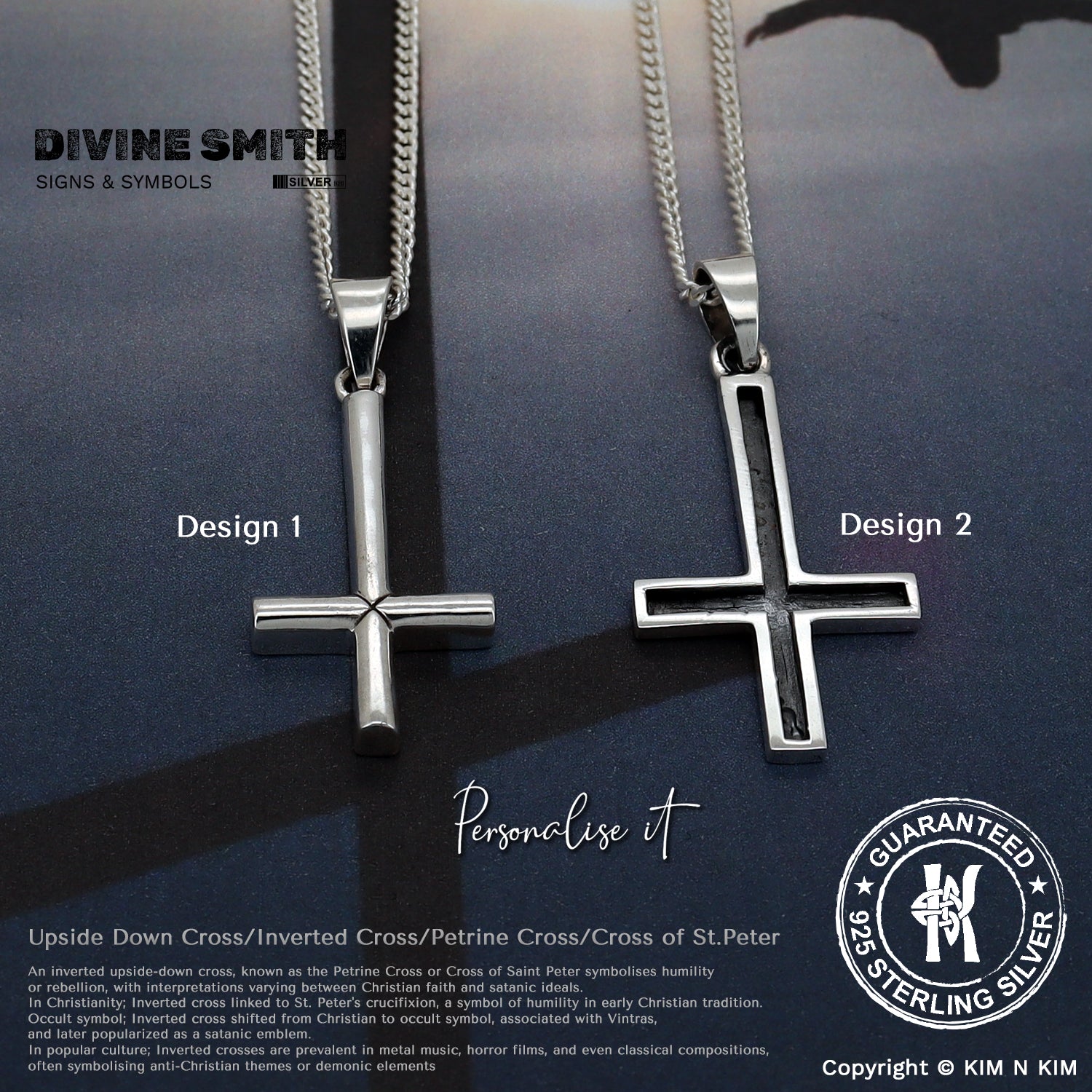
Walk into almost any gothic-style Catholic cathedral, and you might spot something that looks like it belongs in a horror movie. It’s an upside-down cross. For a lot of people raised on a diet of Hollywood exorcisms and heavy metal album covers, that symbol screams one thing: Satanism. But then you see it on the back of a papal throne or carved into the walls of the Vatican.
Wait. What?
Why would the leader of the Catholic Church use a symbol that most of the modern world associates with the occult? Honestly, it’s one of those weird historical quirks where the original meaning got hijacked by pop culture. If you’ve ever seen the famous photo of Pope John Paul II sitting in a chair with a huge inverted cross behind his head during his 2000 visit to Israel, you know how jarring it looks. The internet had a field day with that one. But the truth is way less "Antichrist" and way more "humble fisherman."
The Real Story of the Pope Cross Upside Down
Basically, it all goes back to a guy named Peter. You know him as Saint Peter, the first Pope. According to very old Christian traditions—we’re talking 2nd and 3rd-century sources like the Acts of Peter and the writings of Origen—Peter was sentenced to death by the Romans under Emperor Nero.
The story goes that when they were about to nail him to the cross, Peter made a pretty intense request. He told the executioners he wasn't worthy to die the same way as Jesus. He felt that as a mere man who had once denied Christ three times, he didn't deserve to hang in the same upright position. So, he asked to be flipped.
The Romans, who weren't exactly known for their mercy but were definitely down for creative cruelty, reportedly obliged. He was crucified head-downwards. Because of this, the pope cross upside down—officially called the Cross of Saint Peter or the Petrine Cross—became a badge of extreme humility. It’s a way for every Pope since then to say, "I’m just the successor of the guy who wasn't worthy."
A Symbol Hijacked by Hollywood
It’s kinda funny how symbols flip-flop over time. For nearly 1,900 years, if you saw an inverted cross, you thought of Saint Peter’s sacrifice. It was a sign of the Papacy. You’ll see it in the heraldry of the Vatican, on the "Holy Door" of St. Peter’s Basilica, and in ancient art by masters like Caravaggio.
Then came the 20th century.
Horror movies like The Exorcist and Rosemary’s Baby started using the inverted cross as a shorthand for "the opposite of Christ." It makes sense visually, right? If the upright cross is the ultimate Christian symbol, flipping it must mean you're against it. Satanic groups and black metal bands leaned into this, and suddenly, a 2,000-year-old symbol of Catholic humility became the universal logo for rebellion against the Church.
The irony is thick here. When someone wears an upside-down cross to be "edgy" or "anti-Christian," they are technically wearing the symbol of the first Pope.
That Famous Chair in Galilee
Let’s talk about that 2000 pilgrimage to Israel. Pope John Paul II was celebrating Mass on the Mount of Beatitudes. Behind him was a simple, modern-looking stone chair. Carved into the backrest was a large, plain, inverted cross.
Social media wasn't a thing back then, but the tabloids and conspiracy theorists went wild. They claimed it was a "sign" of the end times. In reality, the chair was designed specifically for that location, which is a place of deep Petrine significance. The designers weren't trying to be cryptic; they were using standard Catholic shorthand.
Understanding the Nuance
Context is everything. There is a huge difference between an "inverted cross" and an "inverted crucifix."
- The Petrine Cross: Just two bars, upside down. This is the Saint Peter version.
- An Inverted Crucifix: This has the figure of Christ (the corpus) on it, but upside down.
In the Catholic world, the latter is actually considered quite offensive and is indeed used by anti-Christian groups to mock the faith. You won't find the Pope using a crucifix with Jesus hanging upside down. But the plain cross? That’s just history.
The Church doesn't really feel the need to "reclaim" the symbol because, in their eyes, they never lost it. To a billion Catholics, the tradition of the Petrine office is much older than a slasher flick.
Why This Matters Today
In a world where we scroll past information in seconds, it’s easy to misinterpret what we see. The pope cross upside down is a perfect example of why historical literacy matters.
If you're ever visiting the Vatican or looking at old religious art, don't freak out when you see it. It’s not a "gotcha" moment or a hidden code. It’s just a reminder of an old fisherman from Galilee who, at the end of his life, chose the most uncomfortable, humbling way to go out because he didn't want to steal the spotlight from his teacher.
What to Keep in Mind
If you’re researching this or explaining it to a friend, remember these three points:
- The Intent Rule: In iconography, the meaning of a symbol depends entirely on who is using it and why. For a Pope, it's about apostolic succession.
- The History Gap: There is a nearly 2,000-year gap between the origin of this symbol and its modern "scary" interpretation.
- The Art Factor: Many of the world’s most famous paintings of Saint Peter show him in this inverted position. It's a standard trope in art history, not a secret society ritual.
Next time you see an inverted cross in a Catholic context, you can skip the conspiracy theories. You're just looking at a tribute to a man who wanted to be lower than the ground he walked on.
To dive deeper into the history of these symbols, you might want to look into the excavations of the "Trophy of Gaius" under St. Peter's Basilica, which many archaeologists believe marks the actual spot of Peter's burial.
Next Steps for the Curious
- Check the Art: Look up Caravaggio’s The Crucifixion of Saint Peter. It’s a masterpiece that perfectly captures the physical reality of the tradition.
- Visit the Source: If you’re ever in Rome, head to the Scavi Tour under the Vatican. It’s the archaeological dig where they found the bones and the "Petros Eni" (Peter is here) inscriptions.
- Read the Acts: Look into the Acts of Peter. While it’s apocryphal (not in the Bible), it’s the primary source that gave us this enduring image of the inverted cross.